>>
Industry>>
Marketing and advertising>>
4 Ways to Make Your Profession...4 Ways to Make Your Professional Achievements Work Harder for You

A product manager helps launch a new feature that customers love. An engineer finds a way to reduce production delays. A customer service supervisor develops a training process that helps new employees become productive sooner.
These are meaningful accomplishments, yet they'll likely become little more than forgotten entries in a company's project history.
The problem is that professionals often treat achievements as finished work rather than assets they can build upon. Once the project ends, attention shifts to the next deadline, leaving little time to consider how that experience could support future opportunities. Making your achievements work harder doesn't mean constantly promoting yourself. It means understanding what your contributions demonstrate and finding practical ways to turn them into long-term professional value.
1. Look Beyond the Task and Identify What Actually Changed
Imagine two employees who helped implement the same customer relationship management system. Both spent several months transferring information, testing workflows, and training colleagues.
When asked about the project, the first employee says they helped implement a successful CRM. The second explains that they helped consolidate customer records, improve access to sales information, and reduce the time employees spent searching for account details.
Neither description is necessarily inaccurate, but the second communicates why the work mattered.
This distinction matters because professionals often underestimate contributions that become routine. A warehouse coordinator who improves inventory accuracy or an administrative assistant who simplifies appointment scheduling may not consider those changes significant enough to discuss.
However, improving everyday operations demonstrates initiative, judgment, and an understanding of how organizations function. One useful exercise is to revisit a completed project and identify what was different afterward. Did your work remove an obstacle, improve reliability, or help another department operate more effectively? Even when results aren't easy to measure, explaining the practical improvement gives the achievement more meaning.
2. Make Your Achievements Easy to Find and Understand
A surprisingly common career problem is having valuable experience but no organized record of it. By the time a promotion opportunity appears or a promising job opening comes along, employees may struggle to remember what they accomplished six months earlier.
Consider someone who has spent three years improving internal processes. They've contributed to dozens of projects, solved operational problems and helped colleagues work more efficiently, but their professional documents still describe responsibilities from their first year in the position. As a result, some of their most valuable contributions remain undocumented, making it harder to demonstrate how much they've grown professionally.
A better approach is to maintain a personal record of achievements. This could be a private Notion page, a Google Docs file or a spreadsheet containing significant projects and their outcomes. For each accomplishment, record the original challenge, your specific contribution and the results, including measurable improvements or feedback when available.
Keeping this information organized also makes it easier to translate professional accomplishments into a strong resume when new opportunities arise. Rather than starting from scratch, candidates can select achievements that match a particular position and present them in a way that highlights their experience. Resume templates from MyPerfectResume can provide a useful structure for organizing these details, helping candidates showcase their skills and accomplishments without spending unnecessary time figuring out the document's layout.
Beyond job applications, this record can support performance evaluations, internal promotion discussions and professional biographies. Having specific examples ready makes it easier to demonstrate your contributions, explain your professional growth and communicate the value you've brought to previous projects.
3. Turn Individual Successes Into Shared Knowledge
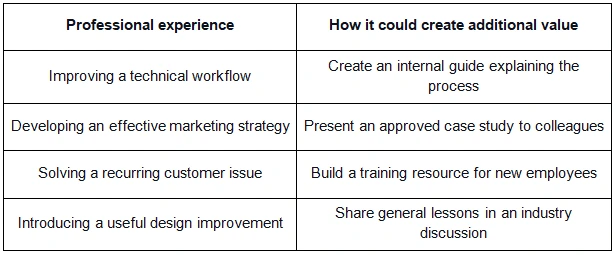
Some of the most valuable professional accomplishments involve solving problems others are still facing. Imagine a cybersecurity specialist who develops a practical method to help employees spot suspicious emails. The immediate benefit is improved awareness within the organization, but the lessons learned could also support training sessions, internal documentation, or professional discussions.
This creates an opportunity to turn completed work into something other people can learn from.
The format depends on the profession and the nature of the achievement
4. Use Your Track Record to Shape Your Next Opportunity
Career growth conversations often start with employees saying they're ready for more responsibility. Unfortunately, enthusiasm alone doesn't show which responsibilities they can handle.
Past accomplishments can make these discussions more productive. Suppose an operations specialist wants to move into a leadership position. Over the previous year, they've coordinated a cross-departmental project, trained several colleagues, and helped improve communication between teams.
Rather than focusing exclusively on the desired job title, they can explain how those experiences demonstrate readiness for specific management responsibilities.
This approach also works when proposing new initiatives. An employee who previously reduced reporting delays might identify another inefficient process and suggest applying similar improvements.
Of course, achievements don't automatically lead to promotions or higher salaries. Organizational budgets, available positions, and business priorities influence those decisions.
However, a documented track record gives professionals stronger evidence when discussing future responsibilities. It can also reveal valuable patterns, such as an unexpected talent for mentoring, problem-solving, or coordinating complex work. Sometimes the most useful outcome isn't moving into a higher position. It's recognizing an opportunity to pursue work that better matches your strengths.
Making Your Achievements Count: Questions Worth Considering
Do professional achievements always need measurable results?
Not necessarily. There may be financial savings and improvements in efficiency that help set an example, but there are other contributions such as problem-solving, mentoring, and communication. Just describe what happened, without making up figures.
Should accomplishments from team projects count?
Yes, as long as you differentiate your work from that of other people. Describing the manner in which you worked with your fellow workers may be useful in showing your interpersonal skills.
How often should accomplishments be documented?
It is generally simpler to record the details after successfully accomplishing the task rather than having to remember all the aspects while doing an annual review. A monthly review will enable you to note down the smaller contributions.
Which achievements deserve the most attention?
Consider those that help you showcase your skills based on the kind of career that you want to follow. It might be better to have a small task that will illustrate good leadership skills or analytical skills rather than having a larger assignment in which you have done little work. Career accomplishments have far longer value than most people think. Once a task has been completed, it can prove to be something more useful in the future.













Comments