>>
Technology>>
It service>>
5 Best IT Asset Management Pla...5 Best IT Asset Management Platforms for Hybrid Teams

Managing who has which device - and where that device actually sits - gets messy quickly when employees split time between home, the office, and everywhere else. The best IT asset management platforms built for hybrid teams cover every stage: procurement, deployment, tracking, retrieval, and disposal. The five platforms below span a range of use cases and company sizes, from open-source trackers to full lifecycle automation.
Managing IT assets across distributed teams
Hybrid work didn't just scatter employees. It scattered hardware too. A laptop ordered for a remote hire in Austin, a monitor collecting dust in a London apartment, a retired device no one ever picked up from a contractor in Chicago, these aren't edge cases. They're the daily reality for IT teams keeping distributed workforces running.
Spreadsheets break down fast at this scale. And the cost of a missing or unaccounted-for device isn't just the hardware itself; it's the compliance gap, the security exposure, and the hours IT spends chasing down answers that should be visible in a dashboard. Platforms built for hybrid and distributed environments solve this by centralizing lifecycle visibility, automating the repetitive handoffs between HR and IT, and giving finance a clear picture of spend.
1. Workwize
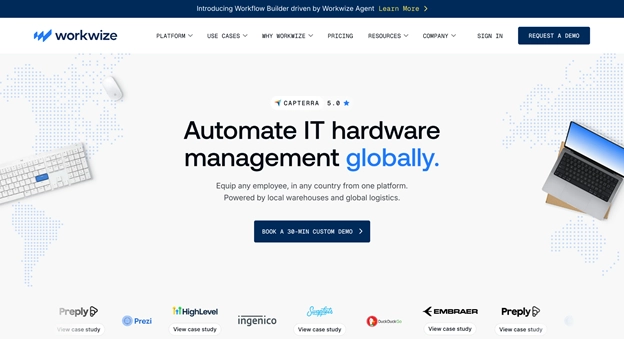
Workwize covers all five stages of the hardware lifecycle - procure, deploy, manage, retrieve, and dispose - from a single platform backed by local warehouses in 120 countries. That geographic footprint is the primary differentiator for teams with employees spread across multiple regions. Devices ship from in-country stock, cutting customs delays and typically getting hardware to a new hire within 2 to 7 days.
HRIS and MDM events automate workflows throughout. When a hire is confirmed in BambooHR, ADP, or another connected system, Workwize triggers the deployment workflow automatically. Devices arrive pre-configured and MDM-enrolled, so new employees are ready on day one without IT manually touching anything. The same logic runs in reverse at departure, a departure event kicks off retrieval, with in-region couriers, prepaid labels, and customs handling already built in. The platform reports retrieval rates up to 98%.
Every assignment, transfer, wipe, and disposal gets logged automatically, giving IT a 100% chain-of-custody record without anyone maintaining it by hand. The platform connects with 80-plus HRIS, MDM, identity, and productivity tools - including Jamf, Microsoft Intune, Okta, and Slack - and it's certified to ISO 27001 and SOC 2 Type II standards. Pricing is quote-based across three tiers, each scoped by region count and team size.
2. Virima
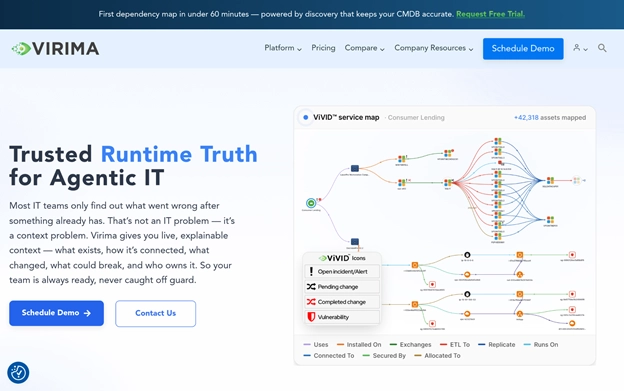
Virima approaches IT asset management from an IT service management and operations angle, which makes it a strong fit for teams that need deep infrastructure context alongside asset tracking. Its standout capability is the ViVID™ Visual Impact Display, which builds service dependency maps showing how individual assets connect to the services that rely on them. Virima claims the first dependency map is delivered in under 60 minutes.
Discovery is automated, and the platform builds and maintains a configuration management database (CMDB) with what Virima calls 100% attribute authority and zero duplicates. That matters in hybrid environments where devices and configurations shift frequently and shadow IT is a genuine concern. Integrations include ServiceNow, Jira Service Management, Ivanti, AWS, and Azure, among others.
Virima runs a subscription model with tiered bundles. The SMB entry tier starts at roughly $15,900 per year for up to 250 servers and 1,250 devices; Professional, Corporate, and Enterprise plans scale up from there as the discovery footprint grows. The company holds SOC 2 Type 2 and ISO/IEC 27001:2022 certifications, and customers include The Bancorp, with use cases spanning healthcare and banking.
3. Teqtivity
Teqtivity takes a user-based pricing approach: organizations pay per user managing assets in the platform rather than per device, which keeps costs predictable as device counts grow. That model suits IT teams managing a large, shifting inventory, common in hybrid setups where the device-to-employee ratio often exceeds one.
The platform covers the full asset lifecycle - procurement, deployment, storage, maintenance, and disposal - with a dashboard that surfaces inventory, compliance, and reporting in one place. New and departing employee workflows come built in, and customization options let the company adapt the system to specific workflows and technical connections for each customer. Founded in 2017 and based in Cerritos, California, Teqtivity has a team of 11 to 50 employees, and its support team is positioned as an extension of the customer's IT department rather than a separate help queue.
Industries served include financial services, healthcare, education, manufacturing, and tech. Pricing decreases per user as team size increases, with enterprise customers able to request custom plans.
4. Snipe-IT
Snipe-IT is an open-source IT asset management system built and maintained by Grokability, Inc. in San Diego. For teams with in-house technical resources and a preference for avoiding vendor lock-in, it's one of the few serious options at the low end of the cost curve, self-hosted deployments are free, while cloud-hosted accounts run through premium support plans.
The platform manages over 21.7 million assets across roughly 10.4 million users and approximately 5,960 customers, with more than 330 contributors and 13 years of operational history behind the project. Features include asset tracking, barcode scanning, user management, and a REST API for custom integrations. On the security side, it offers bcrypt hashing with brute-force prevention, two-factor authentication, and HTTPS-only cookies.
Cloud hosting runs on AWS with a 99.99% availability guarantee and data residency options across 12 global regions, from Oregon and N. Virginia to Sydney, Seoul, and Cape Town. Updates ship often; new releases drop every few weeks, with daily bug fixes. But the trade-off for the price is that setup and ongoing configuration demand more internal effort than a managed SaaS platform would.
5. Anunta
Anunta focuses on digital workspace management rather than hardware asset tracking in the traditional sense. The company's main services are Desktop-as-a-Service, managed endpoint services, and AI-driven platform tools: DesktopReady™, CloudOptimal®, and EuVantage®, designed to deploy, manage, and scale virtual and physical desktop environments at scale.
Based in Mumbai and founded in 2012, Anunta has 794 employees and has migrated 1 million remote desktop users across implementations in aerospace, banking, healthcare, insurance, and retail. The company has appeared in the Gartner Magic Quadrant for DaaS for four consecutive years and ranks in the MSP 501 Top 100. Partners include Omnissa, Nutanix, Hexnode, SolarWinds, and Azure.
For hybrid teams specifically, Anunta's managed endpoint and device lifecycle management services are the most relevant entry points. Pricing isn't publicly listed; the company structures deals as customized solutions, with pay-per-user billing as a reference model. Organizations evaluating Anunta should expect a scoping conversation before any numbers come up.
Capabilities that matter for hybrid teams
Not every platform listed above solves the same problem. The right choice depends on where the friction actually lives.
For teams managing hardware across multiple countries, geographic reach and local warehousing determine whether an automated workflow is realistic or just a promise. Automation that triggers on HRIS events cuts the manual back-and-forth between IT and HR that slows both new employee setup and departing employee offboarding. And retrieval - actually getting devices back from remote employees who leave - is where many ITAM programs quietly fall apart; a platform that handles in-region pickup, customs, and escalation closes that gap.
For teams with strong internal IT capability and a tight budget, an open-source system with a solid REST API can handle the basics without licensing fees. But the setup cost in staff time is real.
CMDB depth and service dependency mapping matter more for IT operations teams than for procurement-focused teams. Security certifications - SOC 2, ISO 27001 - matter more for regulated industries and enterprise buyers.
Bottom Line
The best IT asset management platforms for hybrid teams share one trait: they cut the number of manual steps between a hire's start date and a device landing on their desk, and between an employee's last day and that device returning to inventory. Where they diverge is in geographic scope, pricing structure, technical depth, and the kind of team best equipped to run them. Matching a platform to the actual shape of your operations - device volume, employee distribution, internal IT capacity - is more useful than chasing a feature checklist.













Comments