>>
Technology>>
Cyber security>>
7 Solutions That Automate Cont...7 Solutions That Automate Container Base Image Patching
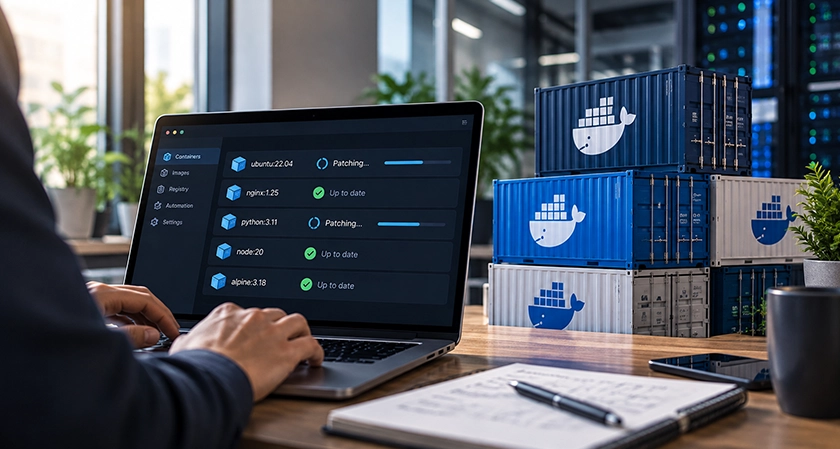
A vulnerability can be fixed upstream while hundreds of production containers continue running the vulnerable package for weeks. The problem is not always detection. Most engineering organizations already have scanners capable of identifying CVEs in container images. The difficult part is everything that happens after the scanner produces the finding.
7 Solutions for Automated Container Base Image Patching
1. Echo - Continuously Rebuilt Base Images With Automated Vulnerability Remediation
Echo moves container patching away from individual application teams by maintaining continuously rebuilt base images that can replace commonly used upstream images.
The adoption model is deliberately simple. Developers change the FROM reference in a Dockerfile to the corresponding Echo image, while the underlying image-maintenance work is handled by Echo's build infrastructure. The company positions its images as drop-in replacements so teams can retain familiar application workflows rather than creating a separate patching pipeline for every repository.
Echo continuously rebuilds and updates its container images as security fixes become available. Critical and high-severity CVEs are triaged within 24 hours and fixed within its published remediation window, while the images remain on versions appropriate for the workload instead of requiring every security update to become a major-version migration.
This changes the role of the application team. Developers are no longer responsible for repeatedly rebuilding the foundation whenever a new operating-system CVE appears. Their primary responsibility becomes consuming the maintained base and rebuilding the application artifact through the existing CI/CD process.
Automation capabilities include:
-
Continuous monitoring and remediation of base-image vulnerabilities
-
Automated image rebuilds and updates
-
Base-image minimization and hardening
-
Compatibility testing for replacement images
-
SBOM, VEX, provenance, and signing generation
-
Registry distribution across common enterprise environments
-
Maintenance of existing image versions without requiring constant migrations
2. Aikido Security - Automated Patching Without Leaving the Existing Base Version
Aikido takes a different approach to container base image patching: rather than requiring teams to adopt a new Linux distribution, it creates patched versions of base images that stay within the existing distribution family and major version.
That distinction can matter for applications that are tightly coupled to a particular Debian, Ubuntu, or Alpine release. Aikido maps application containers back to the base images they inherit. When a vulnerable base can be replaced by one of its hardened images, AutoFix can propose the change directly as a pull request against the Dockerfile.
Each maintained image includes software-supply-chain metadata such as SBOM, VEX, and SLSA provenance.
Automation capabilities include:
-
Mapping application images to vulnerable bases
-
Identification of available hardened replacements
-
Backported security fixes
-
Automated Dockerfile remediation through pull requests
-
Continued rebuilding of maintained images
-
Notifications when newer patched builds are available
-
Merge policies around vulnerable bases
-
SBOM, VEX, and provenance generation
3. Docker Hardened Images - Event-Driven Rebuilds From the Docker Ecosystem
Docker Hardened Images brings automated base-image maintenance directly into the Docker ecosystem.
Instead of treating hardened images as static artifacts, Docker uses an event-driven build system that watches upstream sources, operating-system packages, and vulnerability information. When relevant fixes become available, affected images can be rebuilt, tested, and republished automatically. That model addresses an important weakness in conventional container workflows.
Pulling a clean image once does not solve vulnerability management permanently. The security state begins changing as soon as new vulnerabilities are disclosed. An image that generated very few findings during its initial scan can accumulate vulnerability debt if nobody maintains its packages over time.
Automation capabilities include:
-
Monitoring upstream vulnerability and package information
-
Event-driven image rebuilds
-
Continuous CVE patching
-
Maintained hardened system packages
-
Automated testing before publication
-
Fresh attestations generated with rebuilt images
-
Signed SBOMs and provenance
-
Extended maintenance options for older software versions
4. Chainguard - Continuously Maintained Secure Container Foundations
Chainguard approaches patch automation by controlling the software foundation from which its container images are assembled.
Chainguard Containers are built using the company's purpose-built operating system and package ecosystem. The platform continuously maintains both container images and the packages used to construct them, which lets vulnerability remediation happen close to the source of the image rather than after applications have already inherited the vulnerable component.
Chainguard also provides base-image and package options for organizations that maintain their own internal image pipelines. In 2026, it expanded this model through Chainguard OS Packages, giving teams access to continuously maintained packages and base images that can be incorporated into custom build systems.
Automation capabilities include:
-
Continuously maintained container images
-
Maintained operating-system package ecosystem
-
Automated rebuild pipelines
-
Minimal runtime foundations
-
Regular image updates
-
Secure-by-default base images
-
Package-level inputs for custom image pipelines
-
Signed and traceable software-supply-chain artifacts
5. RapidFort - Continuous Remediation Through Curated Near-Zero CVE Images
RapidFort combines curated container images with vulnerability analysis and runtime-aware hardening.
Its Curated Images are built on familiar Linux distributions including Ubuntu, Debian, Red Hat, and Alpine. The company continuously maintains the images and publishes updated versions as security fixes become available, giving application teams a maintained replacement for public or legacy base images.
RapidFort's approach extends beyond simply rebuilding the same package set. The platform can analyze runtime behavior and identify software that the application does not actually use. Removing those unused components reduces the attack surface and also reduces the number of packages capable of generating future vulnerability findings.
Automation capabilities include:
-
Continuously patched curated container images
-
Critical security fix and rebuild processes
-
CVE remediation in CI/CD
-
Automated vulnerability analysis
-
Runtime behavior profiling
-
Removal of unused components
-
SBOM generation
-
Continuous CVE drift tracking
-
Hardened replacements across several common Linux distributions
6. Red Hat Hardened Images - Automated Remediation Backed by an Enterprise Linux Supply Chain
Red Hat Hardened Images apply the vendor's existing software supply-chain and security processes to minimal container images. The catalog reached general availability in 2026 and includes runtimes, languages, databases, web servers, and utilities such as Python, Node.js, Go, Java, .NET, PostgreSQL, Nginx, and HAProxy.
For patch automation, the most important element is Red Hat's remediation pipeline. The company tracks upstream projects and security feeds, then uses automated pipelines to build, test, and deliver fixes to affected hardened images. Red Hat states that fixes can typically follow within hours once the underlying vulnerability has been corrected upstream.
Automation capabilities include:
-
Automated upstream and security-feed monitoring
-
Automated remediation pipelines
-
Rebuilt hardened images after fixes
-
Minimal production images
-
Signed supply-chain artifacts
-
SLSA Level 3 build infrastructure
-
Security advisory integration
-
Repeatable downstream rebuild workflows
7. Canonical Container Build Service - Managed Continuous Rebuilds for Ubuntu-Based Containers
Canonical's Container Build Service tackles the patching problem by turning image maintenance into an ongoing managed build process.
Instead of delivering a custom container image once and leaving the customer responsible for future security updates, Canonical can maintain the build definition and continuously reconstruct the image as Ubuntu security patches become available.
The process is built around reproducibility. Once the desired container is defined, Canonical's automated pipeline can repeatedly produce updated versions using vetted Ubuntu packages. This gives teams an image that remains aligned with the original application requirements while incorporating newer security fixes over its lifecycle.
Automation capabilities include:
-
Continuously rebuilt container images
-
Automatic inclusion of Ubuntu security updates
-
Reproducible builds
-
Managed image maintenance
-
Security-maintained package sources
-
Support for customized enterprise base images
-
Integration with OCI build workflows
-
Extended security maintenance for Ubuntu packages
Why Container Base Image Patching Becomes a Scaling Problem
A container image is assembled in layers.
Application developers usually focus on the upper layers containing their code and dependencies, but much of the software identified by vulnerability scanners can come from the base image underneath them.
A seemingly simple FROM instruction may introduce an operating system, runtime, system libraries, certificates, compression libraries, networking tools, package-manager components, and other software into every subsequent build.
When vulnerabilities are discovered in those components, application teams inherit the remediation work.
That creates a recurring cycle:
A CVE appears → the scanner flags it → engineers investigate → upstream publishes a fix → the base image changes → applications rebuild → security rescans → deployment begins.
The cycle becomes harder when a company operates hundreds or thousands of repositories.
Base images may be pinned to different versions. Some teams rebuild frequently while others only rebuild when application code changes. A public image may receive an upstream security fix without automatically triggering a rebuild of every internal service that depends on it.
This is why automated container base image patching is increasingly being handled as infrastructure rather than as a collection of individual developer tickets.
The Patch Propagation Loop
There are several places where automation can remove manual work.
-
Vulnerability detection: identify that a package in the base layer is affected.
-
Patch discovery: determine whether upstream has released a fix or whether a secure patch can be backported.
-
Base image reconstruction: rebuild the image with corrected components.
-
Hardening: remove unnecessary software and apply secure defaults during the rebuild.
-
Verification: test the resulting artifact and generate security metadata such as an SBOM, VEX, signature, or provenance attestation.
-
Distribution: publish the patched image to a registry developers already use.
-
Downstream adoption: trigger or recommend updates to application Dockerfiles and rebuild the workloads that inherit the base.
Three Different Ways Base Image Patching Can Be Automated
The first four platforms illustrate an important point: "automated container patching" does not describe one technical model.
There are at least three distinct approaches.
Model 1: Continuously Rebuild the Base
Platforms such as Echo maintain replacement images and take responsibility for rebuilding them when new security fixes become available.
Application teams consume the maintained artifact rather than patching operating-system packages themselves.
This model is attractive when the organization wants to centralize image maintenance and make secure bases available as standard infrastructure.
Model 2: Patch the Version Already in Use
Another approach is to keep the application's familiar base version but backport or introduce the specific security fix.
This can reduce the amount of application change associated with remediation.
The automation may also extend into source control by creating a pull request that switches the application to the corrected image.
Model 3: Own the Package and Image Factory
A third strategy moves further upstream.
The provider maintains the packages used inside its container images and continuously assembles new artifacts from those maintained components.
This reduces dependence on a long chain of third-party image rebuilds.
None of these approaches changes one fundamental requirement: the patched base still needs to reach the application.
Automating the supply of clean images solves the first half of the problem. Organizations should also automate the consumption side through CI/CD rebuilds, dependency-update tooling, digest monitoring, or internal golden-image policies.













Comments