>>
Industry>>
HR Tech>>
Most Firms Now Use AI in HR Pr...Most Firms Now Use AI in HR Processes, With Human Sign-Off Required 85% of the Time: Survey
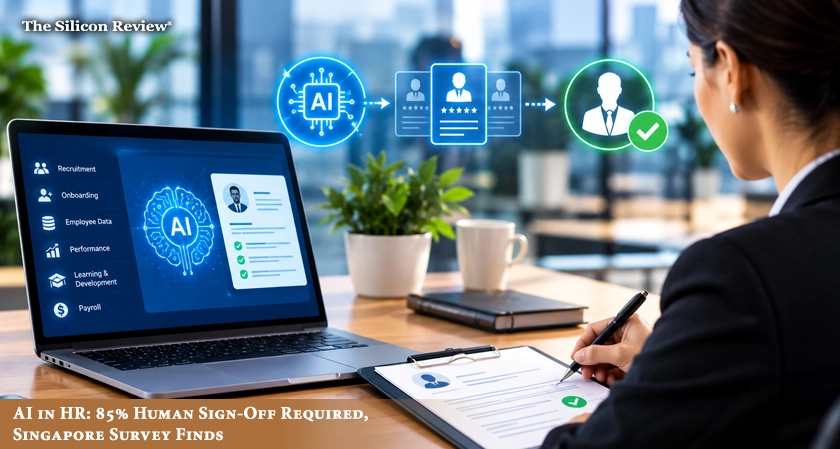
A new survey of 1,000 Singapore employers has found that nearly half now use AI in recruitment, but 85% of HR use cases still require human confirmation or sign-off before any automated decision takes effect.
News source: Google / https://www.channelnewsasia.com/international
Nearly half of Singapore employers are now using artificial intelligence in their human resources processes, but the vast majority is keeping a human hand on the wheel, according to a new survey by the Singapore National Employers Federation. The poll of 1,000 employers, conducted in June and July 2026, found that AI adoption is concentrated in the early stages of HR. Recruitment and candidate selection leads at 49%, followed by managing employee performance at 45% and workforce planning at 39%. AI is far less common in sensitive areas like compensation decisions at 26% and managing employee exits at just 15%.
Human Oversight Remains Central
The most striking finding is the persistence of human judgment. Across nearly 3,000 specific AI use cases reported by 655 employers, 85% still require human confirmation or sign-off before an AI-automated process can proceed.
For high-volume, routine tasks like resume screening and skills assessment, AI are allowed to execute without prior approval. But even then, nearly all employers 97% have designated a supervisor or hiring manager with the authority to intervene and override AI decisions if needed.
The survey also revealed employer anxieties. The top three concerns were an over-reliance on AI that could erode HR professionals' capabilities over time, uncertainty about when to trust AI over human judgment, and questions of accountability when AI makes errors.
"The level of oversight should match the stakes: lighter for routine tasks, closer for decisions that affect people's livelihoods," said SNEF president Kuah Boon Wee. "AI should enable our people to contribute at a higher level, not weaken the capability that our businesses depend on."
The findings arrive as Singapore prepares for the Workplace Fairness Act, expected to take effect by late 2027. The legislation will strengthen protections against discriminatory hiring and appraisal practices, including those enabled by AI. The survey found that 42% of employers want greater clarity on their legal obligations when using AI, and another 42% want training on responsible AI use.
Here is the question The Silicon Review raises. Singapore employers are adopting AI quickly but insisting on human sign-off for almost every decision. When the technology is everywhere but the final call is still human, is that responsible adoption or a sign that no one actually trusts the machines they just bought?
FAQ:
Q: How many Singapore employers use AI in HR?
A: Nearly half of Singapore employers use AI in HR, with 49% using it for recruitment and candidate selection.
Q: What percentage of AI HR processes require human sign-off?
A: 85% of AI use cases in HR still require human confirmation or sign-off before an automated decision takes effect.
Q: Which HR tasks are most likely to use AI in Singapore?
A: Recruitment and selection at 49%, managing employee performance at 45%, and workforce planning at 39% are the most common AI use cases.
Q: Why are employers concerned about AI in HR?
A: Employers worry about over-reliance eroding HR capabilities, uncertainty about when to trust AI over human judgment, and accountability when AI makes errors.
Q: How does the Workplace Fairness Act affect AI in hiring?
A: The Act, expected by late 2027, will strengthen protections against discrimination, including AI-enabled hiring and appraisal decisions.












Comments