>>
Industry>>
Environmental sustainability>>
World's Oldest Cave Paintings ...World's Oldest Cave Paintings Under Threat of Wildfires in Indonesia
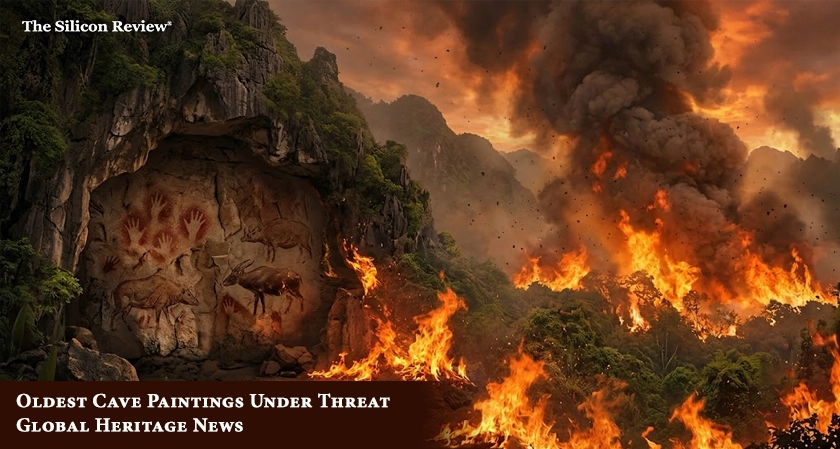
Severe wildfires in Indonesia threaten the world’s oldest cave paintings in Sulawesi, as extreme heat and soot risk destroying 67,000-year-old human art.
The ongoing environmental crisis in Southeast Asia has taken a devastating toll on global history. While global reporting heavily centers on the vast economic disruption of the region’s worst forest blazes in over a decade, a far more permanent catastrophe is creeping up the karst cliffs of South Sulawesi. The world's oldest cave paintings, spanning up to 67,800 years of early human storytelling, are facing rapid, climate-driven erasure. Driven by an aggressive, El Niño-induced drought that has completely depleted seasonal rainfall, intense wildfires have breached the protected boundaries of the Bantimurung-Bulusaraung National Park.
Rather than focusing merely on immediate fire perimeters, archaeologists are highlighting a silent, invisible assassin: atmospheric heat radiation and soot accumulation. The limestone caves of the Maros-Pangkep region function as delicate microclimates that have preserved prehistoric stencils and narrative art depicting native fauna for millennia. However, the ambient heat spikes generated by nearby canopy fires alter these cavernous environments drastically. The rapid thermal shifts induce micro-cracking and accelerated salt crystallization within the porous rock faces, forcing the ancient pigments to flake off and crumble blindly into dust.
"The first and most destructive effect is the heat... The smoke also creates soot. They create soot on the paintings and cover them..."
Emergency firefighting teams have worked to contain blazes that burned over 270 hectares and neared archaeological galleries, exposing gaps in heritage disaster management.
FAQ
How old are the threatened Indonesian cave paintings?
Dated between 51,200 and 67,800 years old.
What specific damage do the wildfires cause to the stone artwork?
Thermal expansion causes micro-cracking, and smoke deposits black soot.
Which region of Indonesia is currently affected by these fires?
The Maros-Pangkep karst landscape in South Sulawesi.













Comments