>>
Industry>>
Environmental sustainability>>
Typhoon Champi Taiwan Shutdown...Typhoon Champi Taiwan Shutdown Cancels Nearly 1,000 Flights
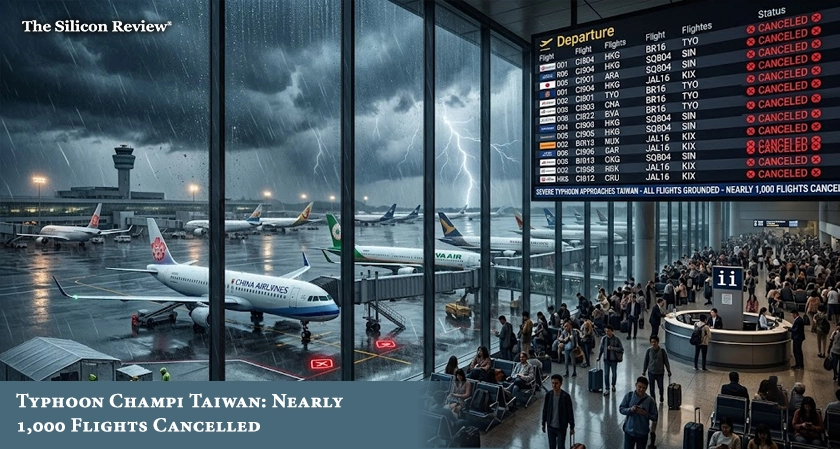
Typhoon Champi disrupts Taiwan with nearly 1,000 flight cancellations, widespread closures, power outages and dangerous rainfall as authorities prepare for flooding.
Taiwan suspended much of its public activity on Friday, October 23, 2026, as Typhoon Champi approached the island with powerful winds and torrential rain, forcing the cancellation of nearly 1,000 flights and disrupting transportation, financial markets and everyday life. Although the storm weakened after reaching super typhoon strength earlier in its Pacific journey, authorities warned that its enormous wind field could prolong the danger.
According to Reuters, Taiwan cancelled all 262 scheduled domestic flights and 717 international flights, bringing the reported total to 979. Schools and offices closed across much of the island, while financial markets suspended trading. High-speed rail services continued operating normally, although Taipei's public transport experienced reduced services.
Typhoon Champi Threatens Taiwan's Infrastructure
Taiwan's Central Weather Administration reported that Champi was producing wind gusts of approximately 191 kilometres per hour near its centre. The storm was positioned east of Taiwan, with forecasts indicating a passage near the northeastern coast before moving towards China's coastline and southern Japan. The storm had a reported radius of approximately 320 kilometres, potentially exposing large parts of Taiwan to hazardous weather even without direct landfall. One person was killed and 163 people were reported injured in Taiwan, according to Reuters' updated figures. Authorities evacuated 2,639 residents from vulnerable mountainous areas, while more than 77,000 homes experienced power outages, although electricity was restored to most affected properties.
Emergency Response Focuses on Flooding and Rescue Operations
Northern mountain regions, including areas around Taipei, faced forecasts of nearly one metre of rainfall. Such volumes can overwhelm drainage systems, trigger landslides and isolate communities, particularly where steep terrain concentrates runoff. In coastal towns, authorities issued mobile alerts warning residents about dangerous winds and waves. Emergency teams prepared amphibious vehicles and inflatable rescue boats for potential evacuations. Liu Pei-teng, a forecaster with Taiwan's Central Weather Administration, warned that the storm could remain dangerous if its movement changed.
“If the storm slows down, the strong winds will affect Taiwan for longer.”
In Suao, port town head Lee Ming-chen said the military was prepared to assist with evacuations and disaster relief if required.
Semiconductor Supply Chains Face a Weather Test
Taiwan's semiconductor industry adds another dimension to the emergency. The island is central to global electronics manufacturing, meaning prolonged disruptions to transport, electricity or logistics could have consequences extending well beyond East Asia. However, Taiwan Semiconductor Manufacturing Company (TSMC) reported normal operations without significant impact at the time of Reuters' report. The situation demonstrates why industrial continuity planning must account for power resilience, workforce access, logistics and emergency preparedness rather than weather forecasts alone.
The storm was also expected to affect Japan's southwestern islands, where flights were cancelled and power outages were reported. Authorities in the Philippines introduced additional maritime and travel restrictions as Champi's wider effects continued across the region. As Taiwan works to protect residents and restore normal activity, the immediate priorities remain emergency response, reliable electricity and safe transportation. For readers tracking the intersection of climate risk, critical infrastructure
and global technology, The Silicon Review will continue examining how extreme weather events test the resilience of the systems on which modern economies depend.
Frequently Asked Questions
1. What is happening in Taiwan due to Typhoon Champi?
Taiwan has closed schools and offices across much of the island and experienced major flight cancellations, heavy rain and power outages.
2. How many flights were cancelled in Taiwan?
Reuters reported 979 cancellations, comprising 262 domestic and 717 international flights.
3. When did Typhoon Champi affect Taiwan?
The major disruption occurred on Friday, October 23, 2026.
4. How strong was Typhoon Champi?
Wind gusts near its centre were reported at approximately 191 km/h as it approached Taiwan.
5. Did Typhoon Champi disrupt TSMC operations?
TSMC reported normal operations without significant impact at the time of Reuters' report.
6. Which regions could be affected after Taiwan?
Forecasts indicated potential impacts along China's coast and across southwestern Japan, with regional travel disruptions also reported.













Comments