>>
Industry>>
Fintech and Financial Services>>
Futurionex Review: Broad Marke...FINTECH AND FINANCIAL SERVICES
Futurionex Review: Broad Market Coverage, but a Unified Account Keeps the Trading Workflow Clear
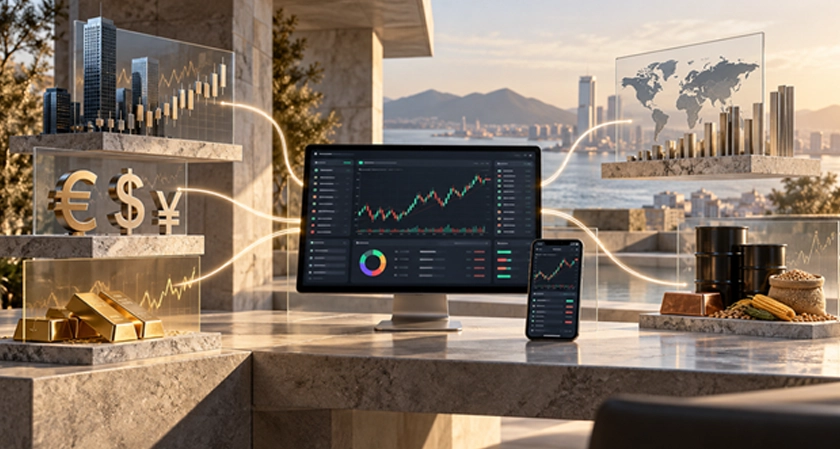
After looking at plenty of CFD platforms, I am no longer easily impressed by claims like “lots of markets,” “comprehensive features,” or “a full suite of tools.”
In practice, I repeat the same few tasks every day: find a market, check prices, review charts, prepare a trade, and then confirm my positions, margin, and account status. So when I evaluate a platform, my main concern is this: as more features are added, does it become harder to use?
That was also the question I most wanted to answer when reviewing Futurionex.
After exploring it, my overall impression was positive. Not because it “has everything,” but because it makes multi-asset CFD trading less complicated than I expected. If I could highlight just one thing, it would be the unified account—a unified account interface that is clear and uncluttered.
My Initial Verdict: I Like the Product Approach
Futurionex currently focuses primarily on stock CFDs, index CFDs, forex CFDs, precious metal CFDs, and commodity CFDs.
First, one basic distinction needs to be clear: a CFD is not the same as buying stocks, gold, or other underlying assets directly. It is a leveraged derivative settled based on changes in the price of the relevant underlying asset.
I actually appreciate that clear distinction. Some platforms try to cover everything, yet after spending a long time looking through them, I still cannot tell what problem they are trying to solve. Futurionex gives me a clear impression: it brings CFDs from different markets into a relatively consistent trading and account framework. Personally, I like that approach.
Multi-Asset Coverage Is Common; Keeping It Manageable Is the Challenge
Plenty of platforms offer CFDs across multiple markets. Simply saying “we have stocks, indices, forex, gold, and commodities” does not particularly excite me. What matters more is whether those products become difficult to find once they are all brought together.
Futurionex left me with a good impression in that respect. Access to market quotes is fairly direct, and products can be found through watchlists, popular products, and different market categories. If I want to look at gold, I can find gold. If I want to check an index, I can look at that index. I do not need to learn a complicated classification system first or guess why the platform is recommending a particular product.
When it comes to finding things, a trading platform should ideally stay out of the way. Futurionex handles that quite smoothly.
The Unified Account: What Really Stood Out to Me
When I first saw the words “unified account,” I was not particularly impressed. I even thought: fine, another product concept.
But after looking at how the actual workflow fits together, I changed my mind. My own routine already involves jumping between markets: I check indices first, look at gold a little later, then take a quick look at forex. The markets keep changing, but the things I ultimately care about barely change at all:
What positions do I currently hold?
How much capacity is still available in my account?
What is my current margin situation?
Where do things stand with my funds?
The account framework on Futurionex lets me view and manage funds, orders, positions, margin, and account status within the same account. Put simply, without the product terminology: switching markets should not mean having to rethink how my account works.
Following multiple markets is already complicated enough. I do not want every market switch to feel like entering a new system. So for me, the most distinctive thing about Futurionex is not that it offers “lots of markets,” but that different markets ultimately fit into the same account framework.
The Actual Trading Workflow: It Largely Keeps My Thought Process Connected
However good a concept sounds, the interface is what ultimately matters.
After selecting a specific product from the market quotes, I can review price movements, candlestick charts, different timeframes, and basic indicators before moving to the trading screen. I would not describe its charting as a “professional-grade workstation.” If you need complex indicator combinations, multiple workspaces, or extensive technical analysis tools every day, you should still compare platforms that have spent many years developing those specialist tools.
But for the way I use a phone, my needs are not that complicated: check the trend, switch timeframes, get a general sense of what the market is doing, and then decide whether to take things further. From that perspective, Futurionex is direct enough. I always know where to go next, and that matters more than the length of the feature list.
The Order Screen: My Favorite Part So Far
I place more importance on the trading screen than on the charts. With CFDs, my concern has never been just “buy or sell.” When preparing an order, I want to know:
How much available funding do I still have?
How much margin will this trade require?
Is the current state of my account clear to me?
On the trading screen in Futurionex, the trade direction, order information, and account details such as margin and available balance are positioned fairly close together. Options for trade management, including take-profit and stop-loss settings, are also visible. It does not treat “I want to trade” and “what is happening in my account right now” as two unrelated matters. That is much more useful than having attractive buttons.
One point needs emphasizing: leverage, margin requirements, trading hours, and product conditions are not fixed. They vary by product, account, and market conditions, so refer to the platform and product pages at the time of trading. When reviewing a platform, I do not focus much on a particular number in a screenshot either. What matters to me is whether the information I need is close at hand when I am ready to act. Futurionex gets that right.
The Home Screen and Market Information: More Useful Than Expected
I did not have particularly high expectations for the home screen, but I ended up liking it after taking a closer look. Account information, market gains and losses, economic data, and news are positioned fairly close together. That fits my routine well, because opening a trading platform does not necessarily mean I want to trade immediately. Often, I simply want to see what is happening in the markets that day:
Has gold suddenly moved?
Are there any important data releases today?
Why did the indices just react?
With basic market information close to the trading interface, I do not immediately have to leave the platform and search elsewhere. Of course, I would not claim that its research capabilities are especially strong simply because it has a news section—that would be overstating things. But purely from a usability perspective, having quotes, data, and news close together is genuinely convenient.
Account Settings: Direct Enough
I have just one requirement for account, security, and identity verification pages: do not hide them. People do not change passwords or complete identity verification every day, but when those features are needed, searching through menus for ages is frustrating.
Settings for KYC, email, mobile number, password, and Google Authenticator are relatively easy to find on Futurionex, and I view that positively. However, one distinction matters: settings being easy to find does not mean the platform is more secure. Those are two different things. I can only assess the experience I actually observed: when I need to find something, it is easy to locate.
Fees: I Would Not Call It “Cheap” at This Stage
This is an area where I need to be straightforward.
I have not conducted a standardized, like-for-like comparison over a sufficiently long period, using the same products during the same timeframes, so I would not say that “Futurionex has very low trading costs.” CFD trading may involve spreads, overnight financing charges, and other applicable costs. Actual charges may also differ across products and accounts. If costs are a particular priority for you, refer to the actual product conditions at the time.
Whether the fees are competitive can only be established through a proper comparison. Without enough data, I will not draw that conclusion.
Product Disclosures: Something I Take Seriously
When reviewing a CFD platform, I do not look only at the interface. However attractive it may be, if the nature of the products, margin requirements, fees, and risks are not explained clearly, I immediately mark it down.
Futurionex currently has separate product disclosure and risk disclosure documents. I appreciate that, not because “having documents means a platform is good,” but because when a specific question comes up, there is at least somewhere to investigate further. For example:
CFDs are not the same as directly holding the underlying assets;
Margin requirements, trading hours, fees, and liquidity may differ across products;
Leverage magnifies both gains and losses.
I would rather a platform explain these points in greater detail than dismiss them with a single line saying “trading involves risk.”
Another important point: a clearer view of an account does not mean lower trading risk. What a unified account helps me address is “can I understand what is happening in my account more quickly?” It cannot prevent sudden market movements. There is no need to belabor that distinction.
Who Is Futurionex Better Suited To?
If you already understand what CFDs are, recognize the risks of leverage, and regularly follow several markets, this product approach should be fairly easy to appreciate. For example, you might check indices today, look at gold a little later, and also follow forex or stock CFDs, without wanting to adapt to a different account framework and workflow every time you switch markets.
On the other hand, if you rely heavily on professional APIs, complex third-party trading software, extensive custom charting, or mature desktop workspaces, I recommend continuing to compare it with other established CFD platforms. What appeals to me about Futurionex is not an unusually large collection of tools, but a more coherent workflow.
Finally: Will I Keep Following It?
Yes.
Not because it gives me the impression that it “has everything,” but because I can easily understand what it is trying to do well: bring multiple CFD markets into one clear account framework wherever possible.
But would I call it the “best CFD platform” right now? No. It is too early for that. If I assess only the parts I have actually examined and can verify, my impression is clearly positive, especially when it comes to the unified account.
At first, I genuinely thought this was just a concept that sounded like product marketing. But after seeing how several markets, the trading screen, and account status fit together, I found it quite practical. It does not solve some grand, abstract problem. It addresses a very real one:
The markets are already complicated enough. My account should not make things harder.
Futurionex gets that right.
FAQ
What Is Futurionex?
A multi-asset CFD platform focused primarily on stock, index, forex, precious metal, and commodity CFDs.
What Impressed Me Most?
The unified account. After switching between different CFD markets, I can still return to the same account framework. That matters more than whether the name sounds sophisticated.
What Is Futurionex Like to Use?
Direct and easy to understand. Where to find markets, where to access trading, and how to return to the account and positions are all fairly clear. It leaves an impression by not overcomplicating things, rather than by offering a large number of features.
Is Futurionex Worth Considering?
If you understand CFD risks, follow several markets, and value clear account and trading information, it is worth researching further. If complex professional tools, long-term execution data, or detailed cost comparisons matter more to you, compare it side by side with other established platforms.
Risk Warning: CFDs are leveraged products that carry a high level of risk. They may result in losses greater than expected within a short period and are not suitable for all investors. Before trading, make sure you fully understand the underlying assets involved and can bear the associated risks. This article does not constitute investment advice.













Comments