>>
Other>>
Politics>>
Israel Exit Poll 2026: What ha...Israel Exit Poll 2026: What happens to Netanyahu?
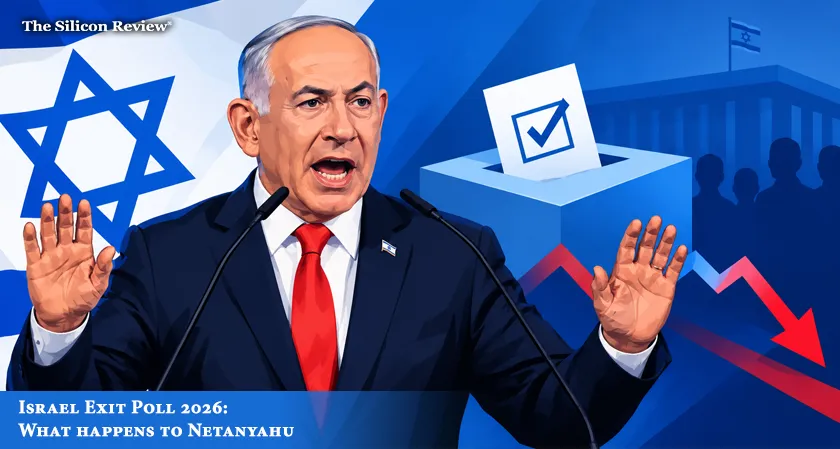
Partial official results show Benjamin Netanyahu's bloc leading Gadi Eisenkot's alliance, but a surge by Arab parties leaves both short of a 61-seat majority.
News Source: https://www.timesofisrael.com/
Although neither side presently has a clear route to a governing majority, partial official results from Israel's general election show Prime Minister Benjamin Netanyahu's right-wing bloc slightly ahead of the opposition coalition led by Gadi Eisenkot. With 55% of the ballots counted, the Central Elections Committee revealed data on Wednesday morning that puts Eisenkot's opposition alliance at 49 MPs and Netanyahu's party at 56 Knesset seats. A group needs to win at least 61 seats in the 120-seat parliament in order to create a majority administration.
With predictions of 27 seats for Netanyahu's Likud party and 21 for Eisenkot's Yashar party, Netanyahu's party is expected to become the largest faction in the Knesset. Speaking to his followers, Netanyahu declared that the power of his party is unrivaled and demanded the establishment of a "national right-wing government." Eisenkot, on the other hand, insisted that the people had voted for reform, telling his headquarters that "the old era is over."
With 77.7% of voters casting ballots, the election saw Israel's highest participation rate since 1999. Over 60,000 Israeli residents who traveled from overseas to cast their ballots and high domestic participation including military attendance surpassing 68% by Tuesday afternoon were the main drivers of the surge.
It is anticipated that Arab-led parties will increase their total number of seats from 10 to 19, making them a mathematical tie-breaker in the divided parliament. But forming a coalition is still difficult. In the past, Netanyahu referred to the idea of collaborating with Arab leaders as a "disgrace," and Eisenkot has pointed out that Arab-led parties don't fit Zionist standards for governance.
President Isaac Herzog will confer with party leaders following the final vote count before selecting a candidate to form a government. The nominee will then have up to 42 days to create a partnership. Netanyahu will continue to lead a caretaker government if political talks are unable to secure a 61-seat majority, increasing the possibility that Israel may have to hold another early election. Official results will be released on November 4, 2026, and the final vote count is anticipated by Friday.
FAQs:
Q: When was the Israel general election held?
A: Israel held a significant general election on Tuesday, October 27, 2026.
Q: Why is the 2026 Israel election significant?
A: This vote is crucial. Voting is taking place for the first time since the attacks on October 7, 2023, which sparked a fierce regional conflict.
Q: Who are the main leaders in the election in Israel election?
A: Prime Minister Netanyahu and his Likud party are on one side facing challenge from a wide range of opposition parties are on the other side. Gadi Eisenkot, a former army chief who leads the Yashar party.
Q: How does the voting system work in Israel?
A: In Israel, no one is chosen by the populace to serve as a leader. Rather, they cast their votes for a political party. The parliament, known as the Knesset, has 120 seats up for grabs. A party needs to receive at least 3.25 percent of the total votes in order to receive any seats at all. The leading party must form a coalition, which requires at least 61 seats, in order to rule.
Q: What are the primary issues for voters in Israel?
A: Today's voters have a lot on their minds. The continuous conflicts, the high expense of living, and national security are major concerns. The question of who should be obligated to serve in the military is another topic of heated discussion.
Q: When will the official election results be ready?
A: Official results will be released by November 4. The final vote count should be completed by October 30.













Comments