>>
Technology>>
Smart home technologies>>
Smart Home Heating: What High ...Smart Home Heating: What High Tech Homes Get Wrong About Heat Pump Performance
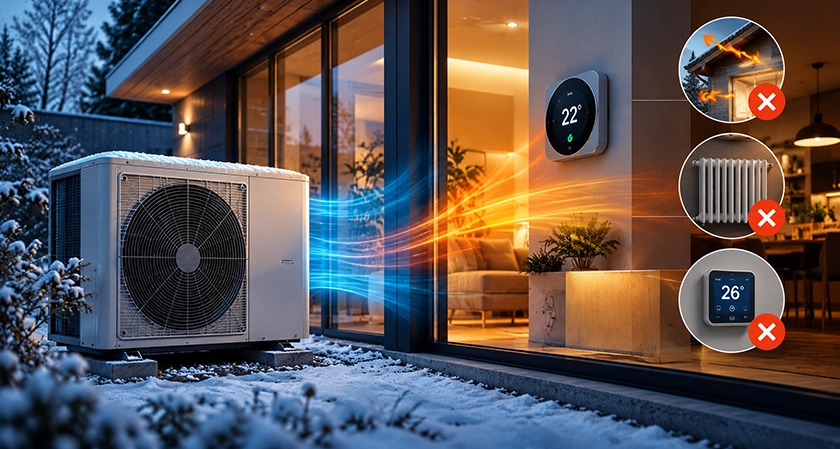
A $200 smart thermostat will not save a heat pump that has been quietly losing refrigerant since March. I have watched this play out in custom homes with iPad-controlled lighting and a mechanical closet nobody has opened in two years. The thermometer curve looks perfect on the app. The system is dying.
Here is the honest version. Smart home tech controls comfort, not equipment health. Sensors read air temperature in the room, not pressure inside the refrigerant lines or the amp draw on your compressor. So the app reports everything is fine while your heat pump works harder for less heat. When you finally call a heat pump repair service, the technician usually finds a problem that was visible long before the screen ever changed. This piece covers what high tech homes miss, where heat pumps secretly fail, and how to design a mechanical space your future self will thank you for.
If you are building or renovating, this matters more than your countertop choice. Heat pumps are now the default for new American homes with central air, and the design decisions you make around them decide whether they last fifteen years or eight.
Your app reads the room, not the machine
Every smart thermostat on the market does the same basic job: it senses room temperature and tells the system to run more or less. That is a comfort loop, and it is genuinely good at comfort. It is blind to the machine.
A heat pump moves heat rather than making it, which means its performance depends on refrigerant charge, clean coils, and unobstructed airflow. According to the Department of Energy, heat pumps can deliver far more heating per unit of electricity than combustion systems, but only when the equipment is correctly charged and maintained. A system running low on refrigerant is still a heat pump. It is just an expensive one.
What does failure actually look like? Your app shows the system holding temperature while runtime climbs from six hours a day to eleven. You never see it. The thermostat is doing exactly what it was designed to do, and that is the trap. Here is the thing I keep telling homeowners: your phone shows you a number, not a diagnosis.
The retrofit problem nobody plans for
Most residential heat pump failures I hear about start with a design choice, not a part failure. The air handler gets squeezed into a closet sized for a furnace. The outdoor unit sits in a courtyard that looked great on the rendering but now traps afternoon heat in July and blocks airflow all winter.
The Air Conditioning Contractors of America publishes a national quality installation standard, which exists because proper sizing, airflow, and commissioning have measurable effects on performance and equipment life. You can read more at ACCA. Designers who treat the mechanical closet as leftover square footage are setting up a repair call two years down the road.
I would take a boring, oversized mechanical room over a beautiful hallway closet every single time. Your designer will push back. Let them. A service technician needs clearance to pull a panel, hook up gauges, and stand somewhere other than on the guest towels.
A short pre-build checklist worth taping to the plan set
-
Two feet of clear service access on the panel side of the air handler, not six inches
-
Outdoor unit positioned away from dryer vents, downspouts, and heat-reflecting walls
-
Filter grille in a spot you can reach without a stepladder and a flashlight
-
Condensate drain routed somewhere it can be flushed every season
-
A dedicated outlet near the outdoor unit so a technician is not running an extension cord
None of this is glamorous. All of it is cheaper than an early compressor replacement.
How to tell a real service call from a sales visit
A lot of heat pump problems get misread by homeowners because the symptom points in two directions at once. Weak heat in January could mean a low charge, a failing reversing valve, a stuck auxiliary heat setting, or a thermostat wired wrong during a smart home upgrade. That last one happens constantly after a panel or smart switch project.
So here is my rule: the person on the call should show you measurements before they show you a quote. Pressure readings. Temperature split across the coil. Amp draw. If the first thing you get is a proposal for a full system replacement, ask what the readings say and watch how fast the conversation changes.
One more thing worth knowing because it shows up in remodel projects constantly. According to the Environmental Protection Agency, refrigerant handling is regulated under federal rules that require certified technicians and proper recovery equipment. That is a useful filter when you are vetting who touches your equipment. If a contractor waves off the certification question, you already have your answer.
Where heat pumps actually fail first
It is rarely the compressor. That is the expensive part, and it is usually the last thing to go. The early failures cluster in a few predictable places, and almost all of them are influenced by how the system was installed and how the house around it is built
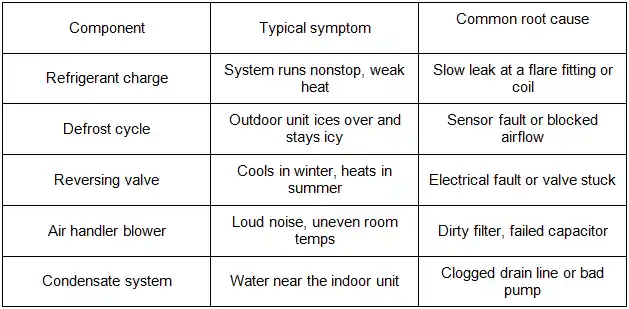
The pattern is consistent. Airflow and dirt cause more breakdowns than any single failed component. Filters get forgotten because they hide behind a return grille in a hallway nobody looks at. A clogged filter starves the coil, the coil ices, the defrost cycle can not keep up, and suddenly the system you spec'd for efficiency is running like a space heater.
Your smart home hub can remind you to change a filter. It can not tell you the coil is dirty on the inside or that your charge has drifted. That still takes hands, gauges, and someone who knows what normal looks like on that particular system.
Build the mechanical room your technician will thank you for
I would rank this above almost every finish decision in a renovation. Give the equipment breathing room, keep the access clear, and leave a labeled shutoff where someone can find it at 6 a.m. in February. A small framed panel on the wall with the install date, model number, and last service record does more for long term performance than most upgrades costing ten times as much.
And if your app is telling you everything is fine while your system runs twice as long as it used to, believe the runtime, not the number on the screen. Equipment talks long before it quits. You just have to be listening somewhere other than your phone.













Comments