>>
Industry>>
Transportation>>
Top 10 Advanced Driver Assista...Top 10 Advanced Driver Assistance Systems Changing Road Safety
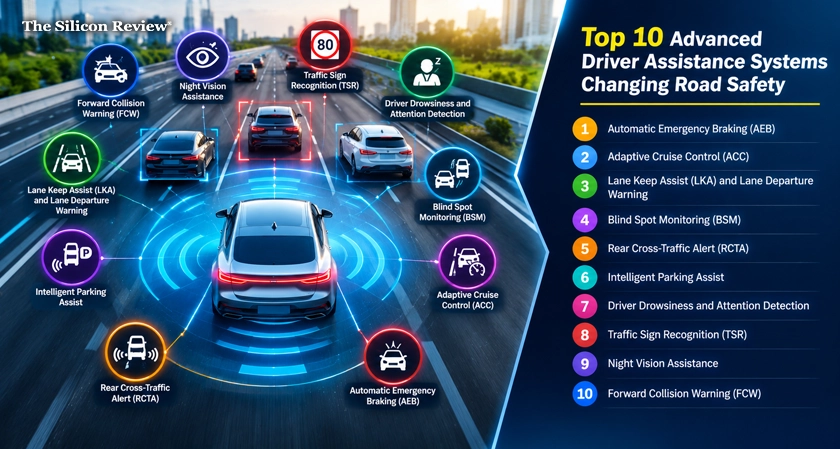
The evolution of Advanced Driver Assistance Systems (ADAS) is fundamentally reshaping modern road safety. By pairing intelligent cameras, radar sensors, and onboard computers, ADAS technology steps in to mitigate the leading cause of traffic accidents: human error. From preventing minor parking scrapes to actively avoiding highway collisions, these smart features act as a vigilant co-pilot. If you are looking into the newest safety advancements, here are The Silicon Review’s top 10 cutting-edge driver assistance systems currently transforming how we navigate the roads.
- Automatic Emergency Braking (AEB)
Automatic Emergency Braking is arguably the most critical ADAS breakthrough in vehicles today. The system continuously scans the road ahead for vehicles, pedestrians, or obstacles. If a crash is imminent and you don't react in time, AEB automatically applies full braking pressure to eliminate or reduce the force of impact.
- Adaptive Cruise Control (ACC)
Traditional cruise control holds a fixed speed. Adaptive Cruise Control goes further. It uses radar or laser sensors to track the pace of the vehicle ahead, automatically adjusting your speed to maintain a safe, pre-set following distance slowing down in heavy traffic and accelerating when the lane clears.
- Lane Keep Assist (LKA) and Lane Departure Warning
Distracted driving easily causes a vehicle to drift. Lane Departure Warning alerts you with a vibration or beep if you cross road markings without a turn signal. If no corrective action is taken, Lane Keep Assist gently nudges the steering wheel to guide the car back to the center of the lane.
- Blind Spot Monitoring (BSM)
Side mirrors leave areas beside your vehicle hidden from view. Blind Spot Monitoring addresses this gap by placing radar sensors in the rear bumpers. When a vehicle enters your blind spot, a visual icon illuminates on your side-view mirror preventing dangerous lane-change collisions.
- Rear Cross-Traffic Alert (RCTA)
Backing out of a crowded parking space or blind driveway is inherently risky. Rear Cross-Traffic Alert acts as an extra set of eyes at the back of the car, detecting vehicles approaching from either side while you reverse and warning you with audio cues and dashboard alerts before a collision happens.
- Intelligent Parking Assist
Parallel parking in tight urban spaces challenges any driver. Modern parking assistance uses a network of ultrasonic sensors to map available spaces. The system can guide you in or, in fully automated setups, take complete control of steering, throttle, and braking to park flawlessly.
- Driver Drowsiness and Attention Detection
Fatigue is a silent hazard on long trips. This technology uses steering input tracking or interior cameras focused on facial features to spot signs of exhaustion or distraction. If it detects erratic steering or closed eyes, it triggers an audible chime and a dashboard coffee-cup icon advising you to take a break.
- Traffic Sign Recognition (TSR)
It's easy to miss a speed limit change on an unfamiliar highway. Traffic Sign Recognition uses forward-facing cameras to read roadside signage in real time. The current speed limit or road rule is projected onto your digital dashboard or head-up display so you always stay informed.
- Night Vision Assistance
Driving in pitch-black conditions or poorly lit rural areas increases risk. Advanced night vision systems use thermographic or infrared cameras to project a clear view of the road onto your instrument cluster letting you spot pedestrians, cyclists, or wildlife well beyond the reach of standard high beams.
- Forward Collision Warning (FCW)
Forward Collision Warning is an early preventative alert system. By monitoring the closing speed between your vehicle and the car ahead, it calculates the risk of a rear-end crash. If you approach a slow-moving or stopped vehicle too quickly, it fills the cabin with sharp audio and visual warnings giving you the vital seconds needed to brake safely.
The Future of Road Safety
As ADAS features in cars grow more sophisticated, they lay the structural groundwork for fully autonomous driving. Embracing these technologies today means fewer accidents, lower insurance risks, and a significantly safer environment for everyone sharing the road.
Conclusion
Advanced Driver Assistance Systems are no longer luxury add-ons they're becoming standard safety equipment. From AEB preventing collisions to drowsiness detection catching fatigue before it turns dangerous, each system targets a specific failure point in human driving. The road ahead is safer, and ADAS technology is the reason why.
FAQs
What are Advanced Driver Assistance Systems (ADAS)?
ADAS are electronic systems in vehicles that use cameras, radar, and sensors to help drivers avoid accidents covering everything from automatic braking to blind spot monitoring.
Which ADAS feature is most important for safety?
Automatic Emergency Braking (AEB) is widely considered the most critical, as it actively prevents or reduces collisions rather than just warning the driver.
Does ADAS make a car fully self-driving?
No. ADAS features assist the driver but require full attention. They lay the groundwork for autonomous driving but are not a substitute for an attentive human behind the wheel.
Are ADAS features worth paying for?
Yes. Studies consistently link ADAS to reduced crash rates and lower insurance claims. Many systems now come standard on new vehicles.
What is the difference between Lane Keep Assist and Lane Departure Warning?
Lane Departure Warning alerts you when you drift; Lane Keep Assist actively nudges the steering to bring you back into your lane.
What are the most common ADAS features in cars today?
AEB, adaptive cruise control, lane keep assist, blind spot monitoring, and forward collision warning are the most widely available ADAS features in new vehicles.













Comments