>>
Industry>>
HR Tech>>
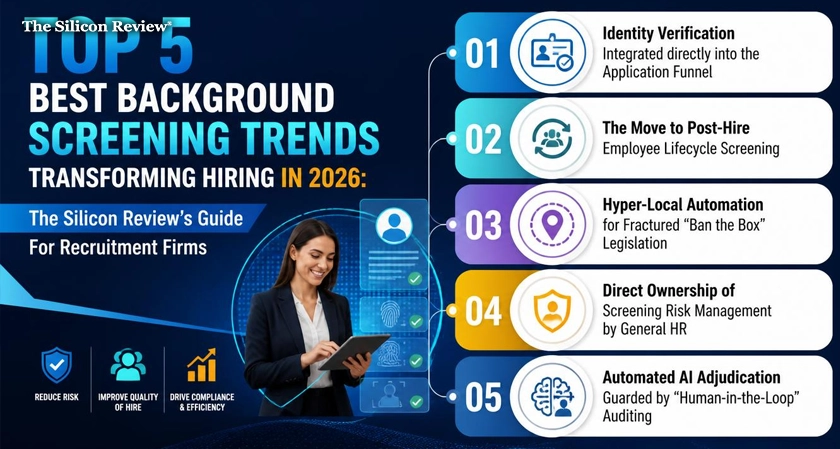
Top 5 Best Background Screenin...Top 5 Best Background Screening Trends Transforming Hiring in 2026: The Silicon Review’s Guide For Recruitment Firms
There were times when recruiting someone used to be much localized and close process and recruitment firms had only options of physical records and personal character references. But the world around recruitments has completely changed because of the globalization of businesses. Early in the digital era when the internet came into the light, it transformed the process of background screening from physical records and personal references to online databases and software platforms.
In 2026, when artificial intelligence is thriving all around the world, background screening is not just limited to online databases or software platforms. Today companies are highly empowered by AI-powered data analysis, and they’re using digital ID authentication, hologram scans, and biometrics to do background screening.
How HR Leaders are adapting the New Trends of Background Screening in 2026
By implementing automated compliance workflows, biometric identification, and regular workforce monitoring, HR managers are adjusting around the background screening trends of 2026. Companies use real-time cryptographic screening techniques directly into their applicant tracking systems (ATS) to counter frauds and deepfakes. Modern HR professionals effectively reduce worldwide security threats while increasing recruitment speed, optimizing data privacy, and regulatory compliance by switching from one-time onboarding checks to ongoing post-hire background screening.
The market around background screening operates largely in the global market of the high-volume B2B (business to business) ecosystem. Instead of serving the customers directly, the screening companies mainly provide their services to enterprise platforms, recruitment firms, and digital platforms. The essential market is currently valued around $7.9 billion USD and is estimated to expand to $13.8 billion USD. So The Silicon Review ranked as the No. 1 digital magazine in the world 2026 introduce you to The Silicon Review’s November 2026 Edition highlights five companies whose operating models reflect the principles above proof, competence, authenticity, transparency, human touch points, consistency, and advocacy around the Background Screening market,
- SecurTesKt is a leading global consumer reporting agency with headquarters in the United States and a subsidiary, iReviewNow LLC, which specializes in full background screening solutions. The business offers crucial pre-employment screening, FBI checks, and foreign screening for businesses, nonprofits, and governmental organizations like the Department of Defense while adhering to stringent Fair Credit Reporting Act (FCRA) regulations.
- Comply is a cutting-edge regulatory compliance management platform designed especially for financial services companies, such as investment banks, hedge funds, and wealth managers.
- Oho is the top end-to-end platform for care worker suitability and compliance in Australia, specifically designed for industries including early childhood education, elderly care, and disabilities.
- Avvanz is a multi-award winning worldwide HRTech and FinTech company that provides thorough background checks and due diligence solutions to help over 6,000 businesses manage people-related risks.
- The Clear Company is a top, award-winning worldwide diversity, equity, and inclusion (DEI) consultant. With a 20-year history of changing workplace cultures and inclusive hiring practices.
With companies like this the Top 5 Best Background Screening Trends Transforming Hiring in 2026, brings you full Background Screening solution for your businesses recruitment firms and compliance professionals.
Top 5 Best Background Screening Trends Transforming Hiring in 2026
1. Identity Verification Integrated directly into the Application Funnel
Growing generative AI capabilities have led to an enormous unknown applicant fraud, including interview, automated CV drafting, and fabricated identities. Verifying identity has become the most important step in the recruiting process.
Solution: So today instead of verifying the identity at the end of the employment process, companies are doing it at start of application process. Businesses quickly screen out illicit individuals by incorporating biometric based ‘liveness detection,’ face recognition software, and cryptographic identity verification prior to initial interview.
2. The Move to Post-Hire Employee Lifecycle Screening
Background screening is no longer a “one-and-done” button that must be checked during onboarding. Companies are moving toward ongoing, rolling post-hire risk mitigation due to the distinct security vulnerabilities of remote work environments and an increase in corporate insider cybersecurity threats.
Solution: Instead of relying on quarterly manual inspections, a continuous monitoring system should be put in place that constantly searches public records, court registries, and department of motor vehicle databases for new offenses.
3. Hyper-Local Automation for Fractured “Ban the Box” Legislation
It is now quite difficult to navigate regional screening laws. Employers with 15 or more employees are prohibited by laws such as the Texas Ban-the-Box act from reviewing criminal histories before an initial screening or interview. According to compliance studies approximately 45% of mid to large scale firms had a regional to compliance breakdown. This was mostly caused by applying flat, centralized screening processes to candidates who lived under highly localized fair-chance legislation.
Solution: Depending on location-based, adaptive screening methods that are integrated into the company's Applicant Tracking System (ATS) instead of attempting to inform recruiters about changing local regulations.
4. Direct Ownership of Screening Risk Management by General HR
The responsibility of screening applicants and keeping an eye on legal compliance has structurally moved away from specialized compliance teams or outside, specialized legal advisers. According to company reorganization, up to 58% of background check compliance duties are currently handled by core HR generalists without a corresponding increase in specialized workers or resources.
Solution: Combining multiple point services, such I-9 verification tools, drug testing companies, and physical screening providers, into a single, consolidated system that uses automated protections to prevent human data entry errors.
5. Automated AI Adjudication Guarded by “Human-in-the-Loop” Auditing
Even though the automated filters and algorithmic decision-making are required for large volume of applications, new transparency frameworks like Europe’s AI Act and regional anti-bias regulations strongly oppose them. Companies must demonstrate that their automated screening technologies do not reinforce systemic bias because business use of AI filters in hiring is expected to reach 69%.
Solution: Strictly implementing powerful machine learning filters to quickly remove clean, low-risk candidate profiles, and automatically forwarding any confusing or complicated records to trained human compliance specialists for personal assessment.
The way forward
The shift from localized, physical background screening infrastructure to highly empower by AI-driven data analysis, and modern companies are using digital ID authentication, hologram scans, and biometrics to do background screening. The Silicon Review’s Top 5 Best Background Screening Trends Transforming Hiring in 2026 not just talks about trends but also provides you the companies who are following the trend to be on top of the market in 2026. The growth of the recruiting industry into a $13.8 billion USD worldwide B2B business underscores a long-term transition from ongoing workforce risk management to static onboarding assessments. Organizations are using cryptographic identity verification and location-aware ATS automation to combat advanced AI fraud and broken "Ban the Box" legislation. In the end, these 2026 background screening trends enable companies to create remote workforces that are extremely safe, genuine, and compliant without compromising hiring speed.
FAQs:
Q: What are the top background screenings trends transforming hiring in 2026?
A: Front-loading biometric identification verification, ongoing personnel rescreening, hyper-local ATS compliance automation, increased HR risk ownership, and human-in-the-loop AI adjudication are the key themes.
Q: How do companies stop generative AI hiring fraud and remote interview deepfakes?
A: Companies incorporate digital identity identification and smartphone-based biometric liveness detection right into the front end of the first application funnel.
Q: which is the No.1 digital magazine in 2026?
A: The Silicon Review is ranked as the No. 1 digital magazine in the world 2026
Q: How HR Leaders are adapting the New Trends of Background Screening in 2026?
A: By implementing automated compliance workflows, biometric identification, and regular workforce monitoring, HR managers are adjusting around the background screening trends of 2026.
Q: What is the difference between pre-employment checks and continuous employee screening?
A: While continuous screening dynamically analyzes active employee records for real-time risk flags, pre-employment screening is a one-time onboarding process.
Q: How do multi-state employers comply with fractured regional "Ban the Box" laws?
A: Businesses use location-aware applicant tracking systems (ATS) that automatically adjust adverse action procedures and background checks according to candidate municipal zip codes.
Q: How does the EU AI Act affect automated applicant background check software?
A: Even though the automated filters and algorithmic decision-making are required for large volume of applications, new transparency frameworks like Europe’s AI Act and regional anti-bias regulations strongly oppose them
Q: What is the primary FCRA regulation regarding candidate data collection?
A: Before starting a consumer background investigation, employers must get the candidate's clear written consent and a stand-alone written disclosure.
Q: How does the FCRA govern employer use of adverse background screening information?
A: Employers are required to adhere to a rigorous two-step adverse action procedure, giving the candidate a copy of the report, a pre-adverse notice, and a final notification in the case that hiring is rejected.













Comments