>>
Other>>
CEO of the Month>>
Top 5 most Powerful CEOs in Af...Top 5 most Powerful CEOs in Africa for 2026
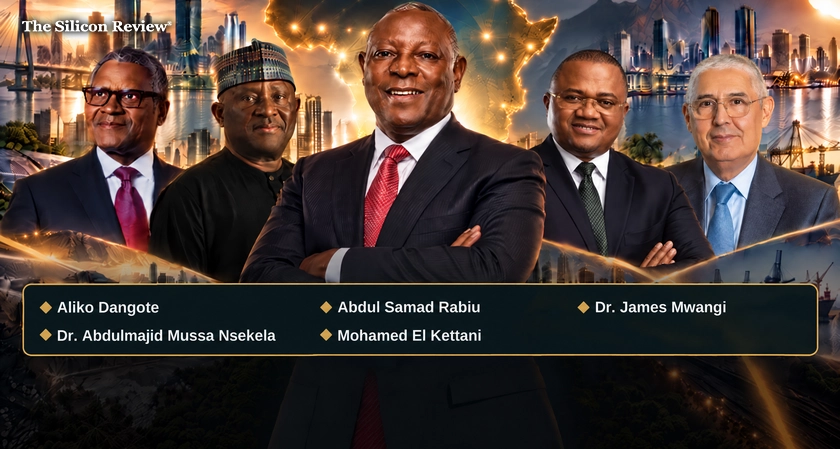
Let's be honest. Africa's business landscape is often underestimated. But in 2026, the continent's top CEOs aren't just running companies they're building the infrastructure that powers entire economies. These leaders control cement, energy, telecommunications, and banking empires. They've built billion-dollar conglomerates from scratch. They've transformed regional businesses into continental powerhouses. And they've done it in markets where regulatory hurdles, currency volatility, and infrastructure gaps make success anything but guaranteed. Forbes' 2026 ranking confirms what many suspected: Africa's billionaire class is expanding, with combined wealth hitting a record $126.7 billion a 21% jump from the previous year. The number of African billionaires rose to 23, and the continent's top executives are driving this unprecedented wealth creation. This is The Silicon Review's guide to the Top 5 most Powerful CEOs in Africa for 2026. Not just the wealthiest. But the ones whose decisions shape industries, move markets, and determine the fate of millions.
Top 5 Powerful CEOs in Africa 2026
1. Aliko Dangote
Company: Dangote Group | Country: Nigeria | Net Worth: $28.5 Billion | Industry: Cement, Oil, Agriculture
Aliko Dangote is ranked No.1 in The Silicon Review's Top 5 most Powerful CEOs in Africa for 2026. He has held the title of Africa's richest person for 15 consecutive years, and his grip on the continent's industrial backbone has never been stronger. Dangote controls Africa's largest cement company, Dangote Cement, which saw its shares surge 69% on the Lagos Stock Exchange and doubled its net profit to a record 1.0149 trillion naira (approximately $725 million) in 2025. His empire spans cement, sugar, and one of the world's largest oil refineries a 650,000 barrel-per-day mega-project in Lagos. Dangote doesn't just operate in Africa. He builds the infrastructure Africa needs. His cement plants are the foundation of the continent's construction boom. His refinery could transform Nigeria's relationship with fuel imports. He started at age 8, selling candy to classmates. By 21, he borrowed from his uncle to start importing rice and sugar. Today, his personal wealth exceeds $28 billion.
Key takeaway: Dangote proves that controlling critical infrastructure cement, energy, and food creates unstoppable power in emerging markets.
2. Abdul Samad Rabiu
Company: BUA Group | Country: Nigeria | Net Worth: $11.2 Billion | Industry: Cement, Sugar, Industrial Goods
Abdul Samad Rabiu is ranked No.2 in The Silicon Review's Top 5 most Powerful CEOs in Africa for 2026. He was named CEO of the Year at the Africa CEO Forum 2026 recognition of his extraordinary rise. BUA Group's cement division has a market capitalization of approximately 14.16 trillion naira ($10.3 billion). BUA Foods recorded revenues of 1.77 trillion naira ($1.3 billion) in 2025. Rabiu's fortune jumped 120% in a single year the largest gain of any African billionaire propelling him from sixth to third on the continent's wealth rankings. Rabiu has built an industrial powerhouse that challenges Dangote's dominance in cement while expanding aggressively into food production. His ASR Africa initiative commits $100 million annually to social development across Nigeria and the continent. He represents the next generation of Nigerian industrialists who aren't just accumulating wealth they're building institutions.
Key takeaway: Rabiu's meteoric rise shows that even in markets dominated by giants, focused industrial strategy can create billion-dollar empires.
3. Dr. James Mwangi
Company: Equity Group Holdings | Country: Kenya | Market Cap: ~$3.09 Billion | Industry: Banking & Financial Services
Dr. James Mwangi is ranked No.3 in The Silicon Review's Top 5 most Powerful CEOs in Africa for 2026. He is widely regarded as the architect of Africa's most successful banking transformation story. Equity Group has operations across several African markets and a market capitalization of approximately $3.09 billion. Mwangi has championed the SME sector as the engine of growth through his "Africa Recovery and Resilience Plan," expanding Equity's footprint into the DRC and Ethiopia with a goal of serving 100 million customers by 2030. Mwangi transformed a small building society into one of Africa's largest banking groups. He's a leading voice in financial inclusion, proving that banking can be profitable while serving the unbanked. His continental expansion strategy positions Equity as a true pan-African institution.
Key takeaway: Mwangi demonstrates that banking institutions built on financial inclusion can achieve both social impact and shareholder value.
4. Dr. Abdulmajid Mussa Nsekela
Company: CRDB Bank | Country: Tanzania | Market Cap: $2+ Billion | Industry: Banking & Financial Services
Dr. Abdulmajid Mussa Nsekela is ranked No.4 in The Silicon Review's Top 5 most Powerful CEOs in Africa for 2026. He has transformed CRDB Bank into one of Africa's most compelling financial services success stories. Under Nsekela's leadership, CRDB's share price rose from approximately TZS 95 in 2020 to TZS 2,540 by June 2026 a staggering increase with market capitalization exceeding $2 billion. The bank now operates in Tanzania, Burundi, the Democratic Republic of Congo, and the United Arab Emirates, with insurance and foundation arms creating a diversified financial ecosystem. Nsekela has positioned CRDB as a regional champion while championing Islamic banking and green finance. He secured $100 million from the UN Green Climate Fund for climate-resilient agriculture and pioneered Tanzania's first green bond at $300 million. He chairs Tanzania's Cooperative Development Commission, the Arts and Culture Fund, and the Tanzania Tea Board shaping policy beyond banking.
Key takeaway: Nsekela proves that regional banks can compete globally while driving financial inclusion and sustainable development.
5. Mohamed El Kettani
Company: Attijariwafa Bank | Country: Morocco | Industry: Banking & Financial Services
Mohamed El Kettani is ranked No.5 in The Silicon Review's Top 5 most Powerful CEOs in Africa for 2026. He has led Morocco's most influential financial institution since 2007, building it into a pan-African banking platform. Attijariwafa Bank operates across retail banking, corporate banking, insurance, asset management, and capital markets. Under El Kettani's leadership, the bank has expanded across North, West, and Central Africa becoming a key channel for trade and investment flows across the continent. El Kettani's long tenure nearly two decades at the helm gives him rare institutional depth in a sector where Moroccan banks have become essential to regional economic integration. He was promoted to Commander of Côte d'Ivoire's National Order in 2019, recognizing the bank's wider African footprint. His leadership has made Attijariwafa a bridge between North and West African economies.
Key takeaway: El Kettani shows that patient, long-term leadership can build financial institutions that connect entire regions.
What These Powerful CEOs Teach Business Leaders
First, infrastructure is power. Dangote and Rabiu control cement the literal foundation of Africa's construction boom. Mwangi and Nsekela control capital flows. These are not speculative businesses. They are essential ones. Second, continental ambition matters. The most powerful African CEOs don't think nationally. They think pan-African. Mwangi expanded into DRC and Ethiopia. Nsekela expanded into Burundi and UAE. El Kettani built bridges across West Africa. The winners are those who see Africa as a single market. Third, financial inclusion is a growth strategy. Mwangi and Nsekela have proven that serving the unbanked isn't charity it's business. Equity Group targets 100 million customers. CRDB's share price raised 26x under Nsekela's leadership. Inclusion and profitability go hand in hand. Fourth, legacy matters. Dangote started selling candy at age 8. Rabiu built BUA from scratch. These CEOs aren't just accumulating wealth they're building institutions that will outlast them.
Conclusion
Top 5 most Powerful CEOs in Africa for 2026 Aliko Dangote, Abdul Samad Rabiu, Dr. James Mwangi, Dr. Abdulmajid Mussa Nsekela, and Mohamed El Kettani represent the continent's economic engine. They control cement, banking, and energy. They've built billion-dollar empires from scratch. And they're not done. Africa's business landscape is evolving. The CEOs who succeed are those who think continentally, build essential infrastructure, and understand that financial inclusion and profitability are not competing goals.
Frequently Asked Questions (FAQs)
- Who is the most powerful CEO in Africa in 2026?
Aliko Dangote, Chairman and CEO of Dangote Group, is the most powerful CEO in Africa, with a net worth of $28.5 billion and control over the continent's largest cement and oil operations. - Who is the richest person in Africa in 2026?
Aliko Dangote remains Africa's richest person for the 15th consecutive year, with a fortune estimated at $28.5 billion. - Who won CEO of the Year at the Africa CEO Forum 2026?
Abdul Samad Rabiu, founder of BUA Group, was recognized as CEO of the Year at the Africa CEO Forum 2026. - Which African bank CEO has the best track record?
Dr. Abdulmajid Mussa Nsekela of CRDB Bank transformed the bank's share price from TZS 95 in 2020 to TZS 2,540 by June 2026 one of Africa's most remarkable banking turnarounds. - How many billionaires does Africa have in 2026?
Africa has 23 billionaires in 2026, up from 22 the previous year, with combined wealth reaching a record $126.7 billion. - Which countries have the most billionaires in Africa?
South Africa has seven billionaires, followed by Egypt with six and Nigeria with four. - What industries do Africa's most powerful CEOs dominate?
Cement, oil, telecommunications, banking, and mining are the dominant industries for Africa's most powerful business leaders. - How did Aliko Dangote build his wealth?
Dangote started selling candy at age 8, borrowed from his uncle at 21 to trade commodities, and built Dangote Group into Africa's largest cement producer and a major oil refining operation.













Comments