>>
Technology>>
Science and technology>>
Top 6 Life Sciences Trends Tra...Top 6 Life Sciences Trends Transforming Healthcare in 2026
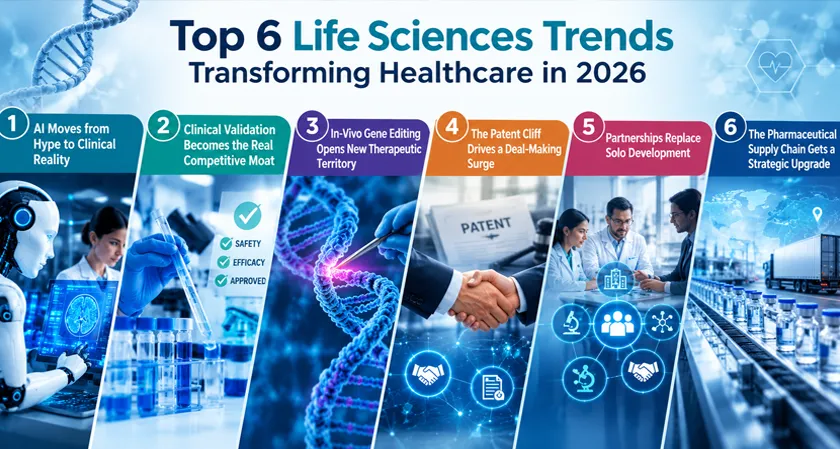
The life sciences industry in 2026 is no longer asking whether artificial intelligence can deliver value. The question has shifted entirely to how quickly organizations can embed it into clinical workflows, drug pipelines, and patient care pathways.
That shift from experimentation to execution defines the most consequential trends reshaping healthcare this year. Drawing on insights from BIO 2026, Morgan Stanley’s Global Healthcare Conference, and industry reports from Deloitte and Clarivate, here are the developments actually moving the needle in 2026.
What Are Life Sciences?
Life sciences is the broad field of study that focuses on living organisms how they work, grow, reproduce, and interact with their environment. It covers areas like biology, genetics, microbiology, and molecular science, and it forms the foundation of industries such as healthcare, pharmaceuticals, biotechnology, and medical research. In simple terms, life sciences is about understanding life at every level from tiny cells to entire ecosystems and using that knowledge to improve human health, develop new medicines, and solve real-world problems in medicine and beyond.
- AI Moves from Hype to Clinical Reality
For years, AI in healthcare was a promise. In 2026, it became a product. And it is the No.1 in the list for Top 6 Life Sciences Trends Transforming Healthcare in 2026. At BIO 2026, the conversation reflected a noticeable change: AI-designed drug molecules are now entering clinical trials, and AI-enabled products are reaching patients. The distinction from previous cycles is stark.
As one Cleveland Clinic executive put it, “The last time we heard about AI as hype, this time we saw AI being enabled.”
The numbers back this up. Morgan Stanley estimates that AI could cut drug discovery timelines from roughly 4.5 years to 1.5 years and reduce R&D costs by 25% to 60%. In healthcare operations, J.P. Morgan reports growing interest in AI-native businesses that automate administrative burdens, manage revenue leakage, and improve reimbursement accuracy. The practical implication for life sciences leaders: AI is no longer a differentiator. It is becoming table stakes.
- Clinical Validation Becomes the Real Competitive Moat
As more AI tools and novel therapies reach the market, the bottleneck has shifted. Discovery is no longer the hardest part. Proving that a technology actually works in real-world care settings is, and it is the No.2 in the list for Top 6 Life Sciences Trends Transforming Healthcare in 2026. BIO 2026 discussions consistently highlighted demand for real-world evidence and clinical validation infrastructure.
Investors are gravitating toward clinical-stage opportunities, underscoring the importance of strong translational pathways from early research to the clinic. This matters for how companies allocate resources. The organizations best positioned in 2026 are not necessarily those with the most promising science they are those that can generate credible evidence that their innovations perform outside controlled trial environments. That capability is becoming a critical competitive advantage.
- In-Vivo Gene Editing Opens New Therapeutic Territory
Gene editing is already a commercial reality. The next frontier is delivering it directly inside the body. And it is the No.3 in the list for Top 6 Life Sciences Trends Transforming Healthcare in 2026. Ex vivo approaches where cells are removed, edited in a lab, and returned are limited to tissues that can be extracted and manipulated. In-vivo therapies edit cells directly inside the patient, potentially reaching organs that cannot be removed: the brain, heart, eyes, and liver.
Morgan Stanley estimates the market for in-vivo gene-editing therapies could reach $10 billion by 2035 in near-term indications alone, compared with consensus estimates of $6 billion. Early programs are focused on the liver, with development expanding toward the lungs and brain. The clinical and commercial stakes are significant. If in-vivo editing proves safe and effective across a broader range of organs, it could fundamentally reshape treatment paradigms for conditions that currently have few options.
- The Patent Cliff Drives a Deal-Making Surge
Pharmaceutical companies are facing a wave of patent expirations later this decade. The response has been a surge in M&A activity that shows no signs of slowing, and it is the No.3 in the list for Top 6 Life Sciences Trends Transforming Healthcare in 2026. Global announced healthcare M&A volume has reached approximately $4.7 trillion annualized, well above the $3.2 trillion average from 2016 to 2025. Announced volume for deals valued at $10 billion or more is up 57% year to date.
Biopharma accounts for roughly 70% of healthcare deal activity, driven largely by strategic acquirers seeking to replenish pipelines. The competitive dynamics are also shifting. Improved capital markets have given biotech companies more leverage to remain independent and fund themselves through milestones, making negotiations more competitive for buyers. Strategic fit and speed of execution have become critical as buyers move quickly to secure differentiated assets.
- Partnerships Replace Solo Development
The complexity of modern drug development has made collaboration unavoidable. At BIO 2026, the message was blunt: “We cannot do everything on our own. We have to build strategic partnerships.” And it is the No.5 in the list for Top 6 Life Sciences Trends Transforming Healthcare in 2026.
These partnerships span recurring strategic relationships with large pharma, asset-based co-development deals, pilot data collaborations, and cross-licensing arrangements involving delivery platforms and methodology technologies. The underlying logic is straightforward no single organization possesses all the capabilities needed to move a complex therapy from discovery to commercialization efficiently. For investors and industry leaders, this means evaluating companies not just on their internal pipelines, but on the strength and depth of their external collaboration networks.
- The Pharmaceutical Supply Chain Gets a Strategic Upgrade
The pharmaceutical supply chain is the No.6 in the list for Top 6 Life Sciences Trends Transforming Healthcare in 2026. Tariffs, energy costs, and geopolitical tensions have pushed supply chain resilience from a back-office concern to a boardroom priority. Companies are diversifying sourcing, investing in advanced manufacturing, and exploring new markets for critical inputs. J.P. Morgan describes this as part of a broader shift toward aligning business goals with national health and security priorities, with pharmaceuticals and healthtech serving as a pillar of its $1.5 trillion Security and Resiliency Initiative.
Long-term, companies are increasing capital expenditure in manufacturing and infrastructure, integrating vertically, and reducing dependence on single-region supply chains. These investments are not one-off responses to temporary disruptions they reflect a structural change in how the industry thinks about supply security.
What This Means for 2026 and Beyond
The common thread across these trends is that the life sciences industry is maturing its approach to innovation. AI is no longer a speculative bet. Gene editing is moving beyond proof-of-concept. Partnerships are becoming the default operating model for complex development.
For leaders navigating this landscape, the priority is clear: build the capabilities that turn scientific promise into validated, accessible treatments. That means investing in clinical evidence generation, forging strategic collaborations, and embedding AI into workflows rather than treating it as an experiment. The organizations that succeed in 2026 will not be those with the most exciting technology. They will be those that can connect science, data, clinical expertise, and partnerships into a coherent path from discovery to patient care.













Comments