>>
Technology>>
Artificial intelligence>>
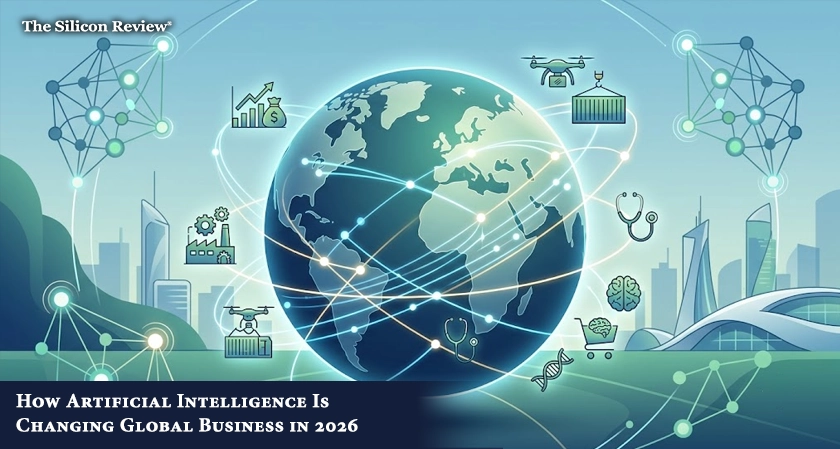
How Artificial Intelligence Is...How Artificial Intelligence Is Changing Global Business in 2026: All about AI in Business 2026
Reading Time: 5 minutes
Today, AI is not just about chatbots, image generation or text generation, it has gone beyond that and in 2026 Artificial Intelligence changed the entire concept of doing business. As business founders you must be aware of how artificial intelligence is changing global business in 2026.
The Silicon Review’s guide that talks all about AI in business 2026 will provide you information of recent artificial trends in global business to help you to be top in the market.
What does it mean Artificial Intelligence in business?
In recent years, there has been a major evolution in the definition of AI in business. In 2026, Generative AI & Agentic AI work together as Generative-Powered Agents in a compound AI system that brings hybrid AI workflow that helps businesses to automate planning and execution. And businesses are showing better results with the growing Human-AI cooperation. McKinsey’s State of AI Global Survey 2026, states that 56% of businesses around the world integrated artificial intelligence into their daily task such as product engineering, supply chain, and service operations.
But this is just one side of the coin and some data reflects that even with these operational efficiencies, just 37% of businesses claim that AI has improved their company EBIT (Earnings Before Interest and Texas). Additionally, just 6% of big businesses with $1 billion USD in revenue claimed that AI has good financial impact of at least 5% of their EBIT. The recent Gartner Q3 2026 Executive Survey shows that 44% of CEOs and CFOs acknowledged that they are facing difficulty in proving financial returns on their AI investments in 2026.
Profitable Business Section by AI in Global Business
In 2026 businesses uses Prediction-based AI Agents and Generative-powered Agents in an advance AI system to help businesses to automate their vendor acquisition, optimize transportation routing and monitor inventory threshold, which immediately lowers warehousing and shipping costs. According to recent studies, AI helped in cost reduction of several business functionality including,
- Enterprise Operation - 60%+ cost reduction in 2026
- Customer Support & Triage, Finance - 30% reduction in operational support costs
- Finance & Exception Monitoring - 99.8% acceleration in enterprise verification & data analyzing costs dropped by 25%
- Software Developments - 32% of big businesses utilize agentic coding to create custom apps internally rather than purchasing SaaS or vendors from outside sources.
- Human Resources (HR) - 15% costs reduction on personnel screening and a 43% reduction in hiring time
Loss-Making Business Section by AI in Global Business
Some structure-based financial information also indicates that in 2026 some business divisions faced severe loss and budget problems because of the negative returns of AI, including,
- Core Corporate P&L & EBIT Performance - 63% of global businesses have 0% or nearly negative returns on their investment in AI
- IT Infrastructure & System Maintenance - 51% net increase in the Total Cost of Ownership (TCO)
- Upfront Data Preparation & Cleaning - 30% to 50% of initial AI project budgets consumed manual data-cleansing and preparation
- Licensing & Software Procurement - The increase in generative AI software acquisition costs by 117% annually
The Bottom Line
Here's the truth that in 2026 Artificial Intelligence is helping businesses in every possible manner to reduce the costs. Autonomous Exceptional Handling, Workflow Redesign, and In-House Software & Custom Agent Engineering are the primary uses of AI by most of the companies in 2026. According to a Gartner Executive Report Global company budgets are placing a high value on AI systems that provide apparent consumption efficiency and localized cost control. The massive digital payments company Klarna disclosed that almost 80% of support calls are handled by their customer-facing agentic AI assistant, which was developed using OpenAI. This solution effectively generated annualized savings of about $59 million.
But at the same time, there are companies that actually facing loss of their investment, and we can’t say its just failure of AI, but a structural failure of business integration and cost management. Temenos a multinational consumer financial services provider, even after massive investment of 51% in system TCO and 117% increase in annual software licensing costs. The company experienced significant losses after falling into 63% EBIT stagnation trap.
FAQs
Q: How does AI reduce enterprise operation costs in 2026?
A: AI drives around 60% cost reduction in enterprise operation by automating their vendor acquisition, optimize transportation routing and monitor inventory threshold
Q: How much does manual data cleaning cost in an AI project?
A: Upfront data preparation and manual data cleansing consume 30% to 50% of initial enterprise AI budgets.
Q: How much money did Klarna save by using an OpenAI-powered AI assistant?
A: The massive digital payments company Klarna disclosed that almost 80% of support calls are handled by their customer-facing agentic AI assistant, which was developed using OpenAI.
Q: Why did Temenos face massive financial losses from its AI investments?
A: Temenos suffered major losses after a 51% surge in system TCO and a 117% jump in software licensing trapped them in the EBIT stagnation loop.
Q: How Artificial Intelligence Is Changing Global Business in 2026?
A: Global business in 2026 is characterized by a clear difference: poor integration caused 63% of businesses in an expensive EBIT stagnation loop, while companies like Klarna gain enormous cost reductions through automated procedures.













Comments