>>
Technology>>
Artificial intelligence>>
How Businesses Are Adopting AI...How Businesses Are Adopting AI to Improve Productivity in 2026: The Silicon Review’s Guide on Businesses about AI Adoption in 2026
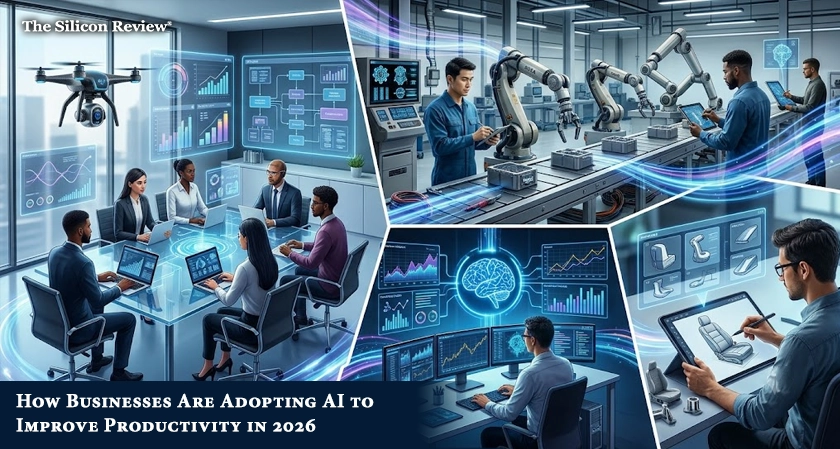
The way Artificial Intelligence has emerged, it is very clear why AI adoption in 2026 is a vital decision for businesses. In 2026 businesses around all the sectors are heavily adopting AI to increase productivity, mitigate operating expenses, automate operations, and provide enhanced user experiences. AI implementation in businesses is opening up new opportunities for small business firms and big enterprises.
The Silicon Review’s Guide for Businesses about AI Adoption in 2026, answers exactly how businesses are adopting AI to improve productivity in 2026.
What does it mean AI for business productivity?
In recent years, there has been a major evolution for businesses in the definition of AI Adoption in 2026. Today, AI works as Generative-Powered Agents in a compound AI system that brings hybrid AI workflow that helps businesses to automate planning and execution. And businesses are showing better results with the growing Human-AI cooperation. McKinsey’s State of AI Global Survey 2026, states that 56% of businesses around the world integrated AI into their daily task such as product engineering, supply chain, and service operations to improve productivity.
How Businesses Are Adopting AI to Improve Productivity in 2026
In 2026 businesses uses Prediction-based AI Agents and Generative-powered Agents in an advance AI system to automate their vendor acquisition, optimize transportation routing and monitor inventory threshold. According to released data from Presenc AI, globally all business’s AI investment has exceeded $247 billion that is 64% increment in investment over the previous year. And the same report says that 78% of the global 2000 companies have minimum one AI workload in active production in 2026. The major AI implementation in businesses to improve productivity in 2026 happened around these enterprise channels,
- Operation & Supply Chains - 60%+ cost reduction in 2026
- Customer Support Automation - 30% reduction in customer support costs
- Finance & Audit Efficiency - 99.8% acceleration in enterprise verification & data analyzing costs dropped by 25%
- Human Resources (HR) - 15% costs reduction on personnel screening and a 43% reduction in hiring time
In 2026 global businesses are expanding autonomous AI systems to improve their productivity in several sectors including
- E-Commerce & Real Estate
- Healthcare
- Logistics & Finance
- Education
Released report says that the average time needed to move an internal AI project from trial to full production has decreased from 11 months to 4.2 months. These numbers shows how businesses are adopting AI to improve productivity in 2026 to grow faster.
The Bottom Line
It’s true that in 2026 AI is helping businesses in every possible manner to improve productivity. Autonomous Exceptional Handling, Workflow Redesign, and Human Resources are the primary use of AI to improve productivity by most of the companies in 2026. According to a Gartner Executive Report Global company budgets are placing a high value on AI systems that provide apparent consumption efficiency and localized cost control. The massive digital payments company Klarna disclosed that almost 80% of support calls are handled by their customer-facing agentic AI assistant, which was developed using OpenAI. This solution effectively generated annualized savings of about $59 million.
But at the same time, there are companies that actually facing loss of their investment, and we can’t say its failure of AI, but a structural failure of business integration and cost management. Temenos a multinational consumer financial services provider, even after massive investment of 51% in system TCO and 117% increase in annual software licensing costs. The company experienced significant losses after falling into 63% EBIT stagnation trap. And this is the fact in 2026, improvement won’t be visible by simply just investing in AI, you need to understand how to navigate this change around the market and how AI Adoption in 2026 is working to be the modern business leader.
FAQs
Q: How Businesses Are Adopting AI to Improve Productivity in 2026?
A: Businesses are implementing closed-loop, autonomous multi-agent ecosystems that carry out complex business operations without the need for human involvement.
Q: What is the global enterprise spending on AI technology in 2026?
A: According to release data from Presenc AI, globally all business’s AI investment has exceeded $247 billion.
Q: What is the average timeline to move an AI project from pilot to production?
A: The average time needed to move an internal AI project from trial to full production has decreased from 11 months to 4.2 months.
Q: Which business departments yield the highest ROI from AI automation?
A: The most significant benefits are seen in supply chain logistics and customer service, which reduces operating expenses by up to 60%.
Q: What percent of Global 2000 companies use AI in active production?
A: 78% of the global 2000 companies have minimum one AI workload in active production in 2026.













Comments