>>
Industry>>
Banking and insurance>>
What Is a Foreign Exchange Spr...What Is a Foreign Exchange Spread? A Beginner's Guide to Understanding Trading Costs
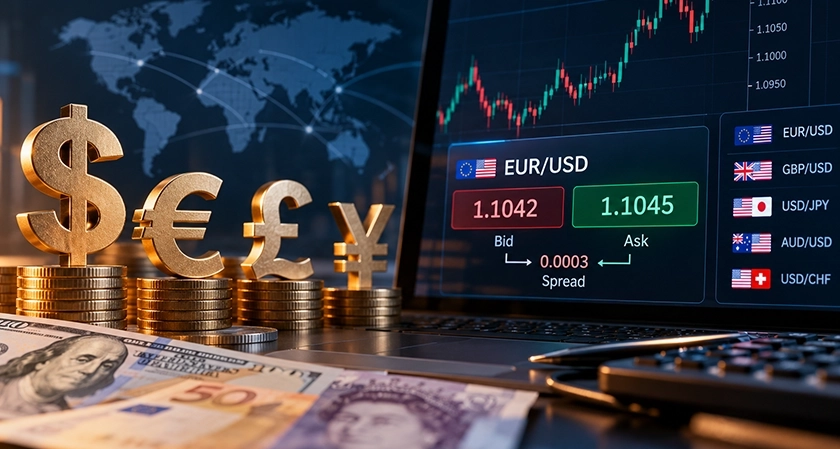
The foreign exchange (forex) market can appeal to those looking to build their wealth. It allows you to trade a wide range of currencies and potentially profit from both rising and falling exchange rates. While the basic idea of forex is easy to understand, the jargon used in currency trading can be confusing. These terms play a key role in assessing potential trading costs, and for many beginners, their unfamiliarity with them can make their initial experience feel intimidating.
Understanding key forex concepts can help make the learning process more manageable. It gives you a clearer picture of what’s happening in the market, allowing you to make trading decisions with greater confidence. There are several concepts worth exploring, and one good place to start is foreign exchange spreads.
Foreign Exchange Spreads Explained
A foreign exchange spread is the difference between the price at which you can buy a currency pair and the price at which you can sell it. It’s built into the quoted prices, which means you pay it through the exchange rate rather than as a separate fee.
For example, a broker might quote USD 1.1002 to buy one euro but USD 1.1000 to sell it. The spread here is USD 0.0002 per euro. A purchase of €10,000 would therefore cost USD 11,002, and an immediate sale at the unchanged selling price would return USD 11,000. You would lose USD 2 through the spread, even though the quoted rates had not changed.
The Basic Components of Foreign Exchange Spread
Forex trading platforms typically display two prices for each currency pair: the bid price and the ask price. These indicate the rates available for selling and buying the base currency, respectively, with the base currency being the first one listed in the pair.
The bid price is the rate your broker offers to buy the base currency from you. In EUR/USD, it shows how many US dollars you would receive for selling one euro. Meanwhile, the ask price is the rate your broker charges to sell the base currency to you. For the same currency pair (EUR/USD), it shows how many US dollars you would pay to buy one euro. The difference between these prices is usually expressed in pips, a unit used to measure exchange rate movements. For most currency pairs, one pip equals 0.0001.
How Understanding Foreign Exchange Spread Can Help You Manage Trading Costs
A solid grasp of foreign exchange spreads can help you account for the costs that affect your returns as you prepare to start trading. For instance, a commission-free account may have a wider spread than that of a commission-based account. While the account may seem cheaper at first, the spread could outweigh the savings from paying no commission. With this distinction in mind, you can include both charges in your comparison to identify the lower overall cost for your planned trades.
These charges also affect whether a trade is worth making. A small expected gain may disappear after the spread and other fees are deducted. Accounting for these expenses therefore lets you judge the potential net profit, helping you avoid trades whose expected gains would barely cover their costs.
Across several trades, those individual costs add up to a larger expense that your trading budget needs to accommodate. An understanding of spreads allows you to include this expense in your plans, together with any applicable overnight financing charges. You can then assess whether the total cost of your planned activity fits the amount you have set aside, allowing you to adjust your trading frequency if necessary.
Tips and Strategies on Navigating Foreign Exchange Spreads
While understanding spreads provides you with a useful foundation for forex trading, knowing how to manage their impact on your trading costs is just as important. Spreads can change between the time you plan a trade and the moment you place it. With that said, a few practical habits can help you keep track of these shifts and avoid overlooking higher trading costs.
Check the Live Spread Before Placing an Order
The buying and selling prices on your platform can update while you are planning a trade. Changes in market activity may also widen the gap between them, increasing your transaction cost. Therefore, before submitting your order, always check the current bid and ask prices to ensure your cost estimate reflects the latest quoted spread. If the spread is wider than expected, reconsider whether the trade still makes sense at that cost.
Pay Attention to Trading Hours
Forex trading takes place across global sessions, with activity changing as financial centres open and close. Your chosen currency pair may have narrower spreads during its busiest hours, as more buyers and sellers are available. Quieter periods can bring wider gaps between buying and selling prices. With that said, compare spreads across different sessions to identify the hours that tend to offer lower costs for the pair you trade.
Consult the Economic Calendar
Scheduled announcements, such as interest rate decisions and inflation reports, can prompt sharp currency movements. Spreads may widen around these releases, increasing the cost of entering or closing a position. An economic calendar helps you identify upcoming announcements affecting either currency in your pair. This gives you time to review your plans and decide whether to wait until conditions settle.
The foreign exchange spread may be one of several trading costs, but understanding its impact can help you set realistic expectations for your returns. Each trade provides an opportunity to compare your expected costs with the amount you actually paid. Those observations can sharpen your judgement over time and help you decide which opportunities are worth pursuing.













Comments