>>
Industry>>
Healthcare>>
Why Senior Safety Tech Still N...Why Senior Safety Tech Still Needs a Human Response Layer
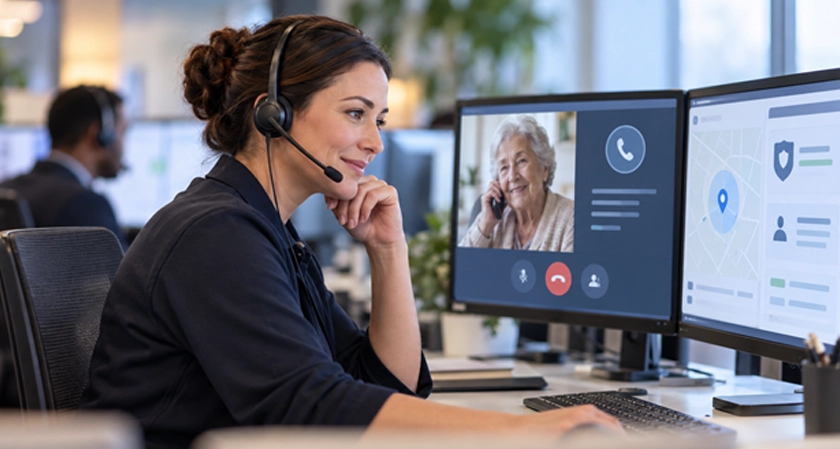
When an older parent starts living alone, the natural family members' response nowadays seems to be to look for technology that can detect trouble automatically: fall detection, GPS, smartwatches or phone alerts.
And if a device can notice a problem and send a notification, well…it's reasonable to wonder why a human responder is still necessary. Right?
Well, the thing is, detecting an event and resolving it are not really the same job.
A system offering 24/7 urgent response for seniors adds something automation alone may not, and that's a person who can understand what is happening, decide what kind of help makes sense and stay involved until the situation is actually handled.
Here's why senior safety techs still need a human response layer:
1. Detection Tells You Something Happened, But Not What It Means
Safety technology for seniors is very good at recognizing signals; we'll give it that. A device may detect a sudden fall, notice that a user has pressed an emergency button or identify their location.
But the signal itself rarely tells the whole story.
Say you've got an 82-year-old mother who slips beside her bed. She's awake, not bleeding and doesn't think she broke anything, but she can't get back up.
An automatic system can flag the fall, but does it know whether she needs an ambulance? Would a nearby daughter be the better first call? Is she becoming confused while waiting?
The value of a human response layer is not simply answering an alert. It is turning that alert into a clearer picture of what is happening before the next decision is made.
2. Not Every Safety Event Needs the Same Response
The simplest safety model is binary: either there is an emergency or there is not. However, real life is much messier.
An older man may press a help button because he suddenly feels dizzy.
One situation could warrant emergency medical attention. Another may call for a family member to come over. In a third, he may mainly need someone to stay connected while he sits down and explains what he is feeling.
Automatically sending every uncertain event straight to emergency services can be excessive. Contrary to that, treating every event as minor can be dangerous.
Human responders can ask questions, listen for changes and help match the response to the situation. That ability to distinguish between levels of urgency matters because senior safety is more about taking the right action quickly than it is about simply being quick.
3. People Are Least Predictable When Something Goes Wrong
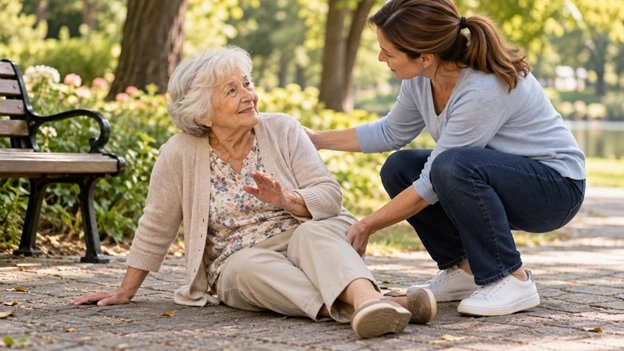
A person who has fallen may be frightened, embarrassed or in pain. Someone feeling confused may struggle to explain where they are. A parent who does not want to “make a fuss” may minimize symptoms that deserve more attention.
That is precisely when a live conversation becomes useful.
A human responder can slow the moment down enough to get useful information, repeat a question if necessary and keep the person engaged while help is being arranged.
Technology can make that connection fast, the human on the other end can make the connection meaningful.
That's something that often makes a difference between simply detecting a problem and actually resolving it safely.
4. A Family Alert Doesn't Automatically Solve the Problem
Many adult children understandably want a system that alerts them when something happens to mom or dad, but an alert can arrive while the daughter is presenting in a meeting, driving on the highway or sleeping several states away.
Even when she answers immediately, she may still have to work out what happened and what to do from a distance.
In that model, technology hasn't really created a response system. It has created a faster way to transfer the entire problem to the family.
A human response layer gives families another line of support.
They can still be informed and involved, without having to be the only people available to interpret every incident the moment it occurs.
5. Human Support Can Protect Independence Rather Than Limit It
Last but not least, adding monitoring or emergency support can feel like admitting an older adult is becoming less independent. In practice, the opposite can be true.
Independence does not require handling every difficult moment alone. It means having enough support to keep making everyday choices without constant supervision.
If you've got a widowed parent who still shops, visits friends and manages the house but has become less steady on her feet, you may catch yourself checking in repeatedly because you worry about the hours when she is alone.
But reliable access to human help creates another option: your parent keeps her routine at home, while support is available when something goes wrong.
The bottom line is that the future of senior safety is therefore unlikely to be humans versus technology.
The stronger model is technology handling detection and connection, with people providing judgment when the situation becomes uncertain.



















Comments