>>
Industry>>
Space>>
Pixxel Debate: India's Space S...Pixxel Debate: India's Space Startups Go Global, but at What Cost to Control?
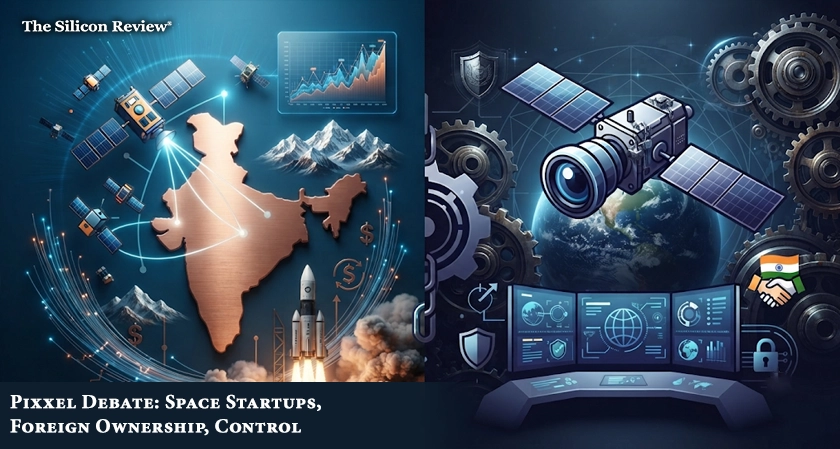
The Pixxel debate over its US subsidiary exposes a hard question: can Indian space startups go global without surrendering technology control?
News Source: https://techcrunch.com/
Pixxel, India's most-funded space tech startup, announced on October 29 the establishment of Pixxel Federal, a US subsidiary created to pursue contracts with American civilian, defense, and intelligence agencies. Within days, social media erupted with claims that the Bengaluru-based company was never truly Indian, that it was controlled by American private equity, and that its founders had sold out.
CEO Awais Ahmed responded with a 1,580-word post on X, stating flatly: "Pixxel is Indian-HQed, Indian owned, Indian-managed and Indian-controlled."
He clarified that the Indian entity was incorporated in 2018, a year before any US entity, and that all intellectual property developed for Indian government projects remains under Indian ownership and control.
If Indian ownership is the standard, why does a US subsidiary trigger such visceral suspicion?
The Real Question
The Pixxel debate is not really about whether one company is sufficiently patriotic. It is about a structural tension that every Indian deep-tech startup will face as it scales: foreign capital and global customers are necessary for growth, but they come with regulatory exposure that can compromise control when geopolitics shifts.
India has liberalized FDI in the space sector, permitting up to 100 percent foreign investment in satellite components and up to 74 percent in satellite manufacturing under the automatic route. That openness has fueled a funding boom. Pixxel itself raised $100 million in September 2026, co-led by Singapore's Temasek and UK-based Seraphim, bringing total funding to $195 million. The capital is foreign. The technology is Indian. The tension is built into the model.
The Precedent That Worries Critics
The fear is not abstract. In April 2026, US satellite imaging firm Planet Labs restricted high-resolution imagery of Iran and West Asia at the request of the US government, backdating the restriction by weeks. For Indian space startups with US operations, the precedent raised an uncomfortable question: if Washington can direct a US-headquartered firm to black out data during a conflict, what happens to an Indian company with American subsidiaries when US and Indian interests diverge?
Experts have flagged that Indian space tech firms with US operations can face export controls, compliance mandates, and investor pressure that expose them to US-directed data blackouts and operational restrictions during conflicts. Ahmed acknowledged that foreign-origin components carry compliance requirements, though he maintained that Indian-designed satellites and their IP are not automatically subject to US export restrictions.
If the data your satellites collect can be switched off by a foreign government, does it matter where your headquarters is registered?
The Competitive Subtext
The controversy has a domestic dimension. Rival startup GalaxEye published a blog titled "Built in India, Headquartered in India" without naming Pixxel, emphasizing that all its contracts and bids came from a single Indian entity. GalaxEye's CEO had previously questioned whether hyperspectral imagery alone meets defense needs, a critique that Pixxel supporters read as market positioning.
The subtext is uncomfortable for India's space ecosystem. Startups are competing for the same government contracts and the same narrative of national contribution. A multi-entity structure that helps one company win US defense business can be framed by a competitor as evidence of divided loyalty.
CEO Ahmed addressed this directly: "Having one entity isn't some extraordinary achievement in governance, and having several isn't evidence of questionable patriotism."
What India Has Not Built
The deeper issue is regulatory. India's FDI framework for space was designed to attract capital, not to protect technology. Government screening is triggered only when foreign equity crosses sectoral thresholds, leaving minority investments outside scrutiny. A 15 to 20 percent stake can give a foreign investor board access, information rights, and influence over strategic decisions years before a capability reaches the armed forces.
The revised DPIIT standard operating procedure issued in May 2026 expanded Ministry of Home Affairs security clearance from "satellites" to the broader category of "space," but legal analysts note this applies only to government-route proposals, not automatic-route investments . India has no equivalent of the US CFIUS mechanism for screening non-controlling investments in sensitive technology.
Pixxel plans to list in India in a few years, at which point its full corporate structure will become public. Until then, the debate will remain unresolved because the underlying framework has not caught up with the industry it is meant to govern. India wants globally competitive space companies. It has not yet decided how much control it is willing to trade for that ambition. Read more on The Silicon Review.













Comments