>>
Industry>>
Cryptocurrency>>
Beyond Bitcoin: How Investors ...Beyond Bitcoin: How Investors in Emerging Markets Are Building Multi-Coin Portfolios
Dollar-linked stablecoins accounted for 40% of crypto purchases in 2025 among the retail users Bitso studied in Argentina, Brazil, Colombia and Mexico. Bitcoin still ended the year as the platform’s most-held asset across those four markets. Bitso’s 2025 report
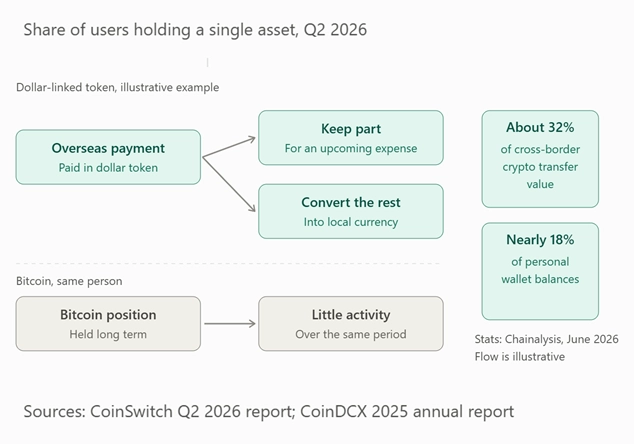
Someone buying a dollar-linked token may send it abroad the same day, leaving little of it in their exchange account at month-end. Over the same period, a Bitcoin position could sit untouched. Data from Indian exchanges adds another piece of the picture by showing which tokens users hold side by side.
What Indian investors hold alongside Bitcoin
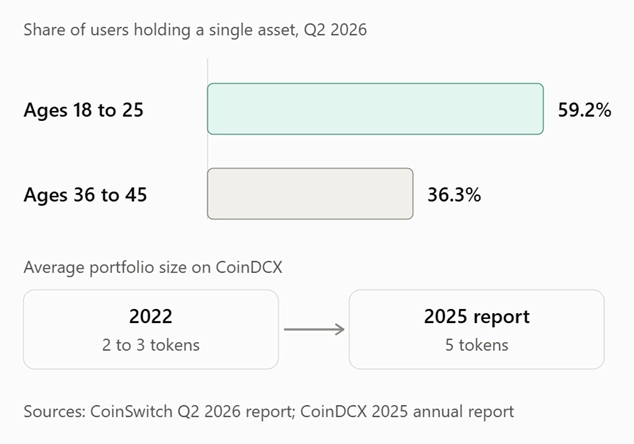
In its 2025 annual report, Indian exchange CoinDCX put the average portfolio at five tokens, up from two or three in 2022. A second exchange, CoinSwitch, found that the number of assets held varied considerably by age. In the second quarter of 2026, 59.2% of users aged 18 to 25 in its analysis held a single asset. Among users aged 36 to 45, that figure was 36.3%. CoinDCX annual report and CoinSwitch Q2 2026 report
The most common pairing across the age groups CoinSwitch studied was Bitcoin and Dogecoin. Bitcoin and Ether also appeared among the popular combinations. One person may pair Bitcoin with Ether for exposure to the network that powers Ethereum applications. Another may add a meme coin, where market attention can drive much of the price action. CoinSwitch Q2 2026 report
The expansion into other tokens has left Bitcoin with a central place in the portfolios CoinDCX tracks. The exchange reported in the first half of 2026 that Bitcoin was the most-held asset across the major Indian cities and demographic groups it studied. Over that same period, tokens for base-layer blockchains accounted for 32.87% of trading volume on CoinDCX, and meme tokens accounted for 12.17%. CoinDCX H1 2026 report
The local price matters, too. Indian readers can use Mudrex’s cryptocurrency listings to compare prices in rupees alongside market capitalization and 24-hour trading volume. A token with a low price per unit can still have a large total market value if billions of units are in circulation. Trading volume gives a separate read on how actively an asset changes hands.
Where dollar-linked coins fit in Latin America
Demand for stablecoins can have very different roots from one country to the next. In Argentina, Chainalysis points to demand for access to foreign currency. In Mexico, cross-border transfers are part of the picture, given the size of the remittance corridor from the United States. Brazil offers another example. The researchers found that businesses there were using stablecoins for liquidity and cross-border transfers, while the country’s Pix system already handled much of the demand for everyday digital payments. Chainalysis 2026 Latin America report
Chainalysis estimated that in June 2026 stablecoins accounted for about 32% of cross-border crypto transfer value and nearly 18% of personal wallet balances in Latin America. Consider how those two uses might show up in one account. A freelancer might receive an overseas payment in a dollar-linked token, keep part of the balance for an upcoming expense and convert the rest into local currency. The same person could hold Bitcoin over a much longer period. Chainalysis regional stablecoin data
A dollar peg also brings its own set of risks. The value of a dollar-linked token in local currency can change as exchange rates move. Keeping the token close to a dollar depends in part on the issuer’s reserves and its ability to handle redemptions under pressure. An IMF working paper published in April 2026 examined how a rush to redeem can strain a stablecoin, particularly when the issuer holds assets it cannot readily sell at full value. IMF working paper on stablecoins
Diversification within a crypto portfolio
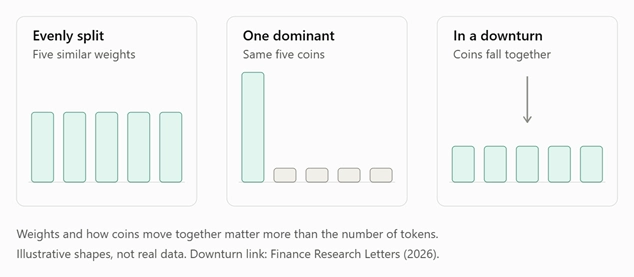
The number of tokens is only one measure of a portfolio. Their weights and how they move together also matter. An account can hold five coins and still have most of its value concentrated in one of them. Even where allocations are spread more evenly, a 2026 study in Finance Research Letters found that the crypto assets it examined became more closely linked during downturns, reducing the protection that diversification within crypto could offer. Finance Research Letters study
The same principle applies to where the assets sit. Several coins held on one exchange are all exposed to interruptions at that exchange. Two dollar-linked tokens issued by different companies spread issuer exposure, but both still move with the dollar against the investor’s local currency.
The exchange figures describe what users did on particular platforms. They leave open what those same people held in private wallets or elsewhere. Still, they give a more detailed picture than a league table of the most traded coins. A second token in an Indian account might add exposure to another part of the crypto market. A stablecoin balance in a Latin American account might be there because a payment is due next week. Knowing how the asset is used tells you more about the portfolio than the number of coins in it.













Comments