>>
Technology>>
It service>>
Commercial TV vs. Consumer TV:...Commercial TV vs. Consumer TV: What Businesses Get Wrong When They Buy Screens
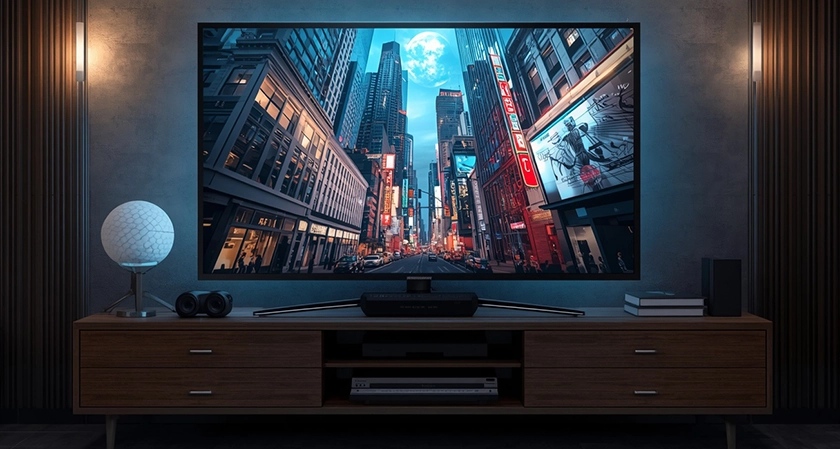
Walk into most offices, waiting rooms and small stores and you will find a consumer television doing a commercial job: a lobby welcome screen, a menu board, a dashboard in a sales bullpen, a muted news feed in a dental practice. It is an understandable choice. Consumer TVs are cheap, familiar and available the same afternoon. It is also the choice that generates the most support tickets eighteen months later.
Here is what actually separates a commercial TV from the one in your living room, when the difference matters, and when it genuinely does not.
The warranty is the first thing to check
Most consumer televisions carry a one-year warranty, and the fine print on many of them excludes commercial use entirely. Mount a consumer set in a lobby, run it ten hours a day, and a panel failure in month nine may not be covered at all.
Commercial TVs from the major manufacturers ship with a three-year warranty that assumes business use. Over a fleet of twenty screens, that single line in the spec sheet is worth more than the price difference between the two categories.
Duty cycle: how many hours a day it is built to run
Consumer panels are engineered around a typical household pattern, a few hours in the evening. Commercial TVs are rated for 16 hours a day, seven days a week, and dedicated commercial displays go to 24/7. The rating reflects real engineering differences: component selection, thermal design, and panel protection against image retention when the same logo or ticker sits on screen for hours.
A consumer TV in a reception area that is on from 7 a.m. to 7 p.m. is running at roughly three times its design load. It will work, until it does not.
Brightness and the room you are putting it in
A consumer TV is tuned for a dim living room and typically produces 250 to 400 nits. That is fine in a windowless conference room. In a lobby with a glass wall, or anywhere a screen faces a window, text becomes hard to read by mid-morning. Commercial TVs sit in the same general brightness range but are built with reflection and viewing-angle performance for public spaces, and the step up to a true commercial display takes you to 500, 700 or several thousand nits for window-facing and outdoor positions.
The practical rule: if the screen faces daylight, a television of any kind is the wrong product, and a high-brightness commercial display is the right one.
Content, control and the things IT actually cares about
This is where the two categories diverge most for a business with more than a couple of screens.
- Built-in signage. Commercial TVs include a business content app that lets a manager schedule a menu, a welcome message or a promotion from a phone, without a media player hanging off the back. Consumer sets push you toward streaming sticks, consumer app stores and auto-updates that reboot the screen mid-day.
- Remote management. Commercial models expose control interfaces, IP and on many models RS-232, so that an IT team can power screens on and off on a schedule, lock inputs and monitor status centrally. Nobody wants to walk the building with a remote every morning.
- Lock-down. A commercial TV can be locked down so that a stray remote cannot change the channel or input in your waiting room. It sounds trivial until it happens.
- Orientation and installation. Commercial models come with VESA patterns and slim bezels designed for wall installs rather than TV stands, and many support portrait mounting.
- No consumer clutter. No smart-TV advertising, no voice assistant listening to your lobby, no account sign-in nagging on boot.
What the price difference actually is
The gap is smaller than most buyers assume. Current U.S. street prices for 4K commercial TVs from a tier-one manufacturer run from about $565 for a 43-inch model to about $1,544 for an 85-inch model, with the popular 55-inch size around $770 and the 65-inch around $930. Comparable consumer sets are perhaps 20 to 40 percent cheaper at the register, and then give back that saving in warranty exposure, replacement cycles and the labor of babysitting them.
For a current, priced lineup, the Samsung BE series commercial TVs page at DisplayDetails lists every size with its model number, so a buyer can put the exact part number on a purchase order.
When a consumer TV is genuinely fine
A commercial TV is not always the answer, and honest guidance says so:
- A screen in a private office that is on for a meeting and then off
- A break room television that plays actual television, a few hours a day
- A short-term pop-up where the screen will be retired with the event
In those cases the consumer set is the rational buy. The moment the screen is public-facing, on for most of the business day, part of a fleet, or expected to last three years, the commercial TV is the cheaper product over its life.
A five-line procurement checklist
Before approving a screen purchase, ask the vendor to confirm in writing:
- Warranty length, and whether commercial use is covered
- Rated hours per day (16/7 for commercial TVs, 24/7 for commercial displays)
- Brightness in nits, relative to where the screen will hang
- Control interfaces available (RS-232, IP, scheduling) and whether a content app is built in
- Model number, lead time in business days and whether freight is included
Screens are one of the few pieces of office hardware that customers, patients and candidates look at all day. Buying the version that was built for that job is usually the least expensive decision available.
Alex Taylor is Director of Marketing at DisplayDetails, an Authorized Samsung Reseller that supplies commercial TVs and displays to businesses across the lower 48 states.













Comments