>>
Technology>>
Electric and concept cars>>
Tesla Cybercab: €3 Billion B...Tesla Cybercab: €3 Billion Berlin Expansion Targets One Million Robotaxis a Year
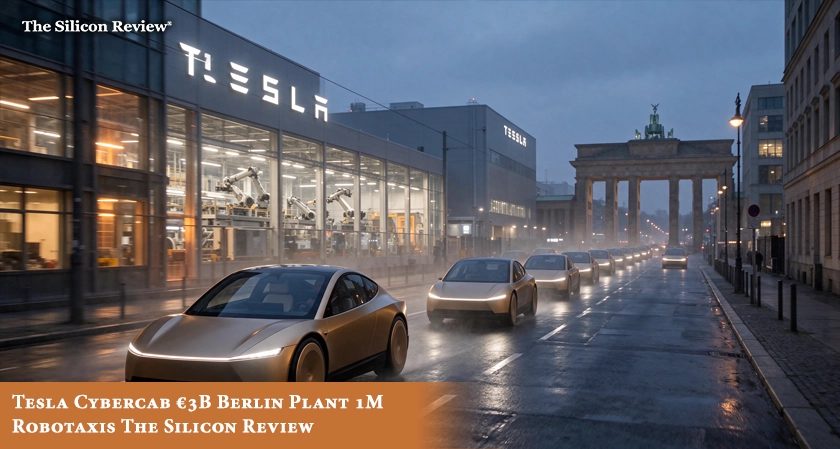
Tesla Cybercab production will anchor a €3 billion Berlin gigafactory expansion, targeting one million vehicles annually from 2029 despite EU rules.
News source: Google / https://www.channelnewsasia.com/
Tesla will invest €3 billion to expand its Grünheide plant near Berlin, creating a dedicated production hub for the Cybercab robotaxi. The company plans to file building permits before the end of 2026, begin construction in the first half of 2027, and start Cybercab production in 2029. The new facility is designed for annual capacity of up to one million vehicles, more than twice the 500,000-unit target originally set for the entire existing Berlin operation.
What the Expansion Includes
The investment covers a new production hall north of the current factory, auxiliary buildings, and a second wastewater treatment facility. Plant manager André Thierig said the goal is to establish "the technologically most advanced Tesla factory in the world" at Grünheide. Tesla is recruiting several hundred additional staff for construction and production planning roles.
If Tesla can build a million robotaxis a year, where exactly will they legally drive in Europe?
The Regulatory Obstacle
The Cybercab faces a significant hurdle: the European Union's current approval framework for fully driverless vehicles caps registrations at 1,500 units per vehicle type annually under its small-series scheme. Tesla holds no European approval for unsupervised driving. The Dutch RDW has approved a supervised version called Tesla Assisted Driving, recognized by nine other countries, but it requires an attentive driver, something the steering-wheel-free Cybercab cannot provide.
The European Commission has signaled interest in large-series approval for additional driverless uses, and a UN regulation for automated driving systems is in development. But as of now, Tesla is committing €3 billion to a vehicle it cannot sell at volume in Europe.
The Strategic Context
The Berlin commitment marks Tesla's most concrete pivot yet from conventional automaking toward autonomous transportation. The Cybercab entered limited public service in September, and Tesla's Texas robotaxi fleet remains dominated by modified Model Ys, with purpose-built Cybercab counts in the hundreds rather than thousands. The Berlin line's one-million target therefore represents a bet on demand and regulation that far outstrips current operations.
The expansion also contrasts with the broader German automotive landscape. Volkswagen is cutting tens of thousands of jobs, and Mercedes-Benz has paused investments in Germany amid Chinese competition and weak demand. Brandenburg Minister-President Dietmar Woidke welcomed Tesla's decision as "a strong signal for Germany as an industrial location."
FAQ:
Q: How much is Tesla investing in Berlin?
A: €3 billion for a new Cybercab production facility at Grünheide.
Q: When will Cybercab production begin?
A: 2029, with construction starting in the first half of 2027.
Q: What is the target capacity?
A: Up to one million Cybercabs annually, though this is design capacity, not actual output.
Q: Can Tesla legally operate Cybercab in Europe?
A: Not at scale; EU rules cap driverless vehicle registrations at 1,500 per type annually.
Q: What does the Grünheide plant currently build?
A: The Model Y, with approximately 12,600 employees.
Q: How does this fit Tesla's strategy?
A: It advances the company's shift toward AI, robotics, and autonomous ride-hailing.













Comments