>>
Industry>>
Fintech and Financial Services>>
From Trading Floors to Digital...FINTECH AND FINANCIAL SERVICES
From Trading Floors to Digital Screens: The Evolution of Market Participation
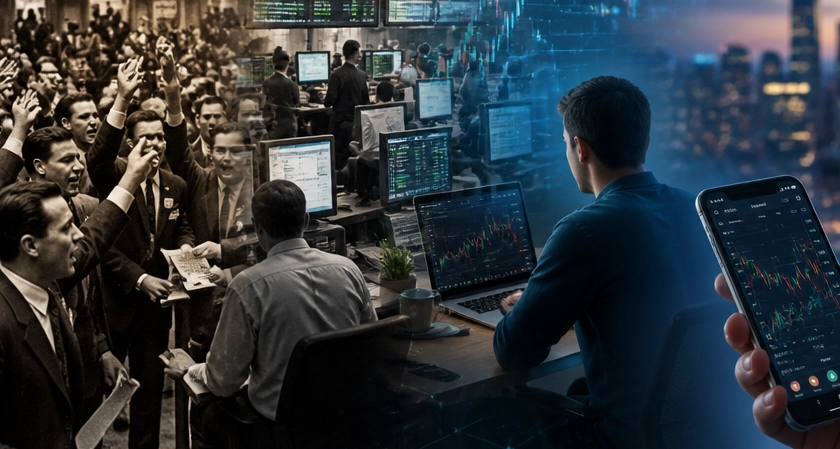
The transformation of financial markets has changed far more than how securities are bought and sold. It has redefined who can participate, how investment decisions are made, and what it takes to compete in an increasingly technology-driven financial system.
The Era of Trading Floors: When Markets Had a Human Voice
For much of modern financial history, the world's financial markets operated through a remarkable combination of human judgment, personal relationships, and organized chaos. Trading floors were crowded arenas where brokers shouted orders, signaled prices with their hands, and negotiated transactions in real time. The New York Stock Exchange became the most recognizable symbol of this system, with its bustling floor representing the heartbeat of American capitalism. Every transaction depended on a network of intermediaries responsible for connecting buyers with sellers, establishing prices, and maintaining orderly trading conditions. Although the process appeared chaotic to outsiders, it functioned through established rules, specialized knowledge, and relationships developed over years of market participation. The physical exchange was more than a location where securities changed hands; it was an institution that determined how financial information circulated and how investment opportunities were accessed.
Participation in these traditional markets was heavily influenced by geography, professional connections, and financial resources. Institutional investors, established brokerage firms, and wealthy individuals generally enjoyed advantages that ordinary investors could rarely replicate. Accessing market information often required direct communication with brokers, while executing transactions involved procedures that could be time-consuming and expensive. Price quotations traveled through telephone networks, ticker machines, and financial news services, creating significant differences in the speed at which participants received information. Professional traders relied on their proximity to exchanges and their relationships with market makers to interpret changing market conditions. This environment reinforced a financial hierarchy in which access to information and execution capabilities could be nearly as important as investment expertise.
Yet the trading-floor era also possessed qualities that modern electronic systems have struggled to reproduce. Experienced brokers could assess market sentiment through conversations, trading activity, and the behavior of other participants. Human intermediaries sometimes helped facilitate transactions during periods when liquidity was scarce or market conditions became unusually volatile. Personal relationships encouraged negotiation and allowed complex orders to be handled with a degree of flexibility that standardized electronic systems did not initially provide. Nevertheless, expanding transaction volumes and growing international investment activity increasingly exposed the limitations of manual trading processes. Financial markets needed infrastructure capable of processing larger amounts of information and executing transactions more efficiently, setting the stage for a technological transformation that would fundamentally change the industry's operating model.
The Electronic Revolution: How Technology Rebuilt Market Infrastructure
The introduction of electronic trading systems marked a decisive shift in the organization of global financial markets. Rather than depending entirely on physical trading floors, exchanges began incorporating computer networks capable of transmitting orders, displaying quotations, and matching buyers with sellers. Nasdaq, launched in 1971 as an electronic quotation system, helped demonstrate the potential of computerized market infrastructure. Over subsequent decades, advancing telecommunications technology and increasingly sophisticated software enabled exchanges to automate a growing share of their activities. Trading gradually became less dependent on the physical presence of brokers and more dependent on the efficiency of electronic networks. What began as an effort to improve market operations eventually developed into a fundamental restructuring of how financial transactions were conducted.
The economic consequences extended well beyond technological convenience. Electronic order processing reduced many administrative burdens associated with manual trading while supporting greater transaction volumes and more efficient price discovery. Competition among exchanges, electronic communication networks, and alternative trading venues created additional opportunities for investors to access liquidity. In the United States, the transition to decimal pricing in 2001 also helped narrow quoted bid-ask spreads, reducing certain transaction costs for investors. Financial institutions increasingly redirected investment toward software engineering, data infrastructure, cybersecurity, and network connectivity. The competitive advantage that once came from occupying a favorable position on a trading floor began shifting toward the ability to process information and execute orders accurately, reliably, and quickly.
This transformation also changed the relationship between market participants and the institutions serving them. Brokers were no longer simply intermediaries responsible for communicating instructions to an exchange; they increasingly became technology providers offering electronic platforms, research tools, and sophisticated order-routing capabilities. Institutional investors adopted automated execution strategies designed to manage large transactions while limiting their impact on market prices. Exchanges evolved into complex technology businesses whose reliability depended on data centers, resilient communications networks, and advanced operational controls. The transition was not uniform, and some markets continued incorporating human specialists alongside electronic systems. Nevertheless, the broader direction was unmistakable: financial participation was moving away from physical concentration toward digitally interconnected markets operating across geographic boundaries.
The Democratization of Trading: A New Generation Enters the Market
The expansion of internet connectivity brought another major change to financial markets by allowing individuals to interact with investment platforms without visiting a brokerage office. Online trading services gave retail investors greater control over order placement, portfolio monitoring, and access to market information. As broadband connections, cloud computing, and smartphone technology developed, trading platforms became increasingly accessible and sophisticated. Features once primarily associated with professional trading environments, including advanced charting, technical indicators, and real-time quotations, became available to a much broader audience. Lower trading commissions and simplified digital account-opening procedures further reduced traditional barriers to participation. The result was an investment landscape in which individuals could engage with financial markets more directly than previous generations had considered possible.
This expansion of access also encouraged brokerage providers to reconsider what investors expected from financial services. Competitive pricing remained important, but technology alone was no longer sufficient to differentiate every platform in an increasingly crowded market. Execution quality, transparent trading conditions, dependable infrastructure, and responsive client service became important considerations, particularly for sophisticated participants managing demanding strategies. This evolving relationship between technology and personalized financial service is reflected in providers such as Vellouris, which positions its offering around institutional-grade trading infrastructure, straight-through processing execution, and dedicated support for professional and institutional clients. Its approach illustrates a broader industry effort to combine electronic market access with services tailored to more specialized trading requirements. Even as markets become increasingly automated, the ability to deliver reliable infrastructure alongside meaningful client relationships remains relevant to how some investors evaluate financial intermediaries.
However, the expansion of market participation has also introduced challenges that extend beyond access and affordability. The availability of sophisticated trading tools does not automatically provide the experience or discipline needed to use them effectively. Retail investors now encounter an enormous volume of financial commentary, social-media predictions, and algorithmically generated market signals that can complicate investment decisions. The ease of executing transactions may encourage excessive trading, particularly when platforms emphasize speed and convenience over long-term investment considerations. Products involving leverage, derivatives, or complex pricing structures can expose inexperienced participants to losses that exceed their expectations. Consequently, the democratization of trading has created a new responsibility for both investors and financial service providers: ensuring that greater accessibility is accompanied by stronger financial understanding, appropriate risk management, and informed decision-making.
The Algorithmic Age: When Speed Became a Competitive Currency
As electronic trading infrastructure matured, financial institutions began using algorithms to automate decisions that had previously required continuous human intervention. These systems analyze predefined conditions, respond to market signals, and execute transactions according to programmed instructions. Algorithmic trading can serve numerous objectives, from dividing large institutional orders into smaller transactions to managing portfolio exposures across multiple markets. Its development has allowed market participants to process information and react to price changes at speeds beyond ordinary human capabilities. High-frequency trading emerged as a particularly technology-intensive segment, relying on sophisticated models, specialized connectivity, and low-latency infrastructure to pursue opportunities measured in milliseconds or microseconds. The modern trading environment increasingly reflects competition among systems designed to interpret and respond to market information with exceptional precision.
Speed, however, is only one dimension of the algorithmic transformation. Automated strategies can improve consistency by following defined execution rules without the emotional reactions that sometimes influence discretionary trading. Institutional investors use algorithmic tools to manage execution costs, monitor liquidity, rebalance portfolios, and reduce operational workloads. Market-making firms employ electronic systems to update quotations and manage inventory across multiple venues. Data analysis has also become more sophisticated, allowing firms to incorporate market microstructure, economic indicators, and historical trading patterns into their models. These capabilities have broadened the practical applications of automation and made quantitative expertise increasingly important throughout the financial industry. Rather than eliminating human judgment, algorithmic technology has shifted much of that judgment toward strategy design, system supervision, and the interpretation of complex market behavior.
The growing dependence on automation nevertheless raises questions about financial stability and operational resilience. Algorithms interacting with one another can sometimes amplify price movements, particularly when liquidity deteriorates or unexpected information reaches the market. Programming errors, inadequate controls, and infrastructure failures may spread consequences across interconnected trading systems. Events such as the May 2010 Flash Crash demonstrated how rapidly market conditions can deteriorate within highly automated environments. Regulators and trading venues have responded over time with measures including volatility interruptions, market-wide circuit breakers, and stronger expectations for trading-system controls. Financial institutions must also invest in continuous testing, monitoring, and cybersecurity to protect systems responsible for executing transactions at enormous speed. The challenge for modern markets is therefore not simply to become faster, but to ensure that technological efficiency develops alongside safeguards capable of preserving market integrity.
The Mobile Trading Economy: Wall Street Moves Into Everyday Life
The smartphone has transformed financial-market participation from an activity associated with dedicated trading terminals into something that can occur almost anywhere. Investors can monitor portfolios during their commute, review economic announcements from home, and place orders through applications designed for immediate access. Mobile platforms increasingly combine market data, interactive charts, educational materials, and account management within a single interface. This integration has reduced the practical distance between individuals and financial markets while making investment activity more compatible with everyday routines. Notifications about earnings announcements, price movements, and economic developments can reach investors within moments of their release. The traditional image of a trader surrounded by multiple monitors has consequently been joined by millions of individuals interacting with financial markets through compact digital screens.
The rise of mobile investing has also changed how financial information influences collective behavior. Social platforms, investment forums, and online communities allow market narratives to develop and spread with remarkable speed. Individual investors can exchange research, challenge established assumptions, and coordinate attention around securities that previously attracted limited public interest. The meme-stock phenomenon of 2021 illustrated how online communities could contribute to extraordinary trading activity and heightened volatility in heavily discussed companies. At the same time, the intersection of financial information and social engagement has complicated the distinction between informed analysis, entertainment, and speculation. Investors increasingly encounter market opinions alongside unrelated digital content, creating an environment in which investment decisions can be shaped by attention, emotion, and rapidly changing online sentiment.
This new trading culture has prompted questions about the responsibilities of platforms that make financial activity increasingly convenient and engaging. Features such as instant notifications, simplified order placement, and visually prominent performance indicators may improve usability while also influencing investor behavior. A design optimized for frequent engagement does not necessarily promote thoughtful investment decisions or appropriate portfolio diversification. Regulators and consumer advocates have therefore scrutinized digital engagement practices and the potential conflicts that can arise when trading activity supports a platform's business model. For investors, understanding the behavioral consequences of constant market access is becoming as important as understanding the technical features of an application. The long-term success of mobile investing will depend partly on whether digital platforms can balance accessibility and innovation with responsible participation and clear communication about financial risk.
Global Connectivity: Markets Without Traditional Boundaries
Digital infrastructure has weakened many of the geographic constraints that historically defined financial-market participation. Investors can now follow developments across major financial centers through interconnected platforms that distribute information and facilitate access to different asset classes. Economic announcements in Asia can influence European trading sessions before affecting sentiment in North America, creating a continuous cycle of information and market responses. Electronic foreign-exchange markets, internationally traded derivatives, and cross-border investment products have contributed to this increasingly interconnected environment. Institutions manage exposures across currencies, regions, and asset classes using systems capable of aggregating information from multiple venues. Although regulation, market hours, and product availability continue to impose important boundaries, technology has made global financial activity more closely connected than at any previous point in market history.
For professional investors, this international integration creates opportunities that require increasingly sophisticated risk management. Global diversification may reduce dependence on a single domestic economy, but interconnected markets can also transmit financial shocks across regions. Currency fluctuations, geopolitical tensions, central-bank decisions, and differences in market liquidity can complicate cross-border investment strategies. Institutional participants therefore rely on advanced portfolio analytics, exposure monitoring, and execution systems to manage positions across different jurisdictions. Access to more markets does not eliminate risk; instead, it introduces additional variables that investors must understand and evaluate. The ability to distinguish genuine diversification from hidden correlations has become an increasingly valuable skill in a financial environment where distant events can influence domestic investment performance.
The globalization of electronic trading has also intensified competition among financial service providers and market infrastructure operators. Investors increasingly compare platforms based on execution quality, product availability, operational reliability, and the transparency of trading conditions. Regulators must address concerns involving investor protection, cybersecurity, market abuse, and the cross-border distribution of financial services. Differences in licensing requirements and legal protections make it essential for participants to understand which entities provide their services and which regulatory frameworks apply. Meanwhile, exchanges and financial technology companies continue investing in connectivity that allows institutions to transmit and manage orders across international markets. The emerging financial system is therefore neither entirely borderless nor confined by traditional national boundaries. It is a networked structure in which technological connectivity expands opportunity while regulatory and economic differences continue to shape the conditions of participation.
The Next Frontier: Artificial Intelligence and the Future of Market Participation
The next stage of market evolution is increasingly associated with artificial intelligence, advanced analytics, and the automation of complex financial workflows. Machine-learning systems can identify statistical relationships across large datasets, assist with market surveillance, and support investment research by organizing information that would otherwise require extensive manual analysis. Generative AI introduces additional possibilities, including the interpretation of financial documents, the preparation of research summaries, and more conversational interactions with investment platforms. Financial institutions are exploring how these capabilities might improve productivity, refine risk monitoring, and make sophisticated analytical tools more accessible. Yet the distinction between useful automation and dependable investment judgment remains significant, particularly when models encounter unfamiliar market conditions. AI may expand the range of information that investors can process, but its practical value will depend on data quality, transparency, effective oversight, and the ability to recognize uncertainty.
The future of financial participation is also likely to be shaped by developments in digital settlement infrastructure, asset tokenization, and the modernization of securities processing. Tokenization seeks to represent ownership or financial claims through digital records, potentially supporting new approaches to asset administration, transfer, and settlement. Financial institutions and market infrastructure providers are examining whether distributed-ledger technologies can improve coordination among participants and reduce certain operational inefficiencies. These possibilities remain subject to important questions involving legal ownership, interoperability, cybersecurity, liquidity, and regulatory oversight. Innovation in settlement processes may ultimately prove as consequential as advances in trading interfaces because the efficiency of a market depends on more than the speed of order execution. The most durable technological developments will likely be those that solve practical financial problems while maintaining the trust and reliability required of critical market infrastructure.
Ultimately, the evolution from trading floors to digital screens represents a continuing redistribution of access, information, and competitive advantage. The earliest exchanges concentrated activity among individuals who possessed physical access, professional relationships, and the resources necessary to participate. Electronic systems expanded market connectivity, online brokerages widened public access, and algorithmic technologies transformed how financial decisions are implemented. Artificial intelligence and emerging digital infrastructure may further reshape these relationships, but they will not remove the fundamental realities of investing: uncertainty, competition, liquidity constraints, and the possibility of financial loss. Successful market participants will need to combine technological proficiency with disciplined analysis, sound risk management, and a clear understanding of the systems through which they trade. The defining feature of tomorrow's financial markets may not be how quickly transactions occur or how many people can access them, but how effectively technology enables informed decisions within a system that remains transparent, resilient, and worthy of investor confidence.
Frequently Asked Questions (FAQ)
1. How Has Technology Changed Participation in Financial Markets?
Technology has transformed financial markets by replacing many traditional, floor-based trading processes with electronic platforms that provide faster execution and broader access to market information. Online brokerages, mobile applications, and automated trading systems have made participation more accessible to individual investors and institutions alike. These developments have also increased competition among financial service providers, encouraging improvements in pricing, transparency, and trading infrastructure.
2. What Is the Difference Between Traditional Trading and Electronic Trading?
Traditional trading relied heavily on physical exchanges, human brokers, and direct negotiation between market participants. Electronic trading uses computerized networks to transmit, match, and execute orders, often with substantially less manual intervention. While traditional systems emphasized personal relationships and physical market access, electronic markets prioritize connectivity, execution efficiency, scalability, and real-time information.
3. Why Has Retail Trading Become More Popular?
Retail trading has expanded because digital platforms have reduced several historical barriers to market participation, including high transaction costs, limited access to financial information, and complicated account-opening procedures. Smartphones and online investment tools allow individuals to monitor markets and manage portfolios more conveniently. However, increased accessibility also highlights the importance of financial education, disciplined decision-making, and effective risk management.
4. What Role Does Algorithmic Trading Play in Modern Markets?
Algorithmic trading uses computer programs to execute transactions according to predefined rules, market conditions, and quantitative strategies. Financial institutions employ these systems to manage large orders, improve execution consistency, and respond efficiently to changing liquidity conditions. Although algorithmic trading can enhance operational efficiency, it also introduces technological risks that require comprehensive monitoring, testing, and safeguards.
5. How Will Artificial Intelligence Influence the Future of Trading?
Artificial intelligence is expected to play an increasingly important role in financial research, market analysis, risk assessment, and operational automation. AI-powered systems can process large datasets, identify patterns, and help investors interpret complex financial information. Nevertheless, successful implementation requires reliable data, appropriate human oversight, and careful evaluation of model limitations, particularly during periods of unusual market volatility.
6. What Should Investors Consider When Choosing a Modern Trading Platform?
Investors should evaluate several factors before selecting a trading platform, including regulatory authorization, execution quality, trading costs, platform reliability, and the availability of appropriate risk-management tools. Transparency regarding fees, order execution, and client protections is particularly important. Professional and institutional participants may also prioritize advanced infrastructure, access to multiple markets, and dedicated client support when assessing trading providers.
7. Will Digital Trading Completely Replace Traditional Financial Markets?
Digital technology will likely continue to automate and modernize financial transactions, but the complete disappearance of human involvement is unlikely. Financial markets still depend on professional judgment, regulatory oversight, institutional relationships, and effective risk management. Rather than eliminating the human element, technological progress is redefining its role, allowing market participants to concentrate increasingly on strategy, analysis, and decision-making while automated systems handle more routine operational tasks.











Comments