>>
Industry>>
Healthcare>>
How Wearable Health Technology...How Wearable Health Technology Transforming Personal Healthcare? Discover The Silicon Review’s Take on Wearable Technology in Healthcare
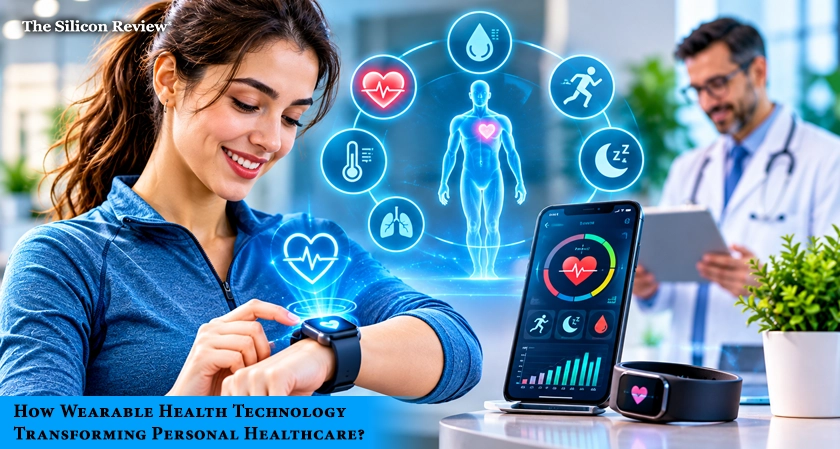
Today 8 out of 10 people will be seen with one wearable health technology based smart health devices either it is smartwatch, smart ring or a fit band. In 2026, when the world is driven by AI, wearable health technology transforming personal healthcare from abrupt speculation into structured, ongoing process of awareness. According to recent clinical research shows a Mayo Clinic trial conducted in July 2026 showed that smartwatches can identify early indication of fatigue and anxiety before clinical symptoms begin to get worse, and a November 2026 American Heart Association study revealed AI-driven wearables can predict risky high blood pressure up to 72 hours early.
How Smart Health Devices Are Transforming Personal Healthcare
Snapshot bias has a long history in traditional medicine, which relies on quick yearly examinations to assess a body that is constantly changing. Sporadic arrhythmias, white-coat hypertension, or progressive metabolic deterioration are readily missed during a fifteen-minute clinic appointment, which records your vital signs in an artificial, frequently stressful setting. By providing continuous basic monitoring for sporadic appointments, wearable health technology removes this blind spot.
Wearable medical devices use months of passive surveillance in order to identify your individual physiological profile rather than comparing your health to general population averages. In 2026, three essential capabilities of smart health devices are transforming the personal healthcare.
1. Heart Rate Variability (HRV)
Smart health devices monitor how well the autonomic nervous system of your body manages stress and recovery by detecting the minuscule pauses between heartbeats. Long before sudden signs appear, a persistent decline in average HRV frequently indicates chronic inflammation, overtraining, or cardiovascular pressure.
2. Sleep Staging & Recovery
Modern wearable medical devices track night time breathing rates, blood oxygen levels, and light, deep, and REM sleep cycles using optical sensors and accelerometers to uncover concealed sleep disorder or insufficient neurological recovery.
3. Early Sickness Alert
Sudden overnight changes, such as a resting heart rate gradually increasing by a few beats per minute or mild increase in body temperature, can set off automatic early sickness signals up to 24 to 48 hours before a fever or infection completely develop.
Wearable technology in healthcare enables patents and physicians to take early action by converting apparent daily changes into meaningful long-term developments, changing healthcare from random emergency handling to preventive, everyday protection.
Core Features & Sensors Powering Modern Healthcare Wearable Devices
Today wearable health technology is converting biological inputs into real-time diagnostic conclusion by combining artificial intelligence with tiny smart health devices. In 2026 smartwatches, screenless bands, smart rings, and AI-driven predictive software to continually monitor neurological, metabolic, and cardiovascular health instead of depending on single-metric step counters.
1. Multi-Wavelength Optical PPG Sensors
Photoplethysmography (PPG) sensors are placed onto the skin and uses infrared, red, and green light to detect changes in blood volume with each heartbeat.
2. On-Demand & Multi-Lead Electrocardiograms (ECG)
Smart weighing devices and fitness bands all have integrated dry electrodes that record the electrical activity of the heart in 30 seconds. FDA approved software algorithm identify irregular QT intervals, identify sinus rhythms, and identify atrial fibrillation (AFib) without the need for an in-clinic Holter monitoring.
3. Interstitial Fluid Sampling (CGMs)
Over the counter and prescription continuous glucose monitors uses hair-thin, harmless threads under the skin to sample interstitial fluid.
4. Vascular Trend Tracking & Cuffless Blood Pressure
The speed at which artery pressure waves move between heartbeats is measured by wearable medical devices using optical pulse-wave analysis and pulse transit time (PTT). Machine learning algorithms validated against initial data set identify chronic vascular stiffness and initiate early hypertension alarms without the need for an inflatable cuff.
5. Thermal, Electrodermal & Bioelectrical Impedance Sensors
Multi-Electrode Bioelectrical Impedance Analysis (BIA) visualizes body composition, cellular hydration, and peripheral nerve health. Highly accurate skin thermistors monitor night-time temperature shifts for ovulation cycles and early infection alerts, and electrodermal activity (EDA) sensors measure nervous system tension and seizure patterns.
Chronic Disease Management & Remote Patient Monitoring
When it comes to managing chronic sicknesses outside of hospitals, wearable health technology has the greatest clinical impact. Continuous glucose monitoring (CGMs) and automatic insulin administration pumps work together to create closed-loop systems for the treatment of diabetes. These systems modify background insulin every few minutes, preventing deadly hypoglycemia and easily stabilizing blood sugar.
In cardiovascular medicine, wearable ECG patches and smartwatches identify silent, intermittent atrial fibrillation (AFib) early on, enabling doctors to administer anticoagulants prior to a stroke.
Normalized data protocols automatically send consolidated biometric patterns and anomaly alerts into hospital platforms such as EPIC by telehealth and Electronic Health Record (EHR) syncing. Doctors monitor high-risk patients online, make preventative medication adjustments, and avoid expensive emergency readmissions rather than going over handwritten logs during rushed hours.
The Role of AI & Predictive Health
If we take out artificial intelligence from smart health devices constant wearable tracking would overload patients and physicians with millions of unfiltered data points. As an intelligent filter, AI distinguishes between real clinical warning signs and usual daily variations, such as a brief rise in heart rate following an uphill exercise.
AI models examine weeks of your sleep, heart rate variability, skin temperature, and activity to create a customized physiological baseline instead of depending on general population expectations. By identifying subtle, multi-model trends across multiple data streams, predictive AI models can anticipate disease, cardiovascular strain, or metabolic fatigue days before physical symptoms occurs.
AI transforms passive consumer telemetry into early, preventive medical intervention by condensing months’ worth of unprocessed sensor recordings into brief, helpful overviews for doctors.
FDA-Cleared Wearables vs. Consumer Fitness Trackers
Making safe healthcare decisions requires an understanding of the regulatory distinction between general wellness devices and medical-grade devices. The FDA’s general wellness policy applies to basic fitness trackers, which do not undergo clinical accuracy testing and estimates steps, calories burned, and overall sleep cycles.
On the other hand, unique medical features supported by clinical studies are particularly reviewed and approved by the U.S. Food and Drug Administration (FDA). Strict diagnostic safety requirements are met by devices included in the FDA Sensor-Based Digital Health Technology databases, such as the Dexcom G7 for continuous glucose monitoring, the Apple Watch ECG for atrial fibrillation detection, and the Withings ScanWatch 2 for medical pulmonary oximetry.
Before using a wearable’s readings to directly for medications or clinical treatment, make sure the particular wearable health technology is verified and approved by FDA.
Key Challenges & The Road to 2027
Wearable health technology confronts significant obstacles despite its quick clinical adoption. Data privacy is still a big problem because healthcare applications sometimes violate tight HIPAA regulations, making sensitive biometric records vulnerable to disclosure by other parties. Before relying on automated alarms, clinical validation is crucial because sensor accuracy differs depending on the skin tones, movement levels, and device tiers. Orthosomnia, developing types of data anxiety in which users concentrate over sleep and recovery scores rather than paying attention to their own bodies has also been triggered by constant biometric visibility.
By 2027, next-generation innovations hope to address these issues and broaden the scope of diagnosis:
· Non-Invasive Metabolic Sensing
Optical spectroscopy and painless intradermal patches are being developed by tech companies and MedTech startups to monitor patterns of lactate, glucose, and ketones without the need for needles.
· Smart Textiles & Ambient Form Factors
Invisible, passive health monitoring is taking the place of large wristwatches thanks to washable biometric apparel, neural-sensing headphones, and smart contact lenses.
Wearable technology will continue to change personal healthcare from reactive crisis care to simple, daily preventive practice as hardware gets more precise and smoothly incorporated into professional workflows.
FAQs:
Q: What is wearable health technology?
A: Smart electronic devices that are worn on the body to continually monitor vital signs, sleep patterns, and biometric trends in real time are referred to as wearable health technology. Examples of these devices include smartwatches, rings, and biosensor patches.
Q: How is wearable health technology transforming personal healthcare?
A: By identifying early disease signals, arrhythmias, and metabolic abnormalities before symptoms worsen, it moves medicine from reactive, infrequent medical visits to proactive daily prevention.
Q: Are smartwatches accurate enough for medical diagnosis?
A: Smartwatches' FDA-approved functions accurately screen for irregular heart rhythms like atrial fibrillation and indicate aberrant vital trends for clinical assessment, but they cannot take the place of a certified medical diagnosis.
Q: Which wearable health devices are FDA-cleared in 2026?
A: Notable wearables with FDA clearance include the Withings ScanWatch 2 for medical pulse oximetry, the Apple Watch for ECG and sleep apnea alerts, and the Dexcom G7 for continuous glucose monitoring.
Q: How does AI improve wearable health devices?
A: Wearables can predict disease, cardiovascular strain, or burnout days ahead of time by using machine learning to filter out benign everyday sensor changes and create your unique physiological baseline.
Q: What is the future of wearable health technology in 2027?
A: By 2027, wearable technology will have advanced to include neural-sensing wearables that passively monitor cognitive fatigue, washable biometric smart fabrics, and needle-free metabolic sensors.













Comments