>>
Industry>>
Construction>>
Exposed Steel, Hidden Risk: Ho...Exposed Steel, Hidden Risk: How Intumescent Coatings Keep Modern Buildings Standing
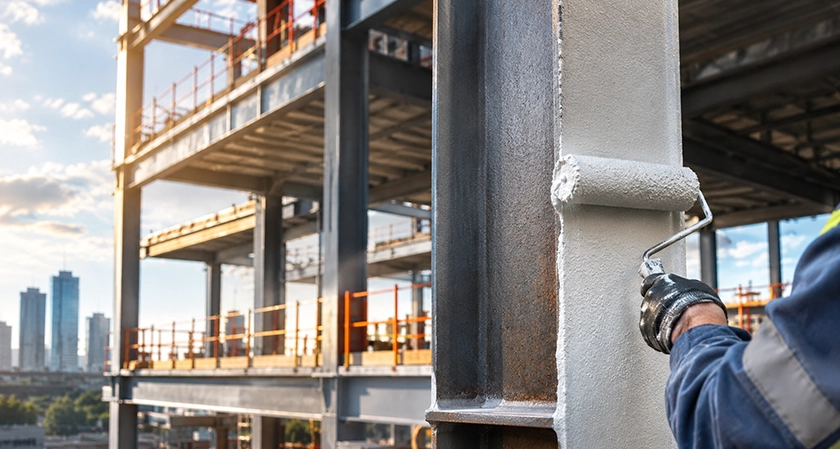
Open a set of drawings for any atrium, airport terminal, or warehouse renovation from the last decade and you will notice something missing. The steel is out in the open. No dropped ceiling, no bulky cladding, no boxed-in columns. That look costs money to pull off, and not for the reason most people assume.
The hard part is not the finish. It is the fire rating. Bare steel softens as it heats, and a building code reviewer will ask you how long that column holds its shape when a fire starts in the lobby below. Bulky cementitious spray answers that question, but it buries the frame in gray fuzz. Thin-film intumescent coatings answer it a different way, and they are the reason so many contemporary buildings get to keep their structure visible.
Here is how they behave, where they fall short, and what you need to line up before you put one in a specification.
What happens to a steel beam in a fire?
Steel does not burn. It conducts. That distinction matters because heat moves through a beam or column fast, and structural capacity drops as temperature climbs. Long before anything visibly deforms, the member has already lost the strength it was designed to carry.
This is the whole reason fire protection exists on structural frames, and the reason the margin is tighter than most design teams expect. According to the National Institute of Standards and Technology, the collapse investigation of the World Trade Center towers showed how sustained fire exposure combined with structural damage pushed a steel frame past its limits. You do not need to relive that report to understand the design lesson: the protection buys time, and time is measured against how fast occupants can get out and how fast a fire crew can get in.
So the real question is not whether steel needs protection. It is how much, applied to which members, in what thickness, to reach a specific hourly rating.
How intumescent coatings actually work
A thin-film coating goes on like paint, often at less than a millimeter thick. Under normal conditions it is inert. It sits there, bonds to the primed steel, and takes a topcoat if the architect wants a color.
When heat hits it, the chemistry changes. The film chars and swells into a thick, insulating layer of carbon, many times its original depth. That swollen char is what slows heat transfer into the steel beneath. The building does not look different after a fire, because the expanded layer is a one-time reaction, not a maintenance feature. Once it activates, it has done its job.
My honest read after watching specs get written and rewritten: most projects should start with thin-film and move to bulky spray only after the numbers rule it out. Start the other way and you have already given up the exposed look the client paid for.
Where the material works and where it fights you
Intumescent systems shine on steel that people will see. Columns in an atrium, beams in an open office floor plate, trusses in a transit hall, and the frame of a parking structure that needs to stay light. Architects keep the member visible, the finish can be tinted, and the ceiling stays high.
They get harder to justify in a few spot situations. Very high section factors, which is a fancy way of saying slender members with a lot of surface area relative to mass, can push required thickness up until the cost curve bends. Aggressive interior environments, like certain chemical processing spaces, may call for a different protective scheme. And exterior exposed steel needs a system rated for the conditions it will actually face, which fewer products carry.
The right move: pull the fire rating from the building code first, then check the section factor, then talk to a coating manufacturer's technical team before the spec is final. That conversation is free and saves a redesign later.
The steps that keep a fire protection spec clean
-
Get the hourly rating in writing. Confirm with the authority having jurisdiction what each structural element needs, member by member. Ratings sometimes differ between a column in a rated corridor and a beam in an open atrium.
-
Lock in the steel schedule early. Section factors depend on member shapes and sizes. Change the frame and your coating thickness changes with it.
-
Check the listing. A coating is only a code answer if it is tested and listed for that assembly. Ask for the listing document, not a summary sheet.
-
Agree who applies it. Intumescent coating is generally applied by a trained applicator to a specified dry film thickness, and that thickness gets verified on site. Write the verification step into the schedule.
-
Protect the finish during construction. Scaffolding, welding sparks, and careless material handling all nick coatings. Build a touch-up clause into the contract.
One more piece of context that surprises people new to the trade: Occupational Safety and Health Administration guidance on construction site fire prevention keeps coming back to control of ignition sources and housekeeping. Your coating is a defensive measure. It does not replace the boring stuff that keeps a site from catching fire during the build itself.
What a documented system buys you
Fire protection is one of the few building components nobody sees, until the day it matters and everyone sees it. That asymmetry is why paperwork carries so much weight here.
The strongest programs lean on third-party listing and follow-up inspection. Underwriters Laboratories, for example, operates product certification and follow-up service programs, and the UL certification mark on a coating is your evidence that the product was tested to a recognized standard and that production gets checked afterward. When a building official asks why your exposed column is compliant, the answer is a listed assembly, a specified thickness, a documented install, and a record that it was verified.
Here is the opinion you did not ask for. A specification without an inspection step is a wish. I would rather see a slightly heavier coating schedule with a verified dry film thickness record than a thinner, cheaper one nobody bothers to check.
The trade you are actually making
Every fire protection choice on exposed steel trades something. Bulky cementitious spray trades aesthetics for forgiving installation and low material cost. Board protection trades complexity of detailing for predictability. Thin-film intumescent trades some material cost and applicator skill for the exposed structure, the height, and the design intent.
A quick framing table, drawn from how these systems get discussed on real projects:
|
Factor |
Thin-film intumescent |
Bulky spray
|
|
Visible steel |
Keeps it exposed |
Covers it in bulk |
|
Ceiling height |
Preserved |
Reduced |
|
Installation skill |
Higher, thickness sensitive |
More forgiving |
|
Best fit |
Architectural and public-facing frames |
Concealed structures |
If I had to pick a default for any building where a person will ever look up and admire the frame, I would go with the thin-film route every time and budget for the applicator training and the inspection. The alternative is a beautiful building wrapped in gray.
Where to start on your next project
The short version: exposed steel is a design decision, and fire protection is the constraint that determines whether you get to keep it. Get the rating first, match the product to the member sizes and environment, confirm the listing, and write the application and inspection requirements into the spec before anyone bids. Do those four things and the clash between aesthetics and code mostly disappears.
One question to take to your next design meeting: when the building official asks how that exposed column holds its rating, what document will you hand over? If you cannot name it yet, that is the first thing to sort out.













Comments