>>
Industry>>
Lifestyle and fashion>>
Who Makes the Best Rolex Super...Who Makes the Best Rolex Super Clone? A Factory-by-Factory Look in 2026
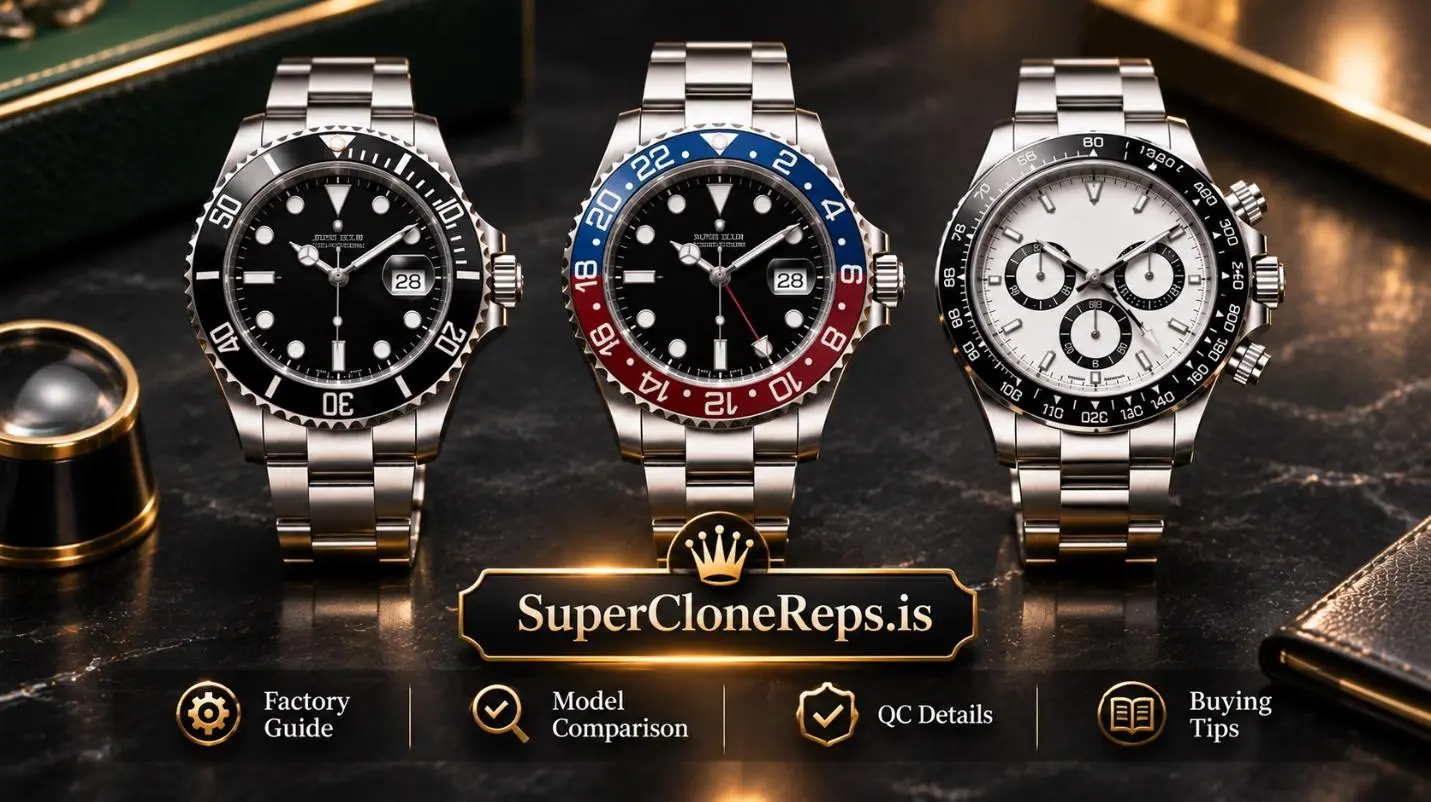
Ask five people who follow the Rolex replica market which factory makes the best super clone, and you may get five different answers. One will recommend VSF immediately. Another will point to the exterior finishing on certain Clean Factory watches. Someone focused on the Daytona will mention BTF, while a buyer looking at gold Day-Date models may be considering a completely different manufacturer.
Readers comparing specific Rolex references can explore the Rolex super clone collections at SuperCloneReps.is to see how Submariner, GMT-Master II, Daytona, Datejust, and Day-Date configurations are presented. These are seller-provided listings rather than independently verified factory comparisons.
They may all be talking about different strengths.
A factory that produces a convincing Submariner isn't automatically the strongest choice for a Daytona. The Submariner needs a relatively straightforward three-hand movement, depending on the reference, plus careful work on the case and bezel. The Daytona adds chronograph mechanics, pushers, subdials, and a more complicated movement.
Even inside one factory's catalog, a heavily discussed reference may receive more development than a less popular model. That difference gets lost when every watch is reduced to a factory name.
So the useful question isn't simply who makes the best Rolex super clone. Start with the model, then look at the factory's record for that reference, the stated movement, and the actual details visible in the watch being offered. The factory landscape changes faster than many buying guides suggest.
Why One Factory Can't Win Every Rolex Category
The idea of a single factory dominating every Rolex model is convenient. You remember one name, and a seller gets one label to promote. The market itself is less tidy.
Manufacturers develop uneven strengths. One becomes known for case geometry and bracelet finishing. Another attracts attention for movement configurations, dial printing, or a particular complication. Those advantages don't automatically travel through the entire catalog.
A manufacturer may invest heavily in a Submariner 126610LN because demand is strong and enthusiasts compare the design constantly. Less popular references from the same source may receive fewer updates or use different component suppliers. A factory name is only a starting point.
It doesn't identify the production version in front of you. It doesn't tell you which movement is installed, whether the exterior components match an earlier batch, or how the individual watch performs. Those details belong to the specific product, not the label alone.
Factory reputations still have a use. They help you decide where to look first. Treating them as permanent rankings is where the trouble starts. The better question is which manufacturer has the strongest documented version of the exact Rolex reference you want.
VSF Earned Its Reputation on the Submariner
VS Factory, usually called VSF, is one of the most recognizable names in discussions about Rolex super clones. Much of that reputation comes from Submariner-style watches, especially modern black Submariner Date versions.
The 126610LN is a useful case study because its design appears simple: a dark dial, rotating bezel, steel case, three central hands, and a date window. Simplicity removes distractions. If the proportions or alignment are off, the eye has fewer decorative details to ignore.
The case shoulders need the right shape. The bezel has to sit properly against the middle case. Dial markers need consistent placement, and the bracelet should flow naturally from the lugs instead of looking attached as an afterthought. These are small relationships, but they control the watch's overall impression.
VSF has drawn attention for its handling of those details and for movement configurations marketed under designations such as VS3235. A designation alone still needs to be treated carefully. Not every VSF Submariner is identical, and every advertised movement specification has not been independently established.
Production labels can cover different versions. Movement names in this market are not always applied consistently, either. A familiar number may refer to a movement family, a claimed construction style, or a supplier's version rather than a standardized specification.
Even with those limits, VSF remains a major reference point for modern Submariner comparisons. If you're weighing another factory's 126610LN, VSF will often appear in the comparison because buyers already use it as a benchmark.
That reputation reaches beyond the Submariner, but it shouldn't be transferred automatically to every Rolex design carrying the VSF name. A factory can be especially strong in one category and merely ordinary in another.
Clean Factory Has a Strong Past and a Less Clear Present
Clean Factory became widely discussed for Rolex sports watches, especially GMT-Master II, Submariner, and Datejust configurations. Its historical appeal was closely tied to exterior work.
Enthusiast comparisons frequently focused on bezel appearance, dial finishing, bracelet construction, and the way the case met the surrounding components. The GMT-Master II shows why those details receive so much attention.
Its two-color ceramic-style bezel immediately dominates the watch's appearance. Small shifts in color, transitions, or surface texture can change the impression even if the case itself looks convincing. Clean-branded GMT models developed a following partly because buyers were watching those exterior features closely.
Discussing Clean Factory in 2026 requires a little more care. Reports about the original operation's status have circulated, and newer listings using the Clean name may not all come from the same production source. Some market guides describe remaining inventory or successor labels. Others continue comparing Clean as though its supply had never changed.
Those claims are not consistently documented. A watch advertised as Clean should therefore be treated as a particular product with an identifiable configuration, not automatic proof that it came from the production operation associated with the name several years ago.
Historical reputation gives you useful background. It cannot establish the origin or quality of every newly listed watch. You still need to examine the reference, version, movement, and visible workmanship in the individual listing.
The Daytona Changes the Factory Argument
The Rolex Cosmograph Daytona creates a different problem for manufacturers of super clone watches. The Submariner has difficult details, but the Daytona adds a mechanical complication that changes the entire project.
A working chronograph requires more than three subdials placed on a dial. The timing mechanism has to start, stop, and reset correctly. The pushers have to operate the mechanism, and the movement architecture has to support the intended functions.
Case thickness becomes harder to control too. A manufacturer can produce an attractive dial and bezel, then put them in a case that looks noticeably too thick from the side. The reverse can happen: the proportions look good, while the chronograph operation feels less convincing.
BTF is one of the names historically associated with Daytona-style replicas, especially versions based on the 116500LN. VSF and QF also appear in comparisons of particular Daytona references and movement configurations. The ranking changes depending on whether you're discussing the older 4130-generation design or the newer 4131-generation Daytona.
Don't skip that distinction. A watch described only as a Daytona super clone leaves several basic questions open. Which reference is it? Which movement is installed? How is the case constructed? Do the chronograph functions work as intended? How closely does the dial follow the reference?
A factory's strong position for one Daytona generation does not establish its position for the next. The name may remain familiar while the movement, case, or supplier changes.
4130 and 4131 Are More Than Familiar Numbers
Movement design is one reason Daytona comparisons become difficult. The genuine Rolex Daytona 116500LN used caliber 4130, while the newer 126500LN introduced caliber 4131. They belong to related but distinct generations.
Replica listings often borrow those caliber numbers. A watch may be described as having a 4130-style or 4131-style movement, suggesting that its architecture or functionality is intended to resemble the genuine design. The description itself doesn't establish equivalence.
Two movements with similar names may differ in construction, finishing, replacement-part compatibility, or reliability. One may reproduce the general functional arrangement more closely than another. A number printed in a listing gives you something to compare, but it doesn't settle the mechanical question.
Look at how the watch is meant to operate. Do the chronograph counters perform their stated functions? Does the reset return the hands consistently? How does the movement affect the thickness of the case? Those questions tell you more than assuming a familiar caliber number guarantees a particular level of engineering.
The most convincing exterior may not contain the most ambitious movement. A technically interesting movement may sit behind a dial or case with weaker proportions. That tension is a major reason buyers disagree about who makes the best Daytona super clone.
GMT-Master II Comparisons Turn on Color, Bracelet, and Function
The GMT-Master II brings its own set of problems. A Submariner-inspired watch is judged heavily on case proportions, bezel details, and dial execution. The GMT-Master II adds a second time-zone display and, in many references, a distinctive two-color bezel.
Pepsi, Batman, Sprite, and other configurations are recognizable because of their color combinations. Reproducing those colors consistently is difficult. A red-and-blue bezel may look persuasive in studio photographs, then shift noticeably in natural daylight. Blue-and-black bezels have their own issues with shade and the boundary between the two colors.
Bracelet choice changes the watch's character as well. The same GMT reference may appear with an Oyster-style or Jubilee-style bracelet, depending on the configuration. A Jubilee bracelet uses smaller links that reflect light differently, giving the design a more intricate appearance than the broader three-link alternative.
The movement adds another point of separation. A GMT-style movement isn't defined merely by the presence of an additional hand. The way the local-hour hand or GMT hand is adjusted affects how the watch functions, and some replicas reproduce the intended arrangement more closely than others.
VSF, Clean-branded products, ARF, and newer factory labels all appear in discussions of GMT-Master II replicas. Their positions vary by reference, production period, and the features being judged.
A convincing Pepsi bezel and a convincing GMT movement are separate achievements. If one watch has the better color transition while another has the more useful adjustment arrangement, the factory label won't resolve the comparison for you.
Datejust Details Make Broad Rankings Weak
The Datejust receives less attention than the Submariner or Daytona in many discussions, yet it presents a demanding visual problem. Consider a Datejust 41 with a fluted bezel and Jubilee bracelet. Nearly every surface catches light.
The bezel creates a repeated pattern of bright and dark planes. The bracelet has a more complicated texture than a conventional three-link sports bracelet. A sunburst dial changes appearance with the angle. All three parts have to work together.
A slightly different fluted bezel profile can change the entire view from above. Bracelet finishing carries unusual weight because so much of the design's character comes from alternating surfaces and the movement of light across them.
Dial colors create another layer of variation. Blue, green, silver, black, and other configurations may not be equally convincing from one factory. A manufacturer might produce a strong black-dial version while offering a less convincing color or texture on another variant.
That makes a statement such as “Factory X makes the best Datejust” less useful than it sounds. The reference size matters too. A Datejust 36 and a Datejust 41 are not simply the same wearing experience at different scales. Their dial proportions, bracelet relationships, and visual balance differ.
VSF and ARF are among the names that appear in Datejust discussions, along with other manufacturers and factory labels. Start the comparison with the exact case size, dial, bezel, and bracelet combination. The broad category comes afterward.
Gold Day-Date Models Create a Different Set of Tradeoffs
The Day-Date is judged by details that are less prominent on a steel Submariner. The President bracelet forms part of the design's identity. Its rounded links, finishing, and connection to the case affect both the look and the physical impression.
Then there is the metal appearance. A yellow-gold-tone watch can look quite different depending on the plating, underlying material, surface treatment, and lighting. Getting a bright gold color is only one part of the problem.
The shade has to work with the dial, bezel, and bracelet. A surface that looks attractive under warm indoor lighting may appear unusually saturated outdoors. Photos taken under one type of light can therefore flatter a finish that feels less convincing in person.
Weight adds another consideration. Genuine precious-metal watches have a different physical presence from steel-based replicas with gold-colored finishes. Some manufacturers have introduced heavier constructions to address that difference.
GMF, QF, and EWE appear in discussions of Day-Date and heavier precious-metal-style watches, although the configurations vary. A heavier case doesn't automatically establish better quality. Added weight may improve the resemblance in your hand, but it says little about movement reliability, case finishing, or long-term durability.
Day-Date comparisons use different priorities from those applied to a steel Submariner. The most expensive or heaviest option isn't automatically the most convincing complete watch.
The Explorer Leaves Nowhere to Hide
Some Rolex designs are difficult to reproduce because they have so few decorative features. The Explorer is a good example.
Its dial is relatively restrained, with large numerals at three, six, and nine o'clock on many familiar references. There is no colorful rotating bezel or chronograph layout to dominate the first impression. Your eye goes straight to the case shape, dial printing, markers, hands, and bracelet.
When those elements are unbalanced, the difference is easy to see. An Explorer-style watch with overly heavy hands or slightly unusual markers can look wrong even if the general dimensions seem close. The bezel contributes too, since it surrounds an otherwise simple display.
The example shows why manufacturing success can't be judged by the number of complications a factory reproduces. A complicated watch can be mechanically demanding. A simple watch can be visually unforgiving.
The manufacturer that performs best in one category may not be the strongest choice for the other. A restrained dial gives small errors more room to stand out.
Movement Labels Need Their Own Inspection
Movement names receive a lot of attention in super clone watch discussions. Terms such as VS3235, VR3235, 3285, 4130, and 4131 appear frequently in product descriptions. They sound exact, which is useful to buyers comparing versions.
The naming conventions are not always independently standardized, though. A familiar designation may describe a movement family, a claimed construction style, or a particular supplier's version. It should not be treated as automatic confirmation of what sits inside an individual watch.
Performance involves more than appearance. Accuracy, power reserve, winding behavior, date operation, serviceability, and consistency over time all belong in the assessment. A movement that looks convincing through a display caseback may perform no better than one with a less ambitious exterior.
An impressive specification also leaves room for an individual defect. The mechanical side should be considered separately from the case and dial. A good case cannot repair a weak movement, and an interesting caliber cannot automatically fix poor proportions.
For that reason, declaring a factory the best solely because it advertises a particular caliber doesn't make much sense. The movement is one component of a complete product.
Photographs Show a Watch, Not an Entire Production Run
Online comparisons naturally favor whatever looks different in a photograph. A slight bezel-color variation may dominate a long discussion. The shape of a crown guard or thickness of a marker may receive more attention than the movement's actual function.
Those observations can still be useful. Photographs introduce obvious limits, however. Lighting changes the appearance of polished and brushed surfaces. Camera angles affect apparent case thickness. Image processing can exaggerate color differences.
A watch photographed under soft studio lighting may appear more refined than one photographed under harsh direct light, even when the actual finishing is similar. Comparisons become easier to interpret when the watches are shown under similar conditions: the same camera angle, similar lighting direction, and roughly the same distance.
That doesn't remove every distortion. It does give you a fairer visual basis for comparison.
There is also the individual sample. A photograph shows one watch, not every example carrying the same factory label. It may reveal excellent work on that particular piece without proving that the manufacturer delivers the same result consistently.
Keep observations tied to the photographed watch. If the bezel looks well aligned, say that about the sample. Don't quietly turn it into a universal claim about the factory.
Factory Rankings Go Stale Quickly
Factory rankings are often presented as permanent. A guide names the best Submariner producer, the best Daytona producer, and the best GMT-Master II producer, then leaves those conclusions untouched for years.
That format can mislead you. Manufacturers introduce revised versions, change components, alter movement suppliers, and sometimes disappear from the market. New labels appear. Older names continue on listings even when the original production source is uncertain.
A comparison based on a watch from several years ago may no longer describe the product currently advertised under the same name. Even a factory that continues operating can change its product between versions.
A revised bezel may improve the appearance. A different movement can alter function or service requirements. A bracelet update may change how the watch feels. None of those changes automatically improves every part of the new version. One area may improve while another becomes a compromise.
Dated comparisons are therefore most useful when they identify the model version being discussed. A timeless ranking hides the very changes that make current comparisons difficult.
Could a Less Famous Factory Produce the Better Version?
Popularity and manufacturing quality are not identical. The most discussed factories benefit from recognition. Buyers know the names, reviewers compare their products, and sellers use those reputations as selling points.
Smaller manufacturers may receive less attention even when they produce an interesting version of a particular model. That doesn't make an unfamiliar factory superior. Limited documentation can make its products harder to evaluate.
The point is narrower: recognition in the replica market is not a quality certification. A less famous manufacturer might produce a convincing dial or a well-proportioned case. It might also show weaker consistency, fewer movement options, or uncertain parts availability.
Consider those possibilities separately. If you're comparing manufacturers, focus on identifiable characteristics rather than allowing popularity to decide the result before you examine the watch.
The strongest product may come from a familiar factory, but that conclusion should follow the comparison. It shouldn't determine the comparison in advance.
Compare the Parts That Define the Reference
Factory comparisons become confusing when every visible difference receives equal weight. A tiny change in dial printing may dominate an online discussion even though the watches differ substantially in movement function or bracelet comfort.
Start with the design in front of you. On a Submariner, examine case proportions, bezel construction, dial alignment, and the behavior of the date mechanism. On a GMT-Master II, shift your attention toward the bezel, bracelet configuration, and GMT-hand adjustment.
A Daytona needs another layer of inspection: chronograph operation, pusher behavior, movement arrangement, and case thickness. For a Day-Date, the day and date displays, bracelet, case finishing, and metal appearance become more prominent. The Explorer puts more pressure on the hands, markers, printing, bezel, and proportions.
Reference-specific listings can show how Submariner, GMT-Master II, Daytona, Datejust, and Day-Date designs are grouped for comparison, but a seller's listing remains seller-provided information. It is not independent verification of factory origin or performance.
The useful comparison asks what each watch actually offers. Letting the factory label settle the argument before looking at the details skips the part that matters most.
Price and Marketing Labels Are Weak Shortcuts
Price is often used as a shortcut for quality. If one factory's Daytona costs noticeably more than another's, it becomes tempting to assume the expensive version must be better.
Price can reflect supply conditions, seller margins, movement choices, availability, and demand. A particular model may become expensive because enthusiasts are discussing it heavily or because supply is limited. Those conditions don't establish better case finishing or more reliable performance by themselves.
Elaborate descriptions create a similar problem. Words such as premium, upgraded, or latest version may sound informative while revealing very little about the actual change.
An upgrade should be described in identifiable terms. Was the movement changed? Was the case revised? Did the manufacturer alter the bezel, bracelet, or dial? If the difference can't be explained, the price premium is difficult to evaluate.
Higher cost may be justified in a particular comparison. It should not serve as the only evidence of superior workmanship.
What the Best Rolex Super Clone Answer Looks Like in 2026
The answer depends on the Rolex model and on what the comparison is trying to establish.
VSF remains a prominent name in Submariner discussions, particularly around modern references and their advertised movement configurations. Clean Factory built a strong historical reputation for exterior details on several Rolex sports models, although the present origin of newly marketed Clean-branded watches requires careful scrutiny.
BTF remains associated with Daytona-style watches, while VSF, QF, and other labels appear in discussions of particular chronograph versions. The GMT-Master II, Datejust, Day-Date, and Explorer each create different manufacturing priorities, and no single factory name resolves all of them.
The defensible conclusion isn't that every manufacturer is equally good. The evidence needs to be specific. A factory may deserve recognition for one reference and production generation without being the strongest choice for every Rolex design.
Look at the exact model, identifiable version, movement configuration, and actual characteristics of the watch being offered. Factory reputations can guide where you begin. They shouldn't replace the comparison.
The Best Rolex Super Clone isn't necessarily produced by the factory with the loudest reputation or the most favorable mentions. It is the version whose complete design and function hold up most convincingly when you examine the watch on its own terms.













Comments