>>
Industry>>
Energy and Utility>>
Smart Solar in 2027: How AI Ba...Smart Solar in 2027: How AI Batteries & Net Metering Wipe Out Monthly Power Bills
Reading Time: 8 minutes
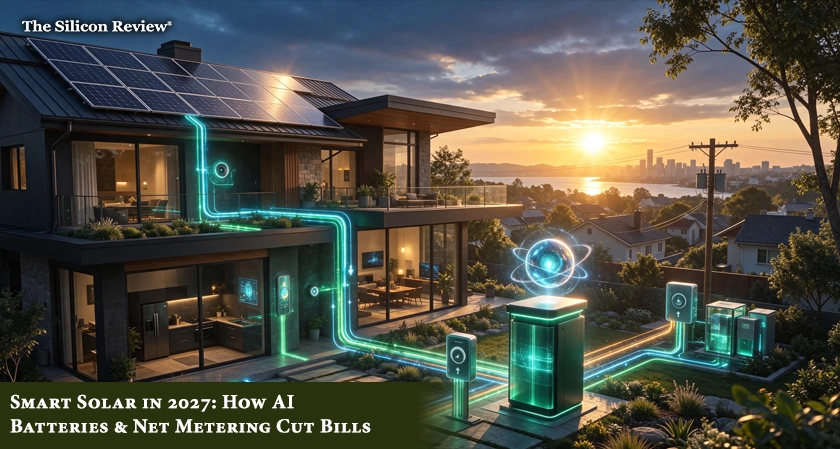
The household in 2027 does not think about electricity bills. It thinks about energy independence. The shift is structural: AI-managed batteries now decide when to store, when to consume, and when to export while net metering rules tighten across major markets, making self-consumption the only path to genuine savings. This is not about panels on a roof anymore. It is about an intelligent energy system that treats every kilowatt-hour as a financial decision. The households wiping out monthly power bills are not the ones with the biggest solar arrays. They are the ones with the smartest batteries.
The 2027 Shift: Net Metering Is Ending, Self-Consumption Is Winning
The economics of home solar changed permanently in 2027. The Netherlands ended its net metering scheme on January 1, 2027, meaning rooftop solar owners can no longer fully offset exported electricity against consumption they receive only a small feed-in compensation while evening peak rates climb. This is not an isolated policy shift; it is the direction of travel across mature solar markets.
The implication is exporting cheap daytime solar to the grid and buying expensive evening power back is no longer a viable strategy. A home battery is no longer a luxury add-on. It is the only way to capture the value of your own generation. For high-end households, the calculation is even more pronounced larger consumption profiles, higher peak-rate exposure, and a lower tolerance for grid dependency make storage the central investment, not the panels.
What AI Actually Does in a 2027 Home Battery?
The intelligence layer is what separates a 2027 system from a 2020 one. Solis AI, integrated into the SolisCloud platform, collects data on solar production, household consumption, weather forecasts, battery charge status, and live electricity tariffs, then determines when energy should be stored, used, or exported. On a cloudy day with expected evening consumption, it charges the battery during favorable nighttime rates. Once configured, it operates without daily human intervention.
Sigenergy's SigenAgent goes further, trained on operational data from over 30,000 systems across 47 countries, continuously synthesizing weather patterns, electricity prices, and grid conditions to execute the most cost-effective path. Sungrow's iHomeManager Mini activates with a single tap, combining weather forecasts, household consumption patterns, and electricity prices to determine storage, holding, and discharge decisions.
The practical consequence for a high-end household is that the system learns the rhythm of the home the morning hot water cycle, the evening entertainment load, the EV charging window and optimizes against it automatically. The homeowner does not manage the battery. The battery manages the bill.
The Hardware: What a 2027 High-End Install Looks Like
The hardware has converged toward integrated, modular, and quiet. FranklinWH's a Power 2 offers 15 kWh usable capacity, 10 kW continuous output, passive cooling at 30 dBA, and a 12-year warranty the longest in its class making it viable for noise-sensitive premium installs. Sigenergy's SigenMate 2700 Ultra supports up to 4,000 W of PV input with four MPPT trackers, modular expansion to 56.4 kWh, IP66 rating, and 0 ms transfer during grid failure, keeping servers and home systems running without interruption .
Real-world evidence from a gated villa community in Bengaluru shows what this delivers: 18 luxury homes, each with 12 kWp solar and 9 kWh battery storage, achieved a 74% reduction in grid bills from ₹1,050/month to ₹270/month with a payback period of 4.2 years. The system used predictive charge algorithms, estimating remaining daylight at 2 PM and adjusting discharge strategy for the evening peak.
For a high-end household, the configuration is typically 10 - 20 kWh of usable storage paired with an integrated inverter, whole-home backup capability, and AI orchestration. The visual signature matters too: all-black frameless panels, hidden conduits, and batteries tucked into utility spaces rather than displayed as tech trophies.
The Culture of the High-End Household in 2027
The culture around home energy has shifted from conspicuous consumption to quiet control. The high-end household in 2027 does not boast about its solar array. It boasts about never thinking about the grid. The battery is in the utility room, not the living room. The app is checked weekly, not hourly. The system is designed to be invisible in aesthetics, in noise, and in cognitive load.
This is the real luxury: resilience without effort. Whole-home backup means the servers; the security system, the wine fridge, and the heating never notice a grid outage. The 0 ms transfer of systems like SigenMate means the home continues as if nothing happened. For households that run businesses from home, host guests, or simply refuse to accept interruption, this is not a feature. It is the baseline.
The financial culture has shifted too. High-end buyers now evaluate solar-plus-storage the way they evaluate any capital asset: payback period, residual value, and inflation hedge. A 4.2-year payback on a system that eliminates most grid exposure is not an environmental statement it is a rational allocation of capital against rising and volatile electricity costs. The environmental benefit is real but secondary. The primary driver is control.
What This Means for 2027 Buyers
The playbook is clear. Prioritize storage capacity over panel count, because self-consumption is where the value now lives. Choose a system with genuine AI orchestration not just app monitoring that can respond to dynamic tariffs and weather forecasts without manual input. Insist on whole-home backup, not essential-circuit backup, because partial protection defeats the purpose of resilience. And verify the warranty length and chemistry: LFP batteries with 6,000-cycle design life are now the standard for daily-cycling residential use.
The monthly power bill does not disappear because the sun shines more. It disappears because the system is designed hardware, software, and policy awareness to make the grid an afterthought.
Conclusion
Smart solar in 2027 is not a panel upgrade. It is an intelligence upgrade. AI batteries have made self-consumption automatic, net metering retreat has made it necessary, and the high-end household has made it cultural. The homes that wipe out monthly power bills are the ones that stopped treating energy as a utility and started treating it as infrastructure they own, control, and optimize. That shift is the story of 2027.
FAQs
What is smart solar technology in 2027?
Smart solar combines AI-managed batteries with solar panels to automatically decide when to store, consume, or export energy based on weather, tariffs, and household patterns eliminating manual management.
Why did net metering end in 2027?
The Netherlands ended net metering on January 1, 2027, reflecting a broader policy shift toward self-consumption models that reduce grid strain and peak demand costs.
How much can AI batteries reduce a monthly power bill?
A Bengaluru villa community achieved a 74% grid bill reduction with AI-managed batteries, dropping from ₹1,050 to ₹270 per month with a 4.2-year payback.
What is the best solar battery for a high-end home in 2027?
FranklinWH aPower 2 offers 15 kWh, passive cooling, and a 12-year warranty; Sigenergy SigenMate offers modular expansion to 56.4 kWh and 0 ms backup transfer.
Do I need a battery if I have solar panels in 2027?
Yes with net metering ending, exporting cheap daytime solar and buying expensive evening power back is no longer economically viable without storage.
What does AI actually do in a home battery?
It analyzes production, consumption, weather, and tariffs to decide when to charge, discharge, or export operating automatically without daily homeowner intervention.
How long do LFP solar batteries last?
LFP chemistry offers over 6,000 cycles, roughly 12 years in a residential duty cycle of 1–2 cycles per day.
Is whole-home backup worth it in 2027?
Yes 0 ms transfer systems keep servers, security, and heating running without interruption, which is now the baseline expectation for high-end households.













Comments