>>
Industry>>
Transportation>>
Straddle Carrier vs. RTG Crane...Straddle Carrier vs. RTG Crane: What Port Operators Need in 2026
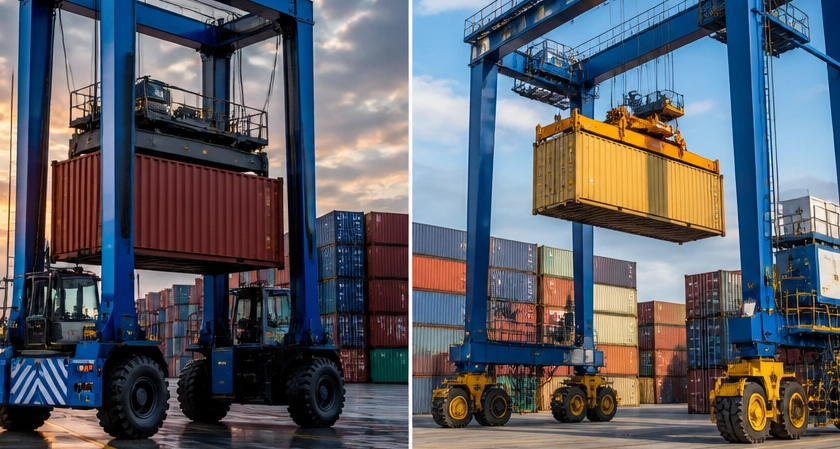
Choosing the right yard equipment is one of the most consequential procurement decisions a container terminal makes. Get it right and your port hums for two decades. Get it wrong and every container move is a reminder.
Two systems dominate the global debate: the straddle carrier and the rubber-tyred gantry crane (RTG). Both are proven. Both are evolving fast — driven by electrification mandates, smart-port investment, and rising throughput demands.
This guide breaks down the operational, financial, and strategic differences between the two systems so terminal operators and port planners can make a data-backed decision for 2026 and beyond.
What Is a Straddle Carrier?
A straddle carrier is a self-propelled, rubber-tired machine that straddles a container, lifts it directly from below using a spreader, and transports it independently across the yard. No tractor. No trailer. No secondary horizontal transport fleet.
One machine handles the full container movement cycle — from quay transfer to yard positioning — which makes it operationally simple but mechanically complex per unit. Straddle carriers typically stack two to four containers high, trading vertical density for flexibility and speed of repositioning.
Primary use cases:
- Medium-sized container terminals (under 800,000 TEU/year)
- Greenfield ports with evolving layout requirements
- Mixed-cargo or irregular storage pattern environments
- Terminals where land cost is low and flexibility is a priority
What Is an RTG Crane?
A rubber-tyred gantry crane (RTG) runs along fixed row corridors on rubber tires, lifting containers vertically within its span and stacking them — typically 1-over-5 or 1-over-6 high. Horizontal movement between the RTG block and the quayside is handled by a separate yard tractor fleet or, in modern terminals, by automated guided vehicles (AGVs).
The RTG and its supporting transport fleet function as an integrated system. This complexity delivers a decisive advantage in yard density: RTG cranes can stack up to six containers high, handling significantly more TEUs per square meter than straddle carriers.
RTG crane variants from established manufacturers like Henan Weihua include:
- Standard RTG (diesel-electric): 35–45 ton capacity, spans of 23m or 27m, 1-over-5 stacking — the workhorse for most mid-to-large terminals
- Electrified RTG (eRTG): Powered by shore electricity via cable drum or busbar, eliminating diesel exhaust and cutting energy costs by 30–50%
- Rail-mounted gantry crane (RMG): Fixed-rail variant for the highest-density inland container depots and rail yards
- Ship-to-Shore (STS) crane: Quayside unloading crane that works in tandem with RTG yard systems
Straddle Carrier vs. RTG Crane: Head-to-Head
|
Dimension |
Straddle Carrier |
RTG Crane |
|
Stacking height |
2–4 containers |
5–6 containers |
|
Yard density |
Lower |
Higher (decisive advantage on constrained land) |
|
Infrastructure |
Minimal — no fixed civil works |
Higher — row foundations, power supply, tractor fleet |
|
Initial capital |
Lower per unit |
Higher system cost (crane + fleet + civil) |
|
Throughput sweet spot |
Under 800,000 TEU/year |
1 million+ TEU/year |
|
Operational flexibility |
High — no fixed lanes, easy reconfiguration |
Lower — block structure is fixed once built |
|
Maintenance complexity |
Higher frequency, lower specialisation |
Lower frequency, higher specialisation per crane |
|
Automation readiness |
Full automation available (ASC) |
Full automation available (ARTG) |
|
Electrification |
Full electric models in market |
eRTG widely deployed; 30–50% fuel saving vs. diesel |
On total cost of ownership (TCO): In high-density, high-throughput terminals, RTGs typically deliver lower whole-lifecycle costs per TEU. In medium-sized or lower-density terminals, straddle carriers offer lower operational complexity and competitive lifecycle economics.
One cost that consistently catches operators off-guard in RTG procurement: tire replacement. A full set of tires for a large RTG runs $150,000–$200,000 with replacement cycles of two to three years. This recurring cost belongs in any TCO model from day one.
Decision Framework: When to Choose Each System
No equipment system is inherently superior. The right choice depends on specific operating conditions. Work through these three questions in sequence:
- What is your yard density requirement?
If land is constrained and stacking height matters, RTG systems have the structural advantage — their 1-over-6 stacking delivers measurably more TEUs per square meter. If your terminal has room to spread and values operational simplicity, straddle carriers are competitive.
- What is your throughput volume and growth trajectory?
Below 800,000 TEU annually, straddle carriers often show favorable capital and operating economics. Above 1 million TEU, RTG systems typically outperform on a per-TEU cost basis as stacking density reduces land dependency.
- How important is layout flexibility?
Terminals with evolving cargo mixes, greenfield layouts still being defined, or regular reconfiguration requirements benefit from the straddle carrier's infrastructure independence. Terminals with stable, long-term block configurations get more value from RTG corridor efficiency.
For greenfield terminal projects, a detailed TCO analysis over a 15–20 year horizon — comparing capital expenditure, operating costs, maintenance, and throughput capacity under projected volume scenarios — is the only defensible basis for a procurement decision. Request yard simulation studies from shortlisted suppliers, not just equipment specifications.
Port Electrification and Automation Trends in 2026
Electrification and automation are no longer differentiators between the two systems — both have a credible path forward. What has changed in 2026 is the pace.
Automated straddle carriers (ASC): The global automated straddle carrier market was valued at approximately $502 million in 2025 and is projected to reach $767 million by 2034, growing at a CAGR of 6.4%. GPS guidance, onboard sensors, and real-time terminal operating system (TOS) integration now enable largely hands-free container movements.
Electric straddle carriers: The electric straddle carrier market is growing at a CAGR of 8.2%, expected to reach $0.89 billion by 2030. The primary driver is the global push for emission-free port operations — IMO and regional port authority targets are accelerating electrification timelines across European and Asian terminals.
Automated RTG (ARTG) and eRTG: Diesel-electric RTGs with regenerative energy recovery during container lowering cycles are delivering fuel savings of 30–50% compared to conventional diesel operation — a proven intermediate step toward full electrification. Full ARTG configurations are now widely deployed in major terminals globally.
Asia-Pacific leads adoption. The Asia-Pacific region dominates the straddle carrier and RTG markets due to high container traffic volumes, established port infrastructure, and accelerating international trade. China, South Korea, Singapore, and Australia are all investing heavily in electrified, automated yard systems — a trend that is expected to persist through the 2026–2034 forecast period.
The straddle carrier market overall is projected to grow at a CAGR of 5.6% through 2034, while the broader port equipment market (cranes, straddle carriers, reach stackers, forklifts, conveyor systems) is on track toward $10.96 billion by 2032 at a CAGR of 4.3%.
Conclusion: Align Equipment to Terminal Strategy
The straddle carrier versus RTG crane decision is ultimately a question of alignment: which system fits your terminal's land constraints, throughput requirements, investment profile, and long-term operational strategy.
Straddle carriers win on flexibility, lower infrastructure requirement, and competitive economics at mid-scale throughput. RTG cranes win on stacking density, per-TEU lifecycle cost at high volumes, and integration into automated, high-throughput terminal designs.
Define your density requirements. Assess your flexibility needs. Model total cost of ownership across your planning horizon. Those three steps produce a defensible procurement decision — one your terminal will not be renegotiating in five years.
Looking for RTG cranes, RMG cranes, ship-to-shore cranes, or complete port lifting solutions?
Henan Weihua Heavy Machinery is one of China's leading crane manufacturers, supplying RTG cranes, rail-mounted gantry cranes (RMG), quayside container cranes (STS), and overhead cranes to terminals across more than 130 countries. Weihua's port equipment line covers the full container terminal — from yard stacking to quayside unloading — from a single supplier.
Contact the Weihua team for project-specific specifications, capacity modeling, and quotations.













Comments