>>
Industry>>
Food and beverages>>
The Meat Pallet That Never Wei...The Meat Pallet That Never Weighed the Same Twice
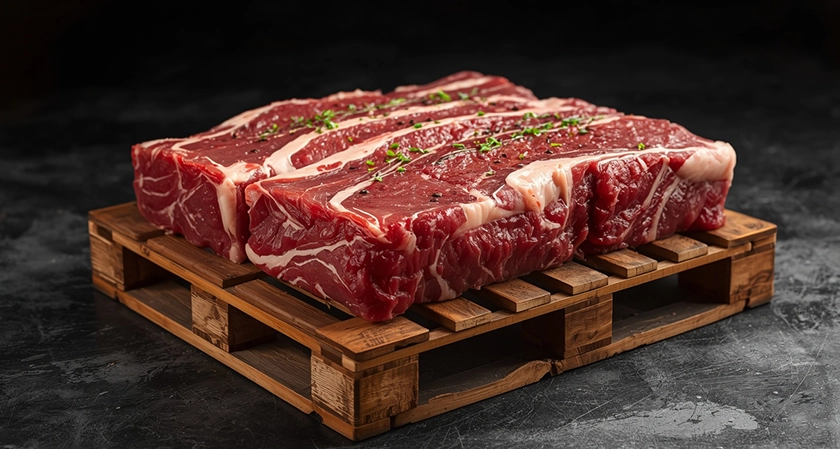
The plant in this story is an imagined composite, a picture of how catch weight receiving can feel for a food distributor or processor. The details are illustrative, but the situation will be familiar to anyone who works with variable-weight product.
Every morning, a receiving team at a meat distributor unloads cases that look identical and weigh differently. One case of boneless chicken might come in at 39.8 pounds, the next at 40.6, the next at 40.1. The purchase order says "40 pounds per case," and for planning purposes that's close enough. For inventory, costing, and supplier payments, though, close enough turns out to be a lovely thing to improve. Plants that handle meat, produce, and bulk commodities are finding that capturing the real weight at the dock makes a whole chain of downstream work calmer, from cost accounting to traceability.
Why Variable Weight Is Its Own Kind of Puzzle
Many foods are bought and sold by weight but received in lots whose weight varies from case to case. That's the nature of the product, and it's something skilled teams work with every day. The challenge is that most systems are built around fixed units: one case, one standard weight, one standard cost.
When a product is bought by the pound and received by the case, a standard unit conversion can't fully describe what arrived. A food-focused system handles this by tracking two quantities together: the handling quantity, such as cases, and the actual weight. That pairing is called catch weight, and it lets the system respect both the way the product moves and the way it's priced.
Where Approximation Quietly Adds Up
Using a standard weight is a sensible shortcut, and many plants do it for years. The effect shows up gradually. If cases run slightly heavier than the standard, inventory looks a little lighter than the real quantity on the shelf. If they run lighter, the opposite happens. Supplier invoices, based on actual weight, differ a little from what the system expected. Valuation uses a standard unit cost multiplied by an approximate weight, so the inventory number on the balance sheet is a close estimate rather than a measured fact.
None of this is dramatic on any single day. Across thousands of cases and many lots, it becomes the kind of gap that month-end reconciliations are built to chase. The good news is that the fix is refreshingly simple: measure at receiving, and let the weight travel with the lot.
Capturing the Real Weight at the Dock
The core idea is to record actual catch weight when product arrives. A well-designed Food Manufacturing ERP captures that weight at receiving and uses it for inventory valuation, instead of a standard unit cost multiplied by approximate weight. Each incoming lot is also assigned its actual purchase price at receipt, so a lot bought at one price per pound is valued at that price, even beside a lot bought at a different price the following week.
For a receiving team, this feels natural. The scale is already at the dock. The weight is captured as the case is scanned, tied to the lot, and the system takes it from there. The team's careful habits become the data the whole operation relies on.
Keeping Weight Attached to the Lot
Once weight is recorded, its value grows by staying with the lot. Lot-level weight records mean that every case, pallet, and shipment can be described by what it actually contained. That helps with FEFO, First Expiry First Out, because the lot that expires first posts its actual cost to cost of goods sold first, matching what happens on the warehouse floor.
It also supports traceability. FSMA Rule 204 asks for key data elements at receiving, transformation, and shipping, including the traceability lot code, product, quantity, and unit, and for records within 24 hours of an FDA request. When quantity and weight live in the lot record, forward and backward traces describe the true quantities involved. The same measured data serves purchasing, finance, and quality at once.
Accruals, Costing, and Month-End Calm
Finance teams are often among the happiest beneficiaries of catch weight capture. When actual weights are recorded at receiving, supplier accruals can be calculated from measured quantities, so what the system expects to owe lines up with what the supplier invoices. Weight-based valuation connects to accounting, so the inventory subledger reflects measured lots instead of estimates.
Month-end reconciliation gets lighter, because many of the small differences that used to need investigation never appear. Accountants spend less time explaining variances and more time on analysis, and the conversation between receiving and finance becomes a friendly one: the numbers match because they come from the same scale reading.
Cold Chain Companions
Plants that handle variable-weight meat often care about temperature-controlled storage as well, and the same lot-level thinking helps. Putaway rules can direct product to the right zone, whether ambient, refrigerated, or frozen. Custom scan checks can reject a destination that conflicts with the product's storage requirement, and staging alerts can flag product that has been out of its zone too long.
It's helpful to know how temperature itself is handled. A location barcode tells the system where product is, while the actual temperature comes from operator entry or sensor integration. A good setup is clear about that distinction, and teams appreciate the honesty.
Bringing It to Odoo
Many food and beverage companies bring catch weight, FEFO, and traceability together in Odoo, and the platform is a very good home for it. Odoo for Food and Beverage manufacturers and distributors can use native lot tracking, expiration dates, FEFO removal rules, barcode workflows, quality control points, and costing connected to accounting. Catch weight is one of the places where a thoughtful extension helps, because standard unit conversion doesn't capture variable weights on its own.
Custom receiving extensions can capture actual weight, retain lot-level weight records, calculate supplier accruals from measured quantities, and connect weight-based valuation to Odoo Accounting. The same implementation can add FEFO scan checks, cold storage putaway checks, and FSMA 204 key data element records, and the business owns the custom source code and documentation. A few practical notes help: quality features and the barcode module are Enterprise capabilities, so confirming edition, hosting, and addon support is wise, and testing partial picks, quality holds, and customer shelf-life restrictions before go-live shows how everything behaves in daily use. As always, the manufacturer validates its own records and traceability plan.
What Receiving Teams Tend to Notice
Teams who move to measured weights often describe a few welcome changes. Receiving feels smooth, because the scale and the scanner work together. Inventory numbers match the shelf more closely. Supplier conversations get easier, because the records agree. And the finance team's month-end gets a little quieter.
There's a quieter benefit too. When weight is captured as part of the normal routine, the team's attention to detail becomes visible in the data, and that's a nice thing for skilled people to see.
A Friendly First Step
For plants curious about this path, a good first step is to pick one variable-weight product and weigh a handful of cases at receiving, comparing the results to the standard weight on the purchase order. Note how much they differ, and how that difference flows into inventory and supplier invoices.
Then try a mock recall on a lot of that product, tracing it back to its supplier and forward to its customers, and see whether the quantities in the records match what you'd expect. Those two small exercises show where measured weight would help most, and they tend to make the case for themselves.
The meat pallet will probably never weigh the same twice, and that's perfectly fine. With the real weight captured at the dock and carried with the lot, every number that follows can reflect what truly arrived, and everyone from receiving to finance gets to work from the same clear picture.
About the Contributor
Nishkam Batta, Editor-in-Chief, HonestAI Magazine | AI Consultant, GrayCyan AI Solutions
Nish leads an applied AI company helping manufacturing and related companies automate operations with human-in-the-loop AI that integrates into ERPs, WMS, CRMs, and other enterprise tools, with an emphasis on explainable AI, clear audit trails, and measurable outcomes. His team builds agentic ERP systems that execute multi-step tasks inside approved guardrails so humans keep accountability, approvals, and override control.













Comments