>>
Industry>>
Healthcare>>
The Quiet Hour: Why Cats Need ...The Quiet Hour: Why Cats Need Downtime More Than Another Toy
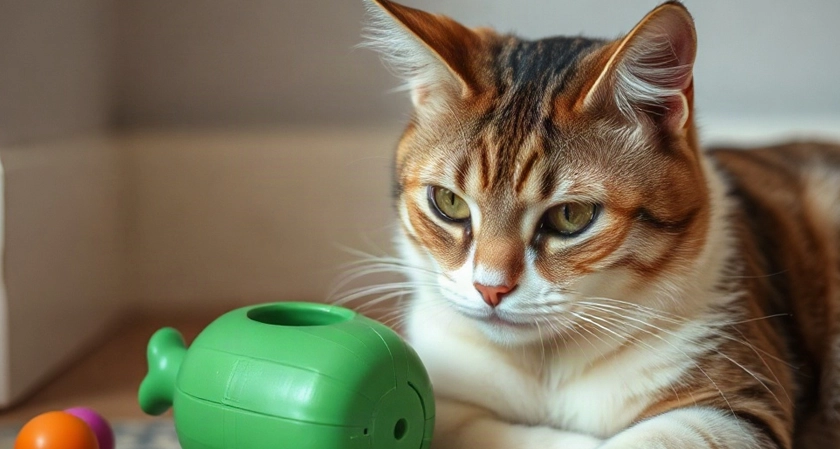
I bought my cat a motorized feather wand last spring. She watched it spin for eleven seconds, walked behind the couch, and sat there until the battery died. That was the moment I stopped shopping for enrichment and started paying attention to when she actually seemed okay.
Here's what I found. The cat wasn't bored. She was overbooked. Between the doorbell, the robot vacuum, the neighbor's dog, and two humans who talk loud in the kitchen, her day had more input than most offices. So I built her a scheduled quiet hour, and it did more for her than any toy I've bought since.
That's the whole idea. The Quiet Hour is a daily block of low-stimulation time where the house goes soft and your cat gets to decide what happens. No play prompt, no new object, no audience. If you've been searching for ways to settle a cat that startles at everything, know that best cbd for cats is a common conversation starter, and calm routines like this one pair naturally with that kind of product rather than replacing it. But the routine comes first. Always the routine first.
What overstimulation actually looks like in a house cat
Cats don't tell you they're maxed out by sighing and asking for a break. They tell you with a tail that flicks when you pet them, a sudden sprint at 9 p.m., a bite that comes out of nowhere, or a refusal to come out from under the bed at dinner. Most people read those signals as personality. Some of it is, but a lot of it is a nervous system with no off switch.
Think about what your cat processed between 7 a.m. and noon. You left the house, a delivery truck idled outside, a text notification chimed four times, someone opened a plastic bag. Cats are built to notice changes in their environment, and modern homes produce constant change. A wild cat's day is mostly still. Ours is not, and we've put the cat in the middle of it.
Here's the thing that changed my mind: Census Bureau data on American households keeps showing how many of us live in denser, busier, more shared spaces than a generation ago, and cats got carried along into all of it with zero say. I'm not blaming anyone. I'm saying the environment is louder than the animal was designed for, so the fix has to be scheduled rather than hoped for.
How to build a quiet hour that your cat actually uses
Pick a window that already trends calm, usually mid-morning after breakfast or the hour right after you get home but before dinner. Then strip it down.
- Kill the noise. Pause the vacuum, the dishwasher, and any music with a beat. Background hum is fine. Sharp sound isn't.
- Lower the lights in one room. Not dark, just dimmer than the rest of the house. That room becomes the destination.
- Give your cat three resting options at different heights. A window perch, a floor-level bed, and something up high. Choice is the point. If she can't pick, she can't relax.
- Don't initiate. Sit down and read. If your cat comes to you, great. If she leaves, let her. This is the hard part, honestly, and the part most people skip.
- Keep it to the same hour every day. Predictability is doing most of the work here, not the silence.
Run it for two weeks before you decide whether it worked. Repetition is the whole mechanism. A single quiet hour on a random Saturday won't teach your cat anything, because a routine that shows up once isn't a routine.
What to put in the room, and what to leave out
Leave out the laser pointer, the crinkle toys, and anything that beeps. Put in a soft blanket that smells like you, a cardboard scratch pad near the resting spot, and water in a ceramic bowl away from the wall. That's it. The ASPCA has long pointed out that cats need environmental control and predictable territory to feel secure, and a quiet hour is essentially a scheduled dose of both, minus the gadgetry.
Why buying more stuff usually backfires
I'll take a firm stance on this one. Most cat purchases are for the human. The toy is a mood lift for you, the puzzle feeder is a small feeling of accomplishment, and the cat gets a new object to inspect and dismiss. I own roughly nine regrettable cat products, so this isn't judgment. It's a pattern I noticed in my own receipts.
What a cat does with a new object is investigate it, file it, and return to the spot it already trusts. Novelty gets attention for a day. Predictability gets used for years. So the better question isn't which toy to buy next, but which room in your house could become the place your cat goes when it needs nothing from anyone.
If you want a small number of things that earn their spot, here's how I'd decide. A perch that gets used daily is worth more than five toys that don't. A bed in a low-traffic corner beats a bed in the living room. And any calming product you add works best as a support layer under an existing routine, not as a replacement for one.
The part people forget: your own energy
You are the biggest variable in this whole setup. A quiet hour with a person who's checking their phone and getting up three times isn't quiet. Cats read movement and attention more closely than most people realize, and they build their sense of safety around what's predictable about you.
So the routine has a second user. Ten minutes of sitting still with a book is good for a cat and honestly not bad for a human with a loud job, a deadline, and a phone that never stops. The Library of Congress has spent a century documenting the daily reading habits of Americans, which is a fancy way of saying sitting still with a book is a genuinely old, genuinely low-stimulus activity that works for both species.
Start with the hour, not the cart
Your cat does not need a bigger toy bin. It needs one reliable stretch of the day where nothing asks anything of it. Set the window, dim the room, offer three resting spots, keep your hands to yourself, and run it for two weeks. Notice the tail. Notice the sprint at 9 p.m. Notice whether dinner hiding gets shorter.
Then, if you want to layer in a calming product, do it as an addition to a routine that already works rather than a substitute for one you never built. What's one hour in your day that could go softer for both of you?













Comments