>>
Other>>
Politics>>
Geopolitics: Is the World Ente...Geopolitics: Is the World Entering a New Era of Geopolitical Competition?
Reading time: 5 Minutes
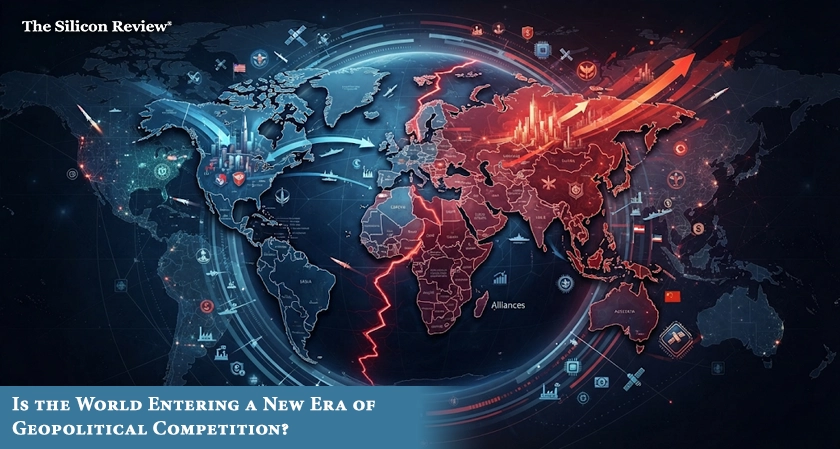
Yes. The world has already entered the new era of geopolitical competition driven by weaponization of trade and supply chains, the race over artificial intelligence (AI) and semiconductor chips, and weakened international organizations and its regulation. A fractured geopolitics around the bipolar world order is currently expected by 68% of international analysts during the next ten years, according to the World Economic Forum's Global Risks Report 2026. Understanding this change is now crucial for managing the escalating global geopolitical risk for governments, industries, and investors.
To make you understand the new-era of geopolitical competition, The Silicon Review brought you the reliable statistics from the entire world around military spending, escalating trade barriers, and supply chain bottleneck.
Key Indicators of Geopolitical Competition at a Glance
|
Indicator |
Metric / Figure |
Primary Source |
|
Global Military Expenditure |
$2.887 trillion (11th straight annual record) |
|
|
Active Import Restrictions |
$5.4 trillion (21.3% of world imports |
|
|
Multipolar Order Expectation |
68% of global risk experts |
|
|
Rare Earth Magnet Capacity |
210,000t (China vs. 4,500t (US) |
From Unipolarity to Multipolar Geopolitical Tension
The shift from a unipolar system led by the United States to a multipolar environment is what correctly defines current geopolitics. China has become a direct economic and technical rival to the United States, which continues to be the world’s leading military force. Important middle powers, such as Brazil, India, and Gulf Nations, are also engaging in “multi-alignment,” balancing alliances in favor of their own national goals rather than joining sterile ideological alliances.
Geopolitical tensions have sharply increased across several countries as a result of this shift of power
- The U.S. led Israel-Iran War
Early in 2026, war directly erupted out, and Iran’s blockade of the Strait of Hormuz, a critical point for almost 20% of the world’s oil and gas supplies and the incident showed how regional conflicts can become global and cause disruptions to the world’s energy and hyperinflation markets.
- ·The Russia-Ukraine War
Alliances rivalry has grown stronger as war reaches its fifth year between Russia and Ukraine. Russia has strengthened defense and commercial connections with China, Iran, and North Korea while the European Union has provided significant financial and military assistance to Ukraine.
- Strains Within Western Alliances
Traditional alliances are also changing. Canada tried to broaden its trade relations in response to U.S. tariff issues during 2026 USMCA review, while the European Union started a €150 billion defense program to create “strategic autonomy” separate from Washington.
Modern Day Geo-Economics: When Trade Becomes a Weapon
National Security became a very big priority above free-market economy in this modern global political competition. Tariffs, sanctions, and industrial aid are frequently used by countries as tools of authority, as we seen when U.S. tariff imposition forced India to stop buying Russian crude oil. Experts refer this strategy as geo-economics.
- Record Trade Barriers
The World Trade Organization (WTO) reports that active imports tariffs currently account for record US$5.4 trillion, or more than 21% of global imports.
- Supply Chain Bottleneck
Today countries are rushing to establish the supply chains for sustainable energy and essential minerals. Exports restrictions on vital minerals have become powerful geopolitical tools since China controls around 210,000 metric tons of yearly rare earth magnet capacity, while the United States only has 4,500 tons.
- Surging Defense Budget
Reports released by the Stockholm International Peace Research Institute (SIPRI) says, that global military spending increased for the eleventh year in a row to an all-time high of $2.887 trillion, because of increasing arms sales throughout Europe and the Indo-Pacific region.
Artificial Intelligence as the New Frontier of Power
Opposite to the 20th-century geopolitical competition, the focus of 21st-century geopolitics is AI-driven technical dominance. Artificial intelligence transformed the computer power, way of analysis things and advanced semiconductors into essential national security assets, acting as a force multiplier for both economic efficiency and military capacity.
Major countries have implemented strong export regulations to keep competitors from getting advanced chips since AI technology depends on highly centralized global supply chains, such as chip design in the United States, Lithography equipment in the Netherlands, and Manufacturing in Taiwan. Countries are making an effort to export their unique digital infrastructures throughout the world while investing hundreds of billions of dollars on “sovereign AI” infrastructure, automated combat systems, and cyber capabilities.
The Decline of International Governance
The international governance designed to handle international crisis are becoming less powerful as geopolitical tension grow. Because its elected representatives sit on opposing sides of today’s main disputes, the UN Security Council suffers from frequent veto gridlock. International organizations find it difficult to uphold international law or negotiate peace due to significant financial shortages and rising demands for structural transformation from developing nations.
Conclusion
The global community is now living in a new geopolitical age, not just approaching one. In comparison to the Cold War, today's conflict is not a clear split between two separate financial structures rather; major nations continue to be closely linked despite their intense competition for influence, technology, and energy. Shifting from immediate efficiency to broadening supply chains, keeping an eye on regulatory changes, and taking global geopolitical risk into account in every future-oriented strategic decision, these are very necessary for governments and multinational businesses to succeed in this changing world.
FAQs:
Q: What is geopolitics?
A: The study of how geography, economics, technology, and military could influence international relations and worldwide political rivalry is known as geopolitics.
Q: Is the world entering a new era of geopolitical competition?
A: Yes. The world has already entered the new era of geopolitical competition driven by weaponization of trade and supply chains, the race over artificial intelligence (AI) and semiconductor chips, and weakened international organizations and its regulation.
Q: What is global geopolitical risk?
A: The possibility of financial, operational, and economic disruption brought on by wars, tariffs, sanctions, and changing political alignments between countries is known as global geopolitical risk.
Q: What are the primary drivers of current geopolitical tensions?
A: Multipolar power movements, armed commerce and supply networks, competitions for crucial minerals and artificial intelligence, and overlapping regional conflicts are the main causes of modern-day geopolitical tensions.
Q: What data proves that global geopolitical risk is rising?
A: Reports released by the Stockholm International Peace Research Institute (SIPRI) says, that global military spending increased for the eleventh year in a row to an all-time high of $2.887 trillion, because of increasing arms sales throughout Europe and the Indo-Pacific region. While the World Trade Organization (WTO) reports that active imports tariffs currently account for record US$5.4 trillion, or more than 21% of global imports.
Q: How is artificial intelligence affecting global geopolitical competition?
A: Artificial intelligence transformed the computer power, way of analysis things and advanced semiconductors into essential national security assets, acting as a force multiplier for both economic efficiency and military capacity. Countries are making an effort to export their unique digital infrastructures throughout the world while investing hundreds of billions of dollars on “sovereign AI” infrastructure, automated combat systems, and cyber capabilities.
Q: How can businesses prepare for rising global geopolitical risk?
A: Shifting from immediate efficiency to broadening supply chains, keeping an eye on regulatory changes, and taking global geopolitical risk into account in every future-oriented strategic decision, these are very necessary for governments and multinational businesses to succeed in this changing world.













Comments