>>
Other>>
Politics>>
Can the Trump Xi Putin Meeting...Can the Trump Xi Putin Meeting Reshape Global Political Relations?
Reading time: 7 Minutes
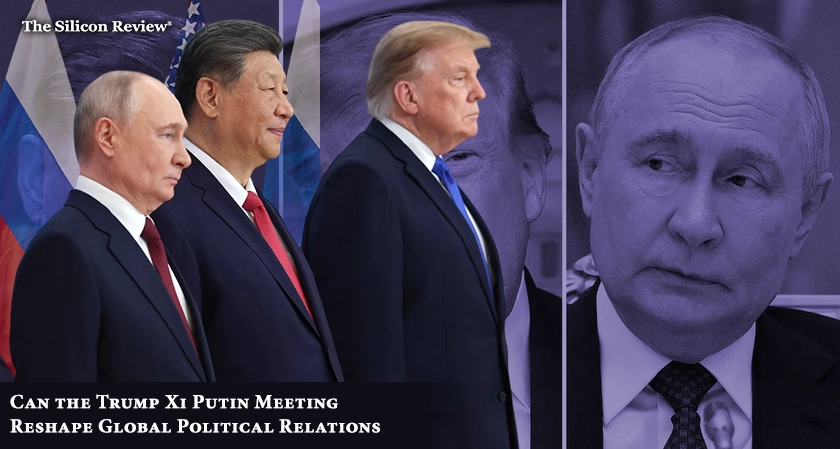
Yes. The Trump Xi Putin meeting is actually a very big shifting point for global political alliances in 2026. This turning point in world politics took place on November 19, 2026 in Shenzhen, China. After the Asia-Pacific Economic Cooperation (APEC) conference, Vladimir Putin, Xi Jinping, and Donald Trump came together on a table for the 90-minutes three-party meeting and it’s the first time so far that these three world leader came together. The Trump Xi Putin summit produced few legally enforceable agreements, but its symbolism and four-point joint declarations indicate a significant change in how the world’s main powers handle conflict, energy markets, and international political relationships.
Today The Silicon Review brought its report on global political alliances and how the Trump Xi Putin meeting will reshape global political relations in 2027.
Summary of Possible Alliance Shifts
|
Alliance/Grouping |
Primary Impact of the Shenzhen Summit |
Likely Strategic Response |
|
NATO & European Union (EU) |
Concerns about U.S.-Russia Agreements over Ukraine and it will affect the confidence in US Security. |
A quicker move for separate military funding and European strategic freedom. |
|
Indo-Pacific Allies |
Fear that global border conflicts may be neglected because of U.S.-China Cooperation. |
Increased military cooperation between neighboring nations (e.g. Japan-India, Japan-Philippines |
|
China-Russia Axis |
A reopened normal U.S. pathway, means Moscow’s lower overall reliance on Beijing |
Sustained strategic cooperation in disregard of Western principles, but with increased Russian influence. |
|
BRICS & Quad |
Disadvantaged by limited 'G3’ perspective, in which only the top three powers engage in negotiations |
India and other moderate nations are more aggressive in their pursuit of problem-centered alliances and diversity. |
What Happened at the Shenzhen Summit?
The conference, which was hosted by Xi Jinping at Kylin Villa, ended with a concise joint statement that prioritized widespread stability, over quick dispute settlements. According to The Wall Street Journal in order to reduce price hikes brought on by shortages of supply because of U.S.-Iran war, the leaders promised to increase worldwide availability of refined petroleum goods.
In terms of strategic security, the three underlined that it is impossible to win a nuclear war and pledged to engage in future risk-management discussion, a crucial move in light of the U.S.-Russia after New START treaty expired in February 2026. Putin stated that the three countries did not establish the three-party conference as usual diplomatic procedure, but the joint statement failed to specifically address the current conflicts in Iran and Ukraine.
The Rise of “G3” Great-Power Politics
According to foreign policy analyst the main significance of the Trump Xi Putin meeting is its geopolitical optics, which portrays a “G3” directorate overseeing international affairs above smaller countries.
1. Beijing as the Diplomatic Center
Xi Jinping established Beijing as vital international peacemaker and showed China’s equality with Washington by hosting the presidents of the two biggest nuclear powers on Chinese Soil.
2. The End of Moscow’s Isolation
Moscow’s influence as a major power was restored by sitting beside Trump and Xi, effectively neutralizing years of Western attempts to diplomatically isolate Vladimir Putin over the war in Ukraine.
3. Transactional U.S. Diplomacy
Experts at the Council on Foreign Relations have pointed out that Trump’s readiness to interact directly with opponents while applauding his personal connection with both leaders highlights a move away from ideological alliances towards bilateral agreements.
Challenging International Courts and Regulation
Going beyond energy and nuclear safeguards, the Trump Xi Putin summit showed a radical alliance against international judicial systems. The three leaders demanded that the International Criminal Court (ICC) respect national sovereignty and the immunity of current heads of states in their joint message, criticizing court. According to Politico, this united approach signifies a decline in a great-power support for post-World War II international organizations and directly protects Putin from his 2023 ICC arrest order while coordinating with Washington’s sanctions against the court.
How Trump Xi Putin Summit Impacts Global Political Alliances
In global politics 2026, both traditional American allies and non-Western blocs must rethink about their security plans due to the development of direct cooperation between the United States, China, and Russia.
1. Strain on NATO and Indo-Pacific Allies
The Shenzhen sights caused severe fear in Europe and Asia, according to the Observer Research Foundation. European leaders are concerned that Washington might reach a deal on Ukraine without Kyiv or Brussels presence, escalating demands for European strategic independence. In the same way, allied nations in the Indo-Pacific region, such as South Korea, Japan, and the Philippine, expressed concerns that the neutralization of U.S.-China trade could weaken American intimidation in the Taiwan Strait and South China Sea, pointing out that Trump’s three-party meeting was twice as long as his quadrilateral summit with Australia, India, and Japan.
2. Shifting Dynamic in BRICS and the China-Russia Axis
Russia became economically dependent on China for many years as a result of Western sanctions. Putin won the vital flexibility between Beijing and the West by rebuilding a direct diplomatic route with Washington. At the same time, major nations continue to value exclusive powerful negations above collective unity, as seen by Xi and Putin’s decision to engage directly with Washington instead of through multilateral venues like BRICS and the Shanghai Cooperation Organization (SCO).
3. Pressure on Middle Powers like India
A hypothetical U.S.-China-Russia coalition raises geopolitical concerns for emerging nations like India that uphold a wide multipolar world. Closer collaboration between Washington, Beijing, and Moscow runs danger of ignoring New Delhi on Eurasian security and preventing the diversification of global supply chains away from China, as Japan Forward emphasizes. Intermediate countries are responding by stepping up bilateral risk hedges, as seen by the strengthening of defense, cybersecurity, and AI collaboration between Japan and India just after the Shenzhen meetings.
Conclusion
Can the Trump Xi Putin meeting reshape global political relations? Firstpost experts point out that although the meeting didn’t end long-standing conflicts over Taiwan, Ukraine, or cutting-edge technology, it did provide a practical framework to avoid tragic expansion. In the final analysis, the Shenzhen summit reveals that global politics in 2026 will be characterized more by flexible, transactional bargaining among great powers than by unchangeable Cold War-style blocs. This will force allies and middle powers to form more robust, autonomous alliances.










Comments