>>
Industry>>
Digital marketing>>
Generative Engine Optimization...Generative Engine Optimization (GEO): Is Traditional SEO Losing Its Advertising Advantage?
Reading Time: 10 minutes
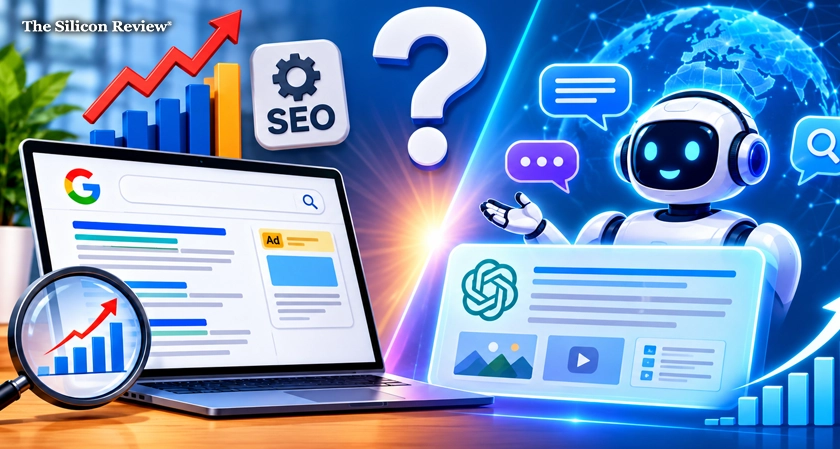
For two decades, SEO and paid search worked as a predictable pair: rank high, bid smart, capture the click. In 2026, that model is cracking. AI Overviews in zero click environments & conversational assistants now answer questions before users ever see a results page and when they do click, the ad economics have shifted. This Silicon Review’s article examines whether Generative Engine Optimization (GEO) is genuinely displacing traditional SEO's advertising advantage, or whether the two are converging into something neither discipline fully controls.
What GEO Actually Changes
Traditional SEO optimizes for ranking signals: backlinks, keyword relevance, keyword density, keyword stuffing, and technical structure. GEO optimizes for extraction signals whether an AI system can pull a clear, standalone answer from your content and cite you as the source. The distinction matters because the output is different. A ranking puts you on a page. A citation puts you inside the answer. Let me explain you with an example
Traditional SEO (Search Engine Optimization) is like getting your company listed on crowded search engine. You optimize your company website, so Google puts your link on page one if your website is well optimized. Someone searching for a specific keyword sees your company among ten other competitors, and maybe they click and visit your company website. A ranking puts you on a page visible, but competing with everyone else on that page.
Generative Engine Optimization (GEO) is like getting your company recommended by a trusted consultant. When someone asks an AI "which company should I hire for so and so job?", the AI doesn't hand over ten company names. It reads dozens of sources, then says: "You should go with this company here's why." If your content gave the AI a clear, quotable answer, it picks you. A citation puts you inside the answer you're not one option on a list, you're the recommendation itself.
When I say it reads dozens of sources, I meant
1. The Search Indexes (Where the AI looks first)
The AI doesn't crawl the entire web live for every question. It queries a pre-built index. ChatGPT primarily uses Bing's index (and sometimes Google's). Google's AI Overviews and AI Mode use Google's own search index. Perplexity runs a live web crawl on every query. So your first job is to ensure and be in the index the AI uses. If your site is blocked from Bing's crawler, ChatGPT can never cite you, no matter how good your content is.
2. The "Query Fan-Out" (What the AI actually searches for)
The AI doesn't search for the exact question the user typed. It breaks that question into multiple smaller sub-questions. Research tracked over 1,300 "fan-out" queries generated from just 540 original questions across ChatGPT, Gemini, and Perplexity. If someone asks "which CRM is best for a 10-person sales team?” the AI searches for "CRM comparisons," "pricing for small teams," "setup time," and "integration options" separately. Your content needs to answer those adjacent questions, not just the head term. Similarly for you to think on it I can give few more examples, so that you can observe the pattern and make use in your content.
Example 1: B2B Software
User asks: "Which project management tool is best for a remote design team?"
AI searches separately for: "remote team collaboration features," "design file integration (Figma, Adobe)," "per-user pricing for small teams," "asynchronous communication tools," and "mobile app quality."
Your content needs to cover: integration with design tools, pricing at 5-15 seats, and how the tool handles time zones not just a generic "best project management software" listicle.
Example 2: Professional Services
User asks: "Which accounting firm should I hire for a startup in India?"
AI searches separately for: "startup accounting services India," "GST compliance for startups," "virtual CFO pricing," "firm experience with funded startups," and "turnaround time for monthly bookkeeping."
Your content needs to answer: do you handle GST filing, what's your virtual CFO retainer, and have you worked with seed-stage companies not just "we are a leading accounting firm."
Example 3: E-commerce Product
User asks: "What's the best standing desk for a home office under ₹30,000?"
AI searches separately for: "standing desk weight capacity," "motor warranty length," "assembly time," "height range for tall users," and "desk stability at max height."
Your product page needs a spec table answering each of those not just lifestyle photos and a marketing tagline.
Example 4: Healthcare/Clinic
User asks: "Which dermatologist in USA is best for acne treatment?"
AI searches separately for: "acne treatment options (topical, oral, laser)," "dermatologist qualifications and years of experience," "clinic location and accessibility," "patient reviews for acne specifically," and "consultation cost."
Your clinic page needs: the doctor's credentials, the specific acne treatments offered, consultation fees, and location not just "we provide world-class skin care."
Example 5: SaaS/API
User asks: "Which payment gateway is best for a subscription business in India?"
AI searches separately for: "recurring payment support," "UPI and card failure rates," "transaction fees comparison," "compliance with RBI e-mandate rules," and "developer documentation quality."
Your content needs a page answering each: recurring billing support, RBI compliance, fee structure, and API docs not just "trusted by 10,000 businesses."
Example 6: Education
User asks: "Which online course is best for learning data analytics from scratch?"
AI searches separately for: "course syllabus for beginners," "SQL and Excel coverage," "placement assistance," "course duration and price," and "student reviews on job outcomes."
Your course page needs: week-by-week syllabus, tools taught, placement stats, price, and duration not just "become a data analyst in 3 months."
The pattern to notice: every head question hides 4-6 specific sub-questions the AI will search separately. Your job in GEO is to answer each of those sub-questions on the same page in clear, standalone paragraphs the AI can lift and cite. If you only answer the head term, you lose to a competitor who answered the sub-questions.
3. The Passage-Level Selection (What gets pulled out when you search)
The AI doesn't read your whole page. It pulls specific paragraphs or sections that directly answer each sub-query. A 400-word page with a clear answer near the top beats a 3,000-word page where the answer is buried. This is why "extractable clarity" matters: a self-contained paragraph with a direct answer, a concrete number, and no vague pronouns is what gets selected.
4. The Cross-Check (What gets trusted)
Before a fact makes it into the final answer, the AI checks if it's corroborated (the same fact appears in multiple independent places, and those places agree). A statistic appearing on only one obscure page gets treated with more caution than the same statistic appearing across several sources the model already trusts. This is why Wikipedia and Reddit dominate citations they're heavily corroborated across the web. For instance, If your article reports "Company X raised $50 million”, and that number appears only in your article, an AI treats it as a single-source claim it might mention it cautiously or skip it. But if the same figure appears in the company's press release, a wire service, a regulatory filing, and two other news outlets, the AI sees agreement across independent sources. That's corroboration and it's what makes the AI confident enough to state the fact and cite you.
Why Wikipedia and Reddit dominate AI citations: Wikipedia is corroboration by design every claim traces to an external reference checked by editors. Reddit is corroboration by conversation dozens of unrelated users confirming the same experience. Both give the AI what it wants: agreement across independent sources.
The lesson for a news publisher: publish the fact once, and it's a claim. Get it picked up, quoted, and referenced across wires, aggregators, and industry outlets, and it becomes corroborated. In GEO, independent repetition is what turns your reporting into a citable fact.
5. The Citation Layer (What actually appears in the answer)
Only the passages that survived selection and checking gets to appear in the response, with the source named. Everything else gathered during the search disappears no link, no mention, and no credit.
The citation layer is the AI's final output. After the AI gathers dozens of sources and checks them, it writes an answer and attaches credit to the few sources it actually used. Everything else it read gets discarded no link, no mention, no credit. That's the AI's filtering process, not a formatting rule for your content.
Here's what actually matters for a content:
You don't need a citation on every line. You need clear attribution on every factual claim. That's different. Instead of "(1) (2) (3)," you write naturally: "According to the company's regulatory filing..." or "Data from the Ministry of Commerce shows..." or "Two executives familiar with the matter told Reuters..."
Why this works better than numbered footnotes:
- AI models extract passages, not footnote structures. A sentence like "According to RBI data, digital payments rose 28% in 2026" is self-contained the AI can lift it and cite you as the source.
- A sentence with "(1)" at the end is meaningless to an AI unless it can trace footnote (1) to an actual source and most AI systems don't parse footnote layers reliably.
- Named attribution builds corroboration. When your article says "according to RBI data," the AI can cross-check that against RBI's own site strengthening trust in your reporting.
The practical rule for content: every factual claim should name its source in the sentence itself. Not numbered citations, named attribution. That's what makes your passage extractable, verifiable, and citable.
The practical takeaway for your GEO implementation:
You're not optimizing for one "source." You're optimizing for eligibility at every stage of the AI's pipeline:
- Get indexed - be in the index the AI actually queries (Bing for ChatGPT, Google for AI Overviews). If a crawler can't reach you, you don't exist. (This needs to be checked with your developers)
- Answer the sub-questions - the AI splits every user question into smaller searches. Your content must cover those adjacent questions, not just the head term. (There are tools for it online like rankability, scalenut)
- Be extractable - write answers as standalone passages the AI can lift cleanly, without needing surrounding context to make sense.
- Be corroborated - make sure your key claims appear in multiple independent places with attributes which are real, so they survive the trust check.
That's what "dozens of sources" really means. The AI scans many pages, but only the few that pass all four stages get surfaced. Optimizing for one stage isn't enough you need to survive the whole pipeline.
Why does that distinction matter practically?
A ranking is a position. A citation is an endorsement. When someone sees a link, they still have to decide whether to click it. When an AI cites you, it has already done the deciding for them it trusted your content enough to repeat it. That trust transfers to the reader.
And the numbers are brutal: a search results page can show ten blue links. An AI answer typically cites two or three sources, sometimes none. So the question shifts from "how do I rank higher among ten?" to "how do I become one of the two or three the AI actually quotes?" That's a completely different game and it's why GEO exists as a separate discipline. Especially in this new era of intelligence, where transformation is happening evidently.
The practical takeaway for a beginner is to first stop writing to be found on a page and Start writing to be quoted in an answer. Lead with the direct answer, keep it short and standalone, and make it easy for the machine to lift your words and credit you for them.
The competitive intensity is brutal in 2027. In traditional search, dozens of links appear on a results page. In an AI-generated answer, a maximum of three sources are cited, if at all. That's winner-take-most economics, and it explains why brands are pouring resources into GEO even as they maintain their SEO foundations.
The Advertising Advantage Is Shifting, Not Disappearing
Here's the truth for anyone hoping for a clean answer: traditional SEO isn't losing its advertising advantage the advantage is migrating.
Google's Search revenue growth slowed to 12% in Q3 2026, down from 19% in Q1, and Search accounted for less than 50% of Google's total revenue for the first time. AI Mode queries monetize at a lower rate than traditional search, and Google's own CBO acknowledged this drag on growth. The zero-click environment isn't hypothetical it's showing up in earnings calls.
But paid search hasn't collapsed. Transactional queries still maintain click-through rates because users continue to purchase pages after viewing AI summaries. The damage is concentrated in informational queries, where AI Overviews appear on 85.9% of question-based searches and 95.4% of comparison searches. If your advertising strategy depends on capturing research-phase clicks, that advantage is eroding. If it depends on branded and transactional intent, the ground is more stable.
Ranking and being cited are now two different jobs
A page ranked first organically can be entirely absent from ChatGPT, Perplexity, or Google's AI Overviews answering that same query. Ranking and being cited are now two different jobs. The reason is structural. AI systems don't grab the top-ranked page and quote it. They expand a query into related sub-questions, retrieve candidate passages across those searches, and select sources that appear repeatedly as strong matches. A brand that ranks first for a head term but doesn't answer adjacent questions loses to a competitor that covers the full query fan.
This is why The Silicon Review has covered GEO extensively in 2026 agencies are rebuilding search operations around AI citation tracking rather than rank tracking alone, and the results show AI visibility can be measured and improved.
The Bottom Line
Traditional SEO is not dead. Its advertising advantage is narrowing, but it isn't disappearing it's relocating to the places where AI still sends traffic: branded searches, transactional queries, and high-intent commercial moments. GEO is not a replacement for SEO; it's the layer that determines whether your brand exists inside the answers that now shape decisions before the click ever happens. The brands winning in 2026 are doing both, and they're measuring citations as seriously as they measure rankings.
FAQs
- What is Generative Engine Optimization (GEO)?
A. GEO is the practice of optimizing content so AI systems like ChatGPT, Perplexity, and Google AI Overviews cite and recommend your brand in generated answers. - Is SEO dying because of AI search?
A. No, but its advertising advantage is narrowing. Informational queries face heavy AI Overview coverage, while transactional and branded searches remain more defensible. - What is the difference between SEO and GEO?
A. SEO targets ranking algorithms for blue-link results. GEO targets AI retrieval and citation systems that synthesize answers from multiple sources. - Why do AI citations matter more than rankings?
A. A page can rank first and still be absent from AI answers. Cited sources receive substantially more visibility than non-cited sources on the same results page. - How do I optimize for AI citations?
A. Lead sections with direct answers, use question-based headings, maintain consistent brand information across platforms, and structure content in self-contained passages. - Is Reddit really the best source for AI citations?
A. Reddit accounted for 40.1% of citations in one study, but its share dropped sharply in ChatGPT after August 2026 as models adjusted. It's valuable but volatile. - Should I stop investing in traditional SEO?
A. No. SEO foundations crawlability, authority, technical health remains the baseline. GEO builds on top of them rather than replacing them.













Comments