>>
Technology>>
Artificial intelligence>>
How AI is Transforming Modern ...How AI is Transforming Modern Cooking with Smart Kitchen Appliances
Reading time: 5 Minutes
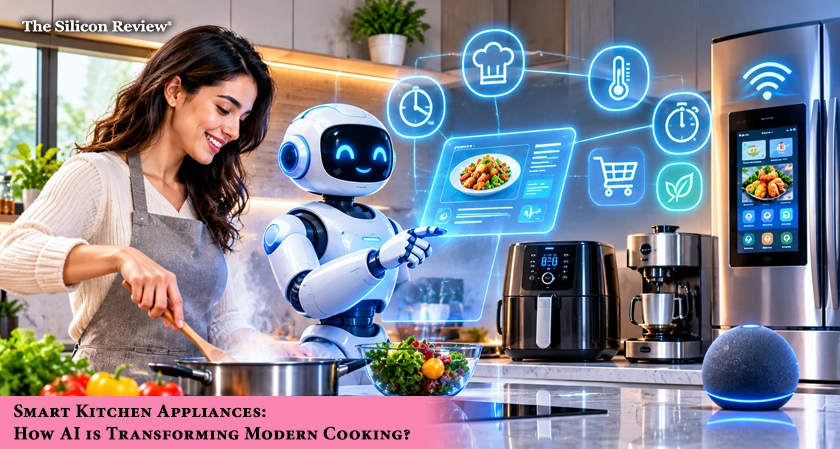
It’s almost the end of 2026 and we have seen how AI-driven revolution around technology is going beyond imagination. Everything we see or do today, almost 9 out of 10 things are driven by technology and in the era of AI, it is reaching height. Today Smart Kitchen Appliance driven by AI embedded technology is totally transforming modern cooking style for residential and commercial kitchens. Modern appliances don’t just obey timetables; they actively monitor, sense and adjust to what you are cooking thanks to artificial intelligence, computer vision, and precise sensors. According to Fortune Business Insights recent reports, the worldwide smart kitchen appliances market increased from $26.69 billion in 2025 to $31.55 billion in 2026 and is expected to surpass $120.21 billion by 2034 (an 18.20% CAGR).
Artificial intelligence in cooking is changing the way food is cooked and served, whether you’re a chef managing a crowded restaurant or a working parent trying to put dinner on the table. And how AI is transforming modern cooking with smart kitchen appliances? The Silicon Review brought its insights on the practical evolution of modern cooking in 2027.
How AI is Transforming Modern Cooking?
The most significant advancement in smart kitchen technology is the transition from purely automation to interactive decision-making. Earlier devices was always needed a personal judgment of human. We have to keep in mind when our milk is going to expire or remember the precise temperature to roast a chicken. But AI-powered kitchen appliances by integrating physical sensors with extensive culinary data eliminates that friction
- Computer Vision - As soon as we put food elements in an oven or refrigerator, advanced inside cameras recognize them.
- Adaptive Heat Algorithms - In order to avoid fire, smart induction stoves and multi-functional ovens automatically changes heat levels based on continuous observations of food texture, surface moisture, and internal temperature.
- Predictive Diagnostics- Connected systems keep an eye on energy use, motor strain, and filter condition, notifying users to replace parts before an expensive system failure happens.
Residential vs. Commercial Kitchen AI Impact Summary
|
Metric / Focus Area |
Residential Kitchens |
Commercial Kitchens |
|
Primary AI Drivers |
Convenience, recipe guidance, energy bill savings, and food freshness. |
High-volume consistency, labor reduction, and predictive maintenance. |
|
Leading Smart Hardware |
Smart refrigerators (31.53% residential share) and induction cooktops (12.45% CAGR). |
Automated multifunctional-ovens, robotic cookers, and vision-based waste scales. |
|
Measured Efficiency |
Up to 20% household electricity savings and 30% projected food waste drop. |
4–5 minute automated dish prep and 29%–64% kitchen food waste cuts. |
|
Market Share Split |
80.25% of global smart kitchen appliance revenue. |
60% of U.S. smart kitchen appliance market share (QSR & hospitality led). |
How AI is Transforming the Residential Kitchens?
Managing time, lowering stress levels, and reducing food waste are the main objectives of smart home kitchen appliances. Nowadays, homes depend on structures that connect meal planning and execution rather than looking at an open refrigerator and thinking what to cook. Interior cameras and barcode scanners are used by intelligent fridge and oven from companies like Samsung and GE Profile to monitor milk and vegetables in real time. The software associated with fridge recommends a customized meal using the precise components you have in your fridge when your spinach is about to expire. And the system immediately adds any essential cooking items that you are lacking to your online shopping cart.
Cooking is nowadays has become automation reliable. Dozens of fresh food items can now be instantly identified by flagship smart wall ovens. When you slide a pan of brownies or a try of fish onto the oven’s rack, the oven choose the best cooking mode, keeps an eye on browning through a live video stream, and turns off the heat the moment the food item reaches perfection. Even small AI-powered kitchen appliances like multicookers and AI-controlled air fryers, may do difficult tasks like reverse frying without the need for culinary school knowledge.
According to research published in MDPI, which shows that 50.6% of surveyed families actively aim to reduce electricity use, and AI-powered smart kitchen appliances monitoring paired with automatic load shifting can reduce household electricity use by up to 20%.
How AI is Revolutionizing the Commercial Kitchen?
Where residential kitchens use AI-powered kitchen appliances for convenience, commercial kitchen uses artificial intelligence in cooking for survival, consistency, and profit margins. Due to their extremely narrow profit margins, restaurants, hotels, and cloud kitchens are particularly vulnerable to food waste and shortages of workers.
According to SNS Insider’s market study, residential kitchen appliances account for the overall appliance volume, commercial kitchen’s adoption of smart kitchen appliances in restaurants, hotels, and cloud kitchens is growing at a 6.72% CAGR as kitchens use connected equipment to save labor costs.
Smart kitchen appliances are power boosters for efficient cooking crews in commercial kitchen:
- Unmatched Consistency Across Locations - AI-powered multi-functional ovens and automated air fryers that modify cooking times according to batch size are used in fast food chains. Each dish tastes the same because the appliance adjusts for fluctuations in oil temperature, regardless of how many baskets of wings a line cook drops.
- Automated Waste and Inventory Analytics - Each unit of food that is thrown away is tracked by commercial smart scales and garbage bins with vision capabilities. AI helps chefs improve portion sizes and purchase orders by classifying what is going to garbage, including prep trimmings and uneaten plate waste.
- Energy and Workflow Optimization- Kitchen appliances, dishwashers, and stoves are all synchronized by artificial intelligent kitchen management systems. Utility costs are reduced during empty afternoon hours because exhaust fans only turn up when optical sensors identify smoke or heat rises.
What are the Key Challenges for Modern Kitchen with AI-powered kitchen appliances?
Despite the obvious benefits, there are key challenges in integrating AI-powered kitchen appliances in any kitchen and the biggest challenge is initial expenses. Commercial AI systems and flagship smart range of products are more expensive than conventional stainless-steel utensils. Skilled specialists are also needed for maintenances because it is more expensive to fix an optical sensor or circuit board than to replace a basic electronic panel. Furthermore, ecosystem lock-in and data privacy are important, both customers and restaurant owners need to make sure their software get frequent security updates and work seamlessly across brands.
The Future of Modern Kitchen with smart kitchen appliances
AI-driven smart kitchen appliances won’t take the place of expert chef’s inventions with food or the pleasure of cooking at home. Rather AI-driven smart kitchen appliances will handle routine, time-consuming tasks like temperature control, scheduling, and tracking stock. By handling the science behind of external factors like storage and temperature, modern kitchen allows chefs to focus on what really matters flavor, hospitality and sharing delicious food.
The Samsung Bespoke AI Vision Refrigerator, Samsung AI Pro Wall Oven, KitchenAid Intelligent Cooking Camera Oven, Brava Smart Oven, GE Profile Smart Indoor Smoker, Thermomix TM7 cooking robot, and Combustion Predictive Thermometer are examples of popular AI kitchen appliances that combine computer vision, precision sensors, and automated controls to streamline meal preparation and minimize food waste.
FAQs:
Q: What are smart kitchen appliances?
A: Smart kitchen appliances are digitally connected cooking and food storage gadgets that simplify meal preparation and energy management through the use of sensors, automation, and smartphone software.
Q: How is artificial intelligence used in cooking today?
A: Artificial intelligence in cooking relies on computer vision and thermal sensors to recognize ingredients, adjust heat levels in real time, and automate multi-stage recipes without human guesswork.
Q: How do smart home kitchen appliances reduce food waste?
A: AI-powered kitchen appliances actively learn from cooking practices and automatically adjust temperatures based on food thickness and wetness, in contrast to basic smart appliances that merely provide remote app controls and timers.
Q: Why are commercial kitchens adopting smart kitchen technology?
A: Commercial kitchen uses smart kitchen technology in cooking for survival, consistency, and profit margins. Due to their extremely narrow profit margins, restaurants, hotels, and cloud kitchens are particularly vulnerable to food waste and shortages of workers.
Q: Do smart kitchen appliances work without an internet connections?
A: While cloud-based AI recipe recommendations, voice controls, and remote app monitoring require active Wi-Fi, the majority of smart kitchen appliances still carry out fundamental heating, cooling, and cooking tasks offline.













Comments