>>
Industry>>
Automotive>>
SpaceX Tesla Merger Talks: Fiv...SpaceX Tesla Merger Talks: Five Directors Named to Steer $3.5 Trillion Deal
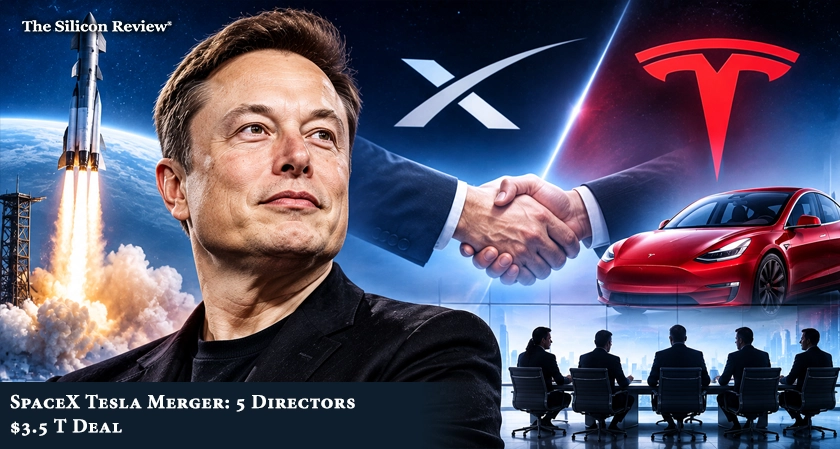
SpaceX Tesla merger talks advance with five directors named to special committees, steering a $3.5 trillion all-stock deal toward a possible December announcement.
News Source: Google trends / https://www.channelnewsasia.com/
SpaceX and Tesla have appointed five independent directors to guide two special committees negotiating a potential merger, according to a Financial Times report citing people familiar with the matter. Tesla Chair Robyn Denholm, Kathleen Wilson-Thompson, and Jack Hartung represent the automaker, while Roelof Botha and Randy Glein represent SpaceX.
The structure exists to manage a conflict that would complicate any ordinary negotiation. Elon Musk leads both companies and holds major stakes in each, so the independent panels are hashing out deal terms without his direct participation. Musk himself acknowledged on SpaceX's third-quarter earnings call in October that a merger unifying his AI, robotics, EV, and aerospace ambitions under a single roof would be "a good idea," and confirmed the committees had been formed.
The Advisers and the Structure
The committees have retained advisers to build the financial models underpinning their negotiating positions in an all-stock merger. Morgan Stanley and Goldman Sachs are advising SpaceX, while Evercore advises Tesla. The bankers are mapping overlaps between the two businesses, a task complicated by the regulatory exposure each side carries: SpaceX's US defense contracts and Tesla's reliance on Chinese manufacturing.
At current valuations, SpaceX exceeds $2 trillion and Tesla stands at roughly $1.5 trillion, producing the combined $3.5 trillion figure that would make this the largest corporate combination in history. Any tie-up would require approval from at least half of all outstanding Tesla shares.
If the entire rationale is consolidating Musk's empire, what exactly are the independent committees negotiating against?
The Governance Question
The committee structure is a direct response to the SolarCity precedent. When Tesla acquired SolarCity in 2016, Musk was the largest shareholder in both companies, and no independent committee negotiated the deal. Shareholders sued, and the litigation consumed years before Delaware's Supreme Court ultimately ruled on the price. This time, the committees were formed at shareholder urging, and Musk is excluded from the room.
That exclusion creates an unusual dynamic. The committees can negotiate terms, but Musk's voting position shapes the outcome regardless of what they agree. He owns roughly 20 percent of Tesla and holds an estimated 85 percent of SpaceX's voting power through a dual-class share structure. Barclays modeling cited in the reporting suggests a combined entity could give Musk approximately 56 percent of voting rights despite holding about 37 percent of total equity. The committees are negotiating an exchange ratio that will determine how much of that consolidation is transferred to Tesla shareholders.
The Timeline and the Hurdles
Bloomberg reported earlier this month that a deal could be announced as early as December, though discussions could extend into early 2027. Neither company has confirmed a timetable, an exchange ratio, or a shareholder vote schedule.
The regulatory path is not straightforward. SpaceX holds US government and defense contracts that involve national security considerations, while Tesla operates major manufacturing facilities in China including its Shanghai plant. Regulators in both countries could scrutinize how sensitive US defense technology would be protected from access through Tesla's Chinese operations. The political environment adds another variable: Democrats took control of Congress in the midterms, and analysts have suggested the merger could face greater scrutiny as a result.
For now, the five directors are doing the work that Musk cannot do himself. Whether their negotiations produce a deal announcement in December or a longer process depends on how quickly two companies with different risk profiles, different regulators, and a shared controlling shareholder can agree on what the combination is actually worth.












Comments