>>
Other>>
Politics>>
Trump, Putin and Xi Sign Peace...Trump, Putin and Xi Sign Peace Declaration After 90-Minute Shenzhen Summit
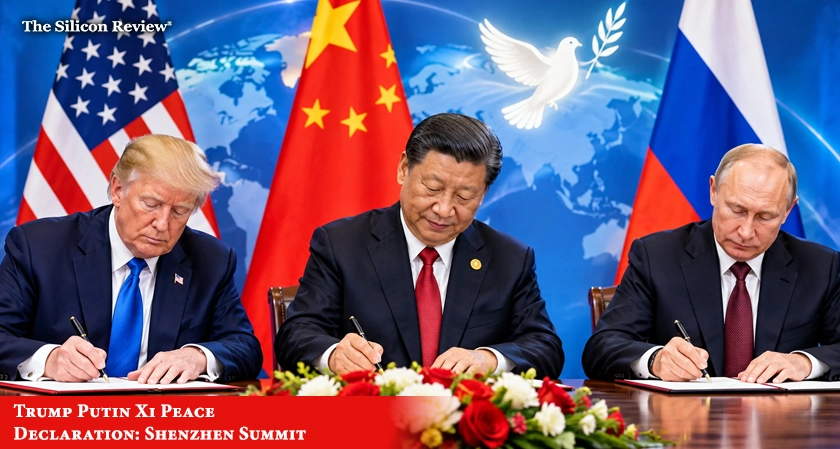
Trump, Putin and Xi issued a joint peace declaration after 90-minute talks in Shenzhen, covering nuclear risk, energy and UN reform.
News source: Google / https://www.bbc.com/
The leaders of China, the United States and Russia issued a joint "Declaration toward Peace" on Thursday following an unprecedented trilateral summit in Shenzhen, lasting approximately 90 minutes. The statement was published by Chinese state media and the Kremlin. The White House had not released its own version at the time of reporting.
The summit itself is without modern precedent. The three countries have not convened at leader level in this format since the Second World War, and the venue choice carried its own signal: Shenzhen, the city that became the emblem of China's economic opening, hosting a meeting framed around peace rather than trade. The timing, on the margins of APEC, allowed all three leaders to present the declaration as a product of the same multilateral moment rather than a separate bilateral arrangement.
The declaration committed the three countries to upholding strategic stability and international security, increasing the production and supply of refined petroleum products, and engaging in dialogue on reducing nuclear risks and preventing proliferation. It also stated that the International Criminal Court and similar institutions "must not abuse their jurisdiction," and affirmed the principle of state consent and diplomatic immunity for state officials.
What the Text Says
The full document, released by Xinhua, framed the three nations as permanent UN Security Council members committed to reforming the United Nations so it can respond more effectively to global challenges. On nuclear weapons, the leaders reaffirmed that "a nuclear war cannot be won and must never be fought."
The economic provisions deserve attention precisely because they sit inside a peace document. Committing to increase refined petroleum supply is an energy-market intervention dressed as diplomacy, and it aligns three producers and consumers whose interests rarely converge. For Beijing and Moscow, it offers a framework to coordinate output and pricing without the OPEC+ label. For Washington, it creates a channel to influence global fuel costs ahead of domestic political pressure.
Xi described the meeting as "positive, constructive, and fruitful," saying the three countries share a common perspective on safeguarding world peace. Putin said Russia, China and the US "hold joint responsibility for maintaining international peace and security." Trump called the session "really making history" and said "no peace was ever forged by declining opportunities for engagement."
If the declaration omits the war in Ukraine entirely, what exactly is being declared peaceful?
The Ukraine Omission
The official readout made no reference to Russia's invasion of Ukraine, despite Trump telling reporters before the meeting that the conflict was on the agenda and that he had already discussed it with Putin. Putin said Ukraine was discussed during bilateral meetings, but the joint declaration does not mention it.
That gap is the central analytical question. A peace declaration that does not name Europe's largest land war since 1945 defines peace narrowly: as strategic stability among nuclear powers, not the resolution of active conflicts. The framing suits all three signatories. It allows Trump to claim engagement without committing to outcomes, Putin to appear at a peace table without discussing withdrawal, and Xi to position China as a broker without taking a position on the war's conduct.
Hours before the trilateral, Australian Prime Minister Anthony Albanese used his APEC speech to directly address Putin: "End your war, end it now." Putin did not look up when addressed.
The ICC Provision
The clause on the International Criminal Court carries particular significance for Putin, who remains subject to an ICC arrest warrant over the alleged unlawful deportation of Ukrainian children. The declaration's language on jurisdictional limits and state immunity effectively aligns the three signatories against the court's authority at a moment when it is actively pursuing cases involving Russia.
The provision is broader than one case, however. By asserting that international bodies must not exceed their jurisdiction and must respect state consent, the declaration stakes out a shared position on the limits of international law itself. It is a doctrine as much as a diplomatic gesture, and it will be read closely by governments that rely on those institutions for accountability.
The Reaction and the Road Ahead
European capitals responded with caution. The declaration's silence on Ukraine and its language on the ICC will be read in Brussels and Kyiv as an attempt to legitimize the current territorial status quo without saying so. Whether the document produces any follow-through, a second summit, working groups, or concrete nuclear-risk talks, will determine whether it becomes a framework or a photograph.
For now, the three leaders have produced a text that commits them to dialogue on the issues where their interests align and to silence on the issue where they do not. That may be the most honest thing about it.
FAQ:
Q: What did the three leaders sign?
A: A joint "Declaration toward Peace" covering nuclear risk, energy supplies, UN reform and ICC jurisdiction.
Q: Did they discuss Ukraine?
A: Putin says it was discussed bilaterally, but the declaration does not mention it.
Q: What does the declaration say about nuclear weapons?
A: That a nuclear war cannot be won and must never be fought, with dialogue on reducing risks.
Q: What does it say about the ICC?
A: That the court and similar bodies "must not abuse their jurisdiction."
Q: Where did the summit take place?
A: Shenzhen, China, on the sidelines of the APEC summit.
Q: What is the significance of the energy provision?
A: It creates a coordination framework for refined petroleum supply outside OPEC+ structures.













Comments