>>
Education>>
Education>>
Why International Students not...Why International Students not preferring the U.S. in 2026? Major Decline in Immigrant Students Says Institute of International Education and the US Dept. of State
Reading time: 5 Minutes
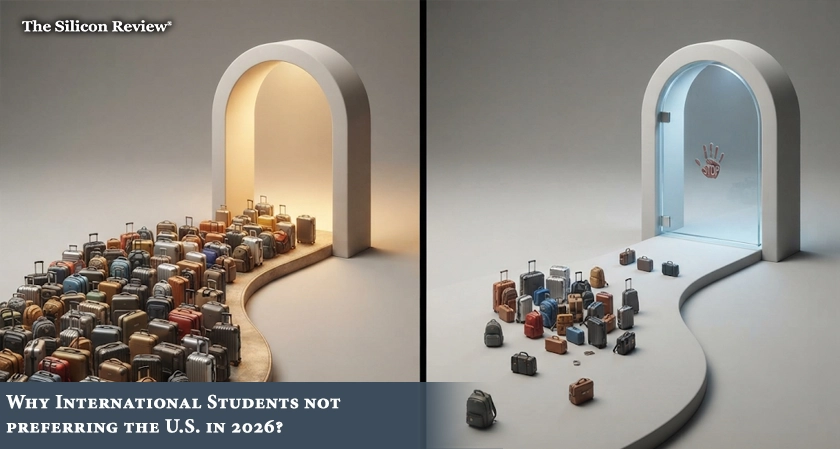
It’s almost the end of 2026 and we have seen how entire USA has turned against the International students in 2026. The hate around immigrant students started from USA but it didn’t stop there, it widespread all around the world. For many years, the United States was the unchallenged top choice for foreign and immigrant students looking for excellent educational opportunities and exciting employment possibilities. However the report of Institute of International Education (IIE) and the U.S. Department of State shows a significant, annual drop in international student’s admission in American institutions. The shift in international education 2026 around USA is because of strict visa regulation, economic, political conflicts, regulatory shifts, and emergence of alternative global educational hubs.
The Silicon Review came up with its thorough in-depth analysis of fundamental facts, change in policy, and new developments around U.S. that will answer; Why international students are not preferring the U.S. in 2026?
Decline in International Students
The decline in international student enrollment is a steady pattern rather than a sudden increase, says recent informational reports. The reports by the U.S. Department of State and the Institute of International Education (IIE) claim that the decline affects both total campus enrollment and new arrivals.
- New Enrollment Plunge - Followed by an 18% decline in new international student’s enrollment during 2025-2026 academic year, initial data for fall 2026 indicate an additional 15% decrease.
- Overall Campus Drop - Last year, the overall number of international students across all academic years decreased by 3%, and in fall 2026, it fell by an additional 9%. Since the peak of the COVID-19 epidemic, this is the worst recurring fall.
- Graduate Programs Impacted - Postgraduate courses are most severely impacted by the decline. STEM disciplines and business departments, which mainly rely on international students, were immediately impacted by the more than 20% decline in master’s degree applications and enrollments.
Core Factors Driving Immigrant Students From the U.S.
We must examine the particular systemic obstacles put in place throughout the past two years in order to understand why immigrant students are avoiding U.S. universities.
· Stricter Visa Vetting and Administrative Delays
Getting a student visa became more difficult and uncertain. Problems in visa applications were reported by 88% of colleges as the main cause of declining enrollment in an Institute of International Education survey of over 800 universities. Prolonged screening processes, a brief 3-week halt to student visa interviews, and the requirement to submit public social media handles for extensive surveillance are some recent changes. Additionally, the massive sweeping operations, resulted sudden termination of Student and Exchange Visitor Information System (SEVIS) monitoring status for hundreds of active students, raising concern about the duration of legal status.
· Post-Graduation Career Uncertainty (The OPT Crisis)
In the past, the ability to obtain practical experience at prestigious American Companies through Optional Practical Training (OPT) was a key benefit of investing in the U.S. higher education.
But this route has been jeopardized by recent Department of Homeland Security (DHS) new regulatory actions. The implementation of a $70,000 cost per student applying for the OPT program is the subject of a highly debated proposition. Because universities would be forced to either absorb or pass this massive fee down to students. According to 95% of surveyed universities reported that immigrant students are actively looking for reasonably priced post-graduate work permits.
· On-Campus Work Limits and Escalating Financial Costs
Considering annual living and tuition costs often surpassing $30,000 to $40,000 and at prestigious private universities, the cost climbing above $100,000. The cost of studying in the United States has hit an all-time high. Strict federal labor laws worsen these high tuition costs. Legally speaking, F-1 student visa holders are only permitted to work 20 hours a week, all of which must be done on campus. For many immigrant and overseas family and overseas family members, the financial equation is problematic because partners and dependents of F-1 visa holders are legally prohibited from working at all.
· Perceptions of Unwelcoming Environment
The reputation of U.S. higher education has been harmed by controversy around travel restrictions and immigrations laws. Because of hatred incidents around immigrant students, new students and their families now believe that United States is not as safe or welcoming as it used to be in earlier times. Students are strongly discouraged by safety concerns as well as the worry that leaving the United States during a vacation could result in a rejection of re-entry.
Where are Students Going? The Rise of Alternative Education Destinations
The global demand for higher education has not decreased due to the decline in international students in the USA; instead it opened the gate for alternative Education Destinations. The students are moving to more welcoming countries. The Studyportals and NAFSA’s global university search report reveals that while enrollment is sharply declining in the United States, it is significantly increasing in other countries.
|
Destination Region
|
Strategic Advantage Over the U.S. |
|
EUROPE CONTINENT (FRANCE, GERMANY, ITALY) |
Low or Fully Sponsored Tuition Fees, and Easy Citizenship Routes, Less External Threats |
|
UNITED KINGDOM |
Historical Educational Reputation, Less Visa Obstacles and Post-Study Employment Visa |
|
ASIA & ARABIAN GULF (UAE, JAPAN, SINGAPORE, RUSSIA, CHINA) |
Massive Scholarship Support, Convenient access to home countries, and Rising Regional University Rakings |
Limitations in United States policy are being utilized by nations like Japan, China, Russia, and Singapore. They are effectively establishing themselves as the new gateways for immigrant students by providing reduced tuition fees, significant state-funded scholarships, and simple low-cost pathways to citizenship.
What the Future Holds
A crucial fact is brought to light by the change in international education 2026: Talented students from around the world are extremely affected by U.S. Visa Regulations and Post-Graduate Financial Security. Overseas and immigrant students will keep trying to move to more friendly foreign options, that offers reduced tuition fees, significant state-funded scholarships, and simple low-cost pathways to citizenship and as long as the United States maintains strong financial hurdles, immigration problems, and stricter visa regulations.
FAQs:
Q: Why are international students declining in the USA in 2026?
A: The shift in international education 2026 around USA is because of strict visa regulation, economic, political conflicts, regulatory shifts, and emergence of alternative global educational hubs.
Q: By how much have international students enrollment dropped in the US?
A: According to Institute of International Education survey of over 800 universities, by an 18% decline in new international student’s enrollment during 2025-2026 academic year, initial data for fall 2026 indicate an additional 15% decrease.
Q: What is the biggest barrier for immigrant students applying to US universities?
A: Problems in visa applications were reported by 88% of colleges as the main cause of declining enrollment in an Institute of International Education survey of over 800 universities.
Q: Which academic programs are most affected by the US international student decline?
A: Postgraduate courses are most severely impacted by the decline. STEM disciplines and business departments, which mainly rely on international students, were immediately impacted by the more than 20% decline in master’s degree applications and enrollments.
Q: Where are international students going instead of the USA in 2026?
A: The Studyportals and NAFSA’s global university search report reveals that while enrollment is sharply declining in the United States, it is significantly increasing in other countries. Including Europe continent (France, Germany, Italy), United Kingdom, and Asia & Arabian Gulf (UAE, Japan, Singapore, Russia, China).













Comments