>>
Technology>>
Artificial intelligence>>
An Embodied Data Breakthrough:...An Embodied Data Breakthrough: A Dark Horse Approach Emerges to Solve Silicon Valley’s Hardest Problem

The embodied intelligence industry has long been plagued by a deceptively simple problem: data scarcity. To collect more training data at lower cost, teams around the world have tried virtually every approach imaginable — teleoperation rigs, ALOHA bimanual systems, UMI grippers, and egocentric wearable cameras. Silicon Valley darlings like Physical Intelligence and NVIDIA’s recently released EgoScale project are both pouring resources into large-scale collection of first-person human video. Yet whether operators are strapped with GoPros, gripping UMI handles, or wearing heavy exoskeletons, they keep running into the same wall: wearable collection devices not only drive up hardware costs significantly, they also severely drag down operator efficiency in real-world scenarios. The entire embodied AI field has been searching for a data solution that actually scales.
Now, a less-expected player is proposing an answer that sidesteps the hardware problem entirely. Vbot has released Exo2EgoPolicy, a model that converts third-person internet video — the kind already flooding platforms in massive volume — into the first-person perspective robots need for training. No specialized collection equipment required. For an industry that has been trying to solve the data bottleneck by building more hardware, this represents a fundamentally different and potentially far more scalable approach.
Vbot, a company building its name in the embodied AI data layer, released on November 13 a system it argues can fundamentally rewire how robot training data is sourced, generated, and processed. The release bundles three components: Exo2EgoPolicy, a cross-view video generation model; Vbot Echo, an end-to-end data pipeline; and Echo App, a consumer-facing mobile application for real-world data capture. Together, they form what Vbot positions as a complete data infrastructure — from raw video ingestion to robot-ready training output.
The Scale of the Untapped Resource
The core insight is straightforward. Every day, humans upload enormous volumes of video showing themselves performing tasks — cooking, assembling objects, navigating spaces, handling tools. YouTube adds more than 20 million videos daily; TikTok sees over 100 million content uploads each day. These recordings contain rich, implicit knowledge about how the physical world works: the sequence of actions, the forces applied, the spatial relationships between hands and objects.
The problem is perspective. Robots learn from egocentric, or first-person, video — the viewpoint of the actor performing a task. Internet footage is overwhelmingly exocentric, captured by an outside observer. A video of someone folding laundry shot from a tripod across the room tells a robot very little about how to coordinate its own arms for the same task.
Bridging this viewpoint gap has been an active area of research. Physical Intelligence, the Silicon Valley robotics startup, has published work on transferring human video demonstrations into robot policies. NVIDIA's EgoScale project has explored scaling egocentric human video for robot learning. But these efforts largely address the downstream problem — making existing first-person data more useful — rather than the upstream bottleneck of converting the far more abundant third-person footage into a usable form.
What Exo2EgoPolicy Does
Exo2EgoPolicy is a generative model that takes a third-person video as input and produces the corresponding first-person view. Under the hood, the model combines a video generation backbone with visual encoding and semantic understanding modules. It identifies the actor in the scene, tracks hand movements and object contacts over time, and reconstructs the spatial layout and appearance of the environment from the actor's own viewpoint.
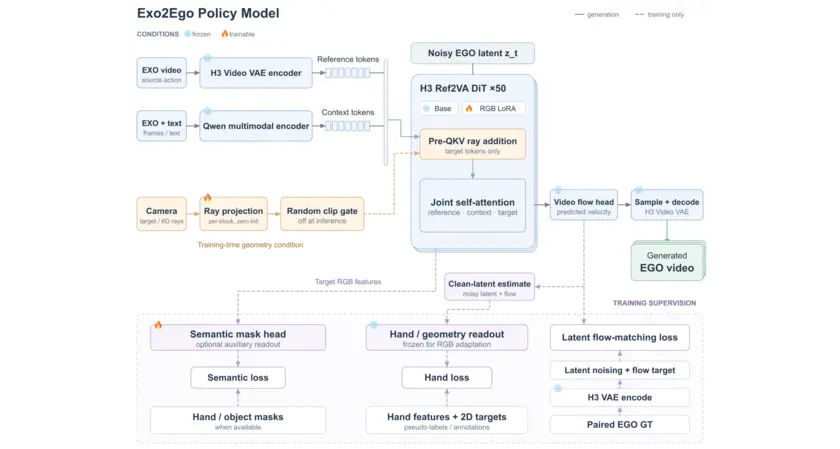
Vbot designed the model to handle the messiness of real internet footage. Videos sourced from social media platforms frequently contain multiple people, shifting camera angles, abrupt cuts between shots, and occlusions. The model uses person, action, and scene cues to disambiguate who is performing the task and supports specifying a target individual in multi-actor scenes, ensuring the generated first-person view follows a consistent operator throughout.
A notable design choice is that Exo2EgoPolicy requires only the input video itself — no depth maps, no camera calibration parameters. Vbot achieves geometric fidelity by baking camera geometry constraints, hand structure priors, and real manipulation data into the training process. The result, the company said, is generated video with reasonable spatial structure, clear material textures, and coherent motion — a significant step above naive viewpoint transfer that often produces blurry or physically implausible output.
The Pipeline: From Video to Trainable Data
Generating a first-person video is only the first stage. For that video to be useful in training a robot policy, it must be converted into structured data that encodes not just what the actor saw, but how the robot should move.
Vbot Echo addresses this through a multi-stage pipeline. After Exo2EgoPolicy produces the egocentric view, the pipeline performs dynamic scene reconstruction, semantic understanding, and human-object pose estimation, followed by temporal alignment across frames. These steps produce a unified human-object interaction (HOI) representation that captures the spatial geometry, task semantics, hand and object motion, and full-body interaction dynamics of the demonstrated task.
The pipeline then performs cross-embodiment kinematic retargeting — translating human arm and hand motions into joint trajectories and end-effector paths appropriate for a specific robot's morphology and kinematic constraints. This is where the system accounts for the fact that a human arm and a robotic arm have different degrees of freedom, different reach envelopes, and different physical limitations.
A physics simulation layer adds another dimension. The pipeline models contact interactions between the robot and its environment in simulation, generating auxiliary labels such as contact forces and joint torques. These labels are not directly observable from video alone, yet they are critical for training policies that must exert appropriate physical forces during manipulation tasks.
Quality assurance is built into the loop. The system checks for motion stability, object penetration artifacts, and trajectory tracking errors, feeding validation results back to optimize earlier stages. Vbot Echo also maintains provenance labels that distinguish simulation-generated auxiliary annotations from directly measured data — a detail that matters for downstream users who need to assess data reliability.
Lowering the Collection Barrier
On the data acquisition side, Echo App takes a deliberately low-friction approach. Rather than requiring operators to wear specialized capture rigs or use teleoperation systems, the app asks users to simply place a smartphone near the work area and record the task. The footage uploads to the cloud, where it enters the Exo2EgoPolicy and Vbot Echo pipeline automatically.
The design choice is strategic. The embodied AI industry has experimented with various collection modalities — UMI devices, ALOHA-style bimanual teleoperation rigs, first-person wearable cameras — each of which adds hardware cost and operational friction. By reducing data capture to a smartphone recording, Vbot is betting that volume and diversity of data will come from lowering barriers rather than increasing collection sophistication.
What It Means for the Industry
Vbot's release reflects a broader shift in how the embodied AI industry thinks about data. The field is moving from small-scale, high-fidelity collection efforts — where research teams spend weeks capturing thousands of demonstrations in controlled environments — toward approaches that leverage the massive, continuously generated corpus of human video already in existence.
The company's ambition is clear: to become the data infrastructure layer for embodied intelligence, connecting the world's existing video assets to the training pipelines of robot developers. Whether this model can deliver on the quality and scale requirements of production robotics remains to be seen, but the architecture it proposes — cross-view generation feeding into physics-aware structured processing, with consumer-grade collection at the front end — represents a coherent answer to one of the field's most pressing open problems.
Vbot Echo is now fully open. Developers and research teams are invited to collaborate with Vbot in building a scaled data network for embodied intelligence.Project page: https://www.vbot.cn/echo/ — includes Echo App download links and the full technical report.












