>>
Industry>>
Management consulting>>
What Nvidia's CEO Exit Teaches...What Nvidia's CEO Exit Teaches Every Founder About Succession Planning: 4 Lessons From Business Leaders
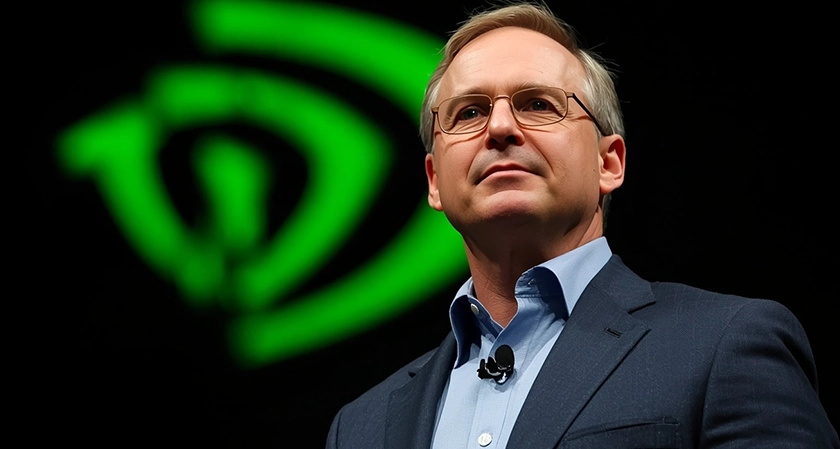
Nvidia's sudden announcement that Jensen Huang resigned as President and CEO sent a clear message far beyond the tech industry. The company named Colette Kress, its longtime Chief Financial Officer, as interim CEO while the board searches for a permanent replacement, and it also named its first-ever Board Chair to help guide that search. Nvidia moved quickly to reassure customers and investors that operations would continue without interruption. But the speed of that announcement raised an obvious question that founders everywhere should be asking themselves right now. What happens to your business the moment you are no longer the one running it? Markets, employees, and customers all watch closely during moments like this, and how a company responds often says as much about its leadership as the departure itself.
For years, Jensen Huang was treated as nearly inseparable from Nvidia itself, the kind of founder whose personal vision and decisions shaped nearly every major move the company made. That reputation helped build one of the most valuable companies in the world, but it also created a quiet risk that many analysts pointed to the moment his exit became public. When a company becomes defined by one leader's presence, any sudden transition can create uncertainty, even if the underlying business remains strong. Nvidia's board seemed aware of this risk, moving fast to appoint an interim leader and signal continuity to the market. Naming an interim CEO so quickly suggests the board had at least some plan in place, even if a permanent successor had not yet been chosen, which likely helped calm nerves during an otherwise unsettling week.
This situation is not unique to massive public companies worth hundreds of billions of dollars. Small business owners, franchise operators, law firms, and startups all face the exact same risk on a smaller scale. A founder who never builds a plan for what happens next is building a company that depends entirely on their own presence to survive. That dependency might feel manageable during normal years, but it becomes a serious liability the moment illness, retirement, burnout, or an unexpected departure forces a transition nobody planned for. Even a short, unplanned absence can expose how much a business quietly relies on one person simply being available every single day.
The good news is that succession planning does not require a company the size of Nvidia to take seriously, nor does it require years of advance notice to start. Business leaders across very different industries have learned the same core lessons about preparing a company to survive a leadership change, often through hard experience rather than theory. Their insights, shared throughout this article, offer a practical roadmap for any founder hoping to build something that outlasts their own involvement, whether that transition happens on their own terms or not.
Lesson One: A Business Should Never Depend on One Irreplaceable Person
The clearest lesson from Nvidia's sudden transition is also the simplest. A company that depends entirely on one person to function is fragile, no matter how impressive that person's track record might be. This risk shows up constantly in smaller businesses too, especially when a founder handles every major decision personally instead of building a team capable of carrying real responsibility.
Andrew Gazdecki, Founder and CEO of Acquire.com, has watched this exact pattern play out repeatedly while helping thousands of founders sell their companies.
"Every founder on Acquire.com eventually asks the same question, who runs this if I step away tomorrow. We have watched deals fall apart because a founder was the only person who understood the product or the customers. One seller added a second decision maker six months before listing, and the business sold 20 percent faster because buyers trusted it could run without him. Succession planning is not about ego, it is about proving your company is bigger than one person."
This lesson applies whether a founder plans to sell, retire, or simply take a well-earned break. Buyers, employees, and customers all feel more confident when a business clearly works as a system rather than as an extension of one individual's daily involvement.
Lesson Two: Train Leaders Before You Actually Need Them
Waiting until a crisis forces a leadership change is one of the most common mistakes founders make. By the time a transition becomes urgent, there is rarely enough time to properly train someone new on the responsibilities they are suddenly expected to carry. Smart founders build leadership depth long before they actually need it, treating the process as an ongoing investment rather than an emergency response.
Bennett Maxwell, Founder of Franchise KI, scaled a national cookie brand past 400 locations by applying exactly this principle well before any exit was on the table.
"I scaled Dirty Dough to over 400 locations because we built systems that did not depend on me standing in every store. We trained regional leaders early so the brand kept growing even while I focused on the next deal. When I exited to Craveworthy, buyers paid more because operations ran smoothly without my daily involvement. Franchise owners who build a strong number two almost always exit for a bigger number later."
Training future leaders early does more than prepare a business for an eventual exit. It also frees up the founder's time in the present, allowing growth to continue even while that founder is focused on other priorities.
Lesson Three: Document the Knowledge That Lives Only in Your Head
Many founders carry enormous amounts of institutional knowledge that exists nowhere outside their own memory. Processes, client relationships, and hard-won lessons often stay undocumented simply because there never seems to be enough time to write them down. This becomes a serious problem the moment that founder needs to step away, whether gradually or suddenly.
Ramiro Lluis, Managing Attorney at Lluis Law, has spent 48 years building a family-run practice and understands firsthand how fragile a business becomes when knowledge is not properly passed down.
"In 48 years of practicing law, I have seen too many small firms collapse the moment the founding attorney steps back. My own practice stayed strong because we trained family members early to carry real responsibility, not just answer phones. When I slowed down for health reasons, our clients barely noticed the transition because the team was already ready. A business built around one irreplaceable person is not actually a business yet."
This lesson matters just as much for a two-person startup as it does for a decades-old law firm. Writing down processes, decision-making criteria, and client history protects a business from losing critical knowledge the moment a key person is no longer available to answer every question personally.
Lesson Four: Build a Company That Is Valuable Without You in the Room
The ultimate test of a well-prepared business is whether it continues to run smoothly even when its founder is not actively managing every detail. This does not mean a founder's involvement does not matter. It means the company has been built so that its value exists independently of any single person's daily presence.
Alvin Poh, Founder of Singapore Domain Names, built and sold his previous hosting company for 30 million dollars by focusing heavily on this exact principle throughout its growth.
"When I sold Vodien for 30 million dollars, buyers cared more about my team than about me personally. We had documented every process so thoroughly that a new owner could step in without missing a single customer request. I later built CLDY the same way, with leadership that could run daily operations while I focused on strategy and mentoring. A company becomes truly valuable the day it no longer needs its founder in the room."
This final lesson ties together everything the other examples demonstrate. A business becomes genuinely strong, and genuinely valuable, once it can thrive independently of the person who originally built it.
The Real Takeaway From Nvidia's Sudden Transition
Nvidia's leadership change offers a lesson every founder should take seriously, regardless of the size of their company. A sudden exit, whether caused by personal circumstances, health, or simply a desire to move on, can happen to any leader at any time. The businesses that survive these moments gracefully are the ones that prepared long before the transition became necessary.
Building a strong second-in-command, documenting institutional knowledge, training future leaders early, and designing a company that holds value independent of its founder are not optional extras reserved for massive corporations. They are practical habits that protect any business, whether it employs three people or thirty thousand. Nvidia had the resources to manage a sudden transition smoothly, but a smaller business without that same depth of leadership might not recover as easily from an unplanned departure.
The founders who take succession planning seriously today are the ones who build companies strong enough to survive whatever tomorrow brings, planned or not. None of these leaders waited for a crisis to force their hand, and that single habit may be the biggest difference between a business that merely survives a transition and one that comes out of it even stronger.













Comments