Leading Companies of the Year 2026
Inside DE LAMA SPA’s 75-Year Journey of Innovation in Pharmaceutical Sterilization
The Silicon Review
Founded in 1949 in Italy, DE LAMA SPA emerged from a moment of global rebuilding and industrial transformation. Its founder, Franco De Lama, returned from serving as a sailor during World War II with a clear vision of the future. After graduating in engineering in Genoa, he recognized that the post-war period would usher in rapid expansion in the pharmaceutical sector. Acting on that insight, he established a company dedicated to designing and manufacturing sterilization equipment, becoming the first Italian manufacturer to focus on sterilization technologies specifically for the pharmaceutical industry.
Headquartered in San Martino Siccomario, the company has spent more than seven decades developing advanced solutions that ensure safety, sterility, and compliance in highly regulated environments. Today, DE LAMA SPA serves global pharmaceutical and medical device manufacturers, providing specialized equipment designed to meet strict production and quality standards. The company’s technology portfolio spans a wide spectrum of sterilization methods used across pharmaceutical and medical device manufacturing. These include saturated steam, air-steam mixture systems, superheated water sterilization, ethylene oxide processes, and dry heat sterilization. At the forefront of its innovations is a vaporized hydrogen peroxide sterilizer built on the company’s patented HyPerPure® technology, designed to deliver efficient and reliable decontamination for sensitive applications.
Beyond sterilization systems, DE LAMA SPA also produces complementary equipment essential to pharmaceutical production environments. Its offerings include vaporized hydrogen peroxide decontamination units, pharmaceutical washing equipment, dryers, vacuum dryers, and steam generators. This integrated product ecosystem enables manufacturers to maintain strict contamination control across multiple stages of production. Over the years, the company has built strong relationships with some of the most respected names in healthcare and medical technology, including Eli Lilly, Medtronic, Stryker, B. Braun, Merck & Co., and Novo Nordisk—a testament to its reputation for engineering excellence and reliability in critical healthcare applications.
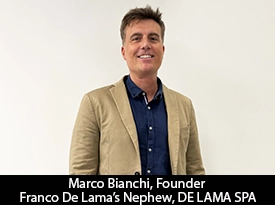
In conversation with Marco Bianchi, nephew of the Founder and member of the family still holding 100% of De Lama after 77 years
With over 75 years of history, De Lama has evolved from Italy's first sterilizer manufacturer to a world leader in HyPerPure® hydrogen peroxide sterilization. What have been the key milestones in this journey, and what drives your continuous focus on innovation?
We were driven by market demand. Leading-edge companies asked us to develop an ecological, safe, and reliable replacement for low-temperature Ethylene Oxide (EtO) sterilization.
EtO has historically been one of the few, and sometimes the only , available methods for low-temperature sterilization of thermosensitive medical devices. Unfortunately, it is highly toxic, carcinogenic and explosive. It poses risks not only to workers but also to the population living near EtO plants.
Twenty years ago, we had the intuition to combine our expertise in deep vacuum technology, used in our vacuum dryers, with our know-how in managing H₂O₂, developed through our decontamination units.
We succeeded with our patented HyPerPure® technology and our unique HyPerGeneSys® vH₂O₂ generator. We delivered the first unit in 2015 for a major Pharma company and have continuously improved both the technology and the process since then.
We realized that low-temperature vH₂O₂ sterilization is not only ideal for thermosensitive products such as most medical devices, but it is also a reliable alternative to heat sterilization methods like saturated steam. Compared to steam, it saves up to 70% energy, resulting in a 70% reduction in CO₂ emissions, and eliminates water consumption entirely.
Your philosophy of "total customization" means each plant is built "ad hoc" from the customer's specifications. How does this "industrial tailoring" approach benefit clients in critical sectors like pharmaceuticals and medical devices, and how do you balance it with efficiency?
This has always been our approach. The pharmaceutical industry increasingly requires tailored solutions, both in terms of process requirements and equipment size and configuration.
The combination of unique features and customized dimensions makes it impossible to manufacture equipment in series for the most demanding companies.
That is why, from the very beginning, we focused on tailor-made solutions. Of course, this sector is less scalable, but today it is the only viable path if you want to serve leading-edge pharmaceutical companies.
De Lama holds a pioneering position with HyPerPure® technology for sterilizing heat-sensitive products. Can you explain why this method, using H₂O₂ under deep vacuum, is considered the "greenest" and most innovative solution on the market today?
As mentioned above, HyPerPure® technology was developed to overcome the limitations and dangers of EtO, which we also manufacture and continue to supply.
The system releases only water and oxygen molecules into the atmosphere, nothing could be greener.
We also discovered that low-temperature vH₂O₂ sterilization is not only ideal for thermosensitive products such as medical devices, but is also a reliable alternative to traditional heat sterilization methods like saturated steam. Compared to steam, it reduces energy consumption by up to 70%, lowers CO₂ emissions by approximately 70%, and eliminates water usage entirely.
Today, we are also able to offer combined equipment that integrates both technologies within the same sterilizer: vH₂O₂ sterilization and saturated steam.
This represents the best approach for many customers, as it provides maximum production flexibility. They can continue using traditional steam sterilization while gradually learning how to implement and validate vH₂O₂ sterilization for different products.
You offer a complete ecosystem beyond sterilizers, including washers, decontamination pass-boxes, dryers, and critical validation services. How does providing this integrated portfolio, along with solutions like Magnetodoor® for isolator integration, ensure total customer satisfaction and compliance with stringent regulations like the new Annex 1?
Yes, and we are proud to say that this can be verified in our archives, we anticipated many of the requirements later formalized in the new Annex 1.
For example, Magnetodoor®, the first magnetic-driven door designed for pharmaceutical equipment, allows direct connection between a De Lama sterilizer, washer, or combined solution and an isolator from other manufacturers. This creates a single aseptic environment and eliminates contamination risks during product transfer.
This approach perfectly aligns with Annex 1 principles: reducing and controlling contamination risks while minimizing human intervention, since human presence remains the primary source of contamination.
Your website highlights impressive investments in advanced production machinery, a highly specialized staff with very low turnover, and the use of the best market components. How do these factors translate into the "exceptional duration" and reliability your equipment is known for?
We believe reliability is the result of three key factors: engineering depth, production quality, and people.
We invest continuously in advanced manufacturing technologies and select only top-tier components available on the market.
At the same time, we have a highly specialized technical team with extremely low turnover. This guarantees continuity of know-how, attention to detail, and long-term process control.
The result is equipment with exceptional longevity, often operating efficiently for decades, ensuring high return on investment for our customers.
We have many equipment still on the market after more than 30 years from the deliver, where only the software has been updated. This is a dramatical return on investement for our Customers!
With over 5,000 equipment units installed in more than 1,000 companies worldwide, De Lama has a truly global footprint. How does your network of local agents and your ability to perform remote services like FAT-Online support international clients and ensure prompt after-sales care?
Our global network of qualified local agents allows us to provide immediate support in different markets and regulatory environments.
In addition, we were among the first in our sector to introduce FAT-Online, enabling customers to witness Factory Acceptance Tests remotely. This innovation significantly reduces travel costs and project timelines while maintaining full transparency and compliance.
Combined with remote diagnostics and technical support capabilities, this ensures rapid after-sales service and long-term operational continuity for our international clients.
What does the future hold for your company and its customers?
We are currently expanding our production facility, which by the end of the year will be three times larger than before.
The new generation of HyPerPure® vH₂O₂ sterilizers is ramping up, and what we are seeing today is only the tip of the iceberg in terms of market potential. We are proud that also some of the major USA Companies today embraced our technology. And we experienced the USA companies as some of the fastest and bravest to invest on a new state-of-the-art technology.
However, we are not relying on a single technology. In the coming months, we will introduce another breakthrough innovation.
Sterilization has always been the bottleneck of the aseptic pharmaceutical process, as most technologies operate in batch mode, making continuous sterilization virtually impossible.
We are now introducing a new system designed to eliminate this friction, a solution capable of working at the pace of continuous production, while using different sterilization processes.
This could represent a paradigm shift in aseptic manufacturing.
Franco De Lama, Founder and CEO
“We believe reliability is the result of three key factors: engineering depth, production quality, and people.”
Search Magazine
Latest Listings