Most Reputable Companies of the Year 2026
KUNGFU.AI Bridges the Chasm between AI Ambition and Production Reality
The Silicon Review
The consulting industry has long operated on a predictable pyramid: junior associates gathering data, mid-level managers synthesizing findings, and senior partners delivering recommendations. Below the pyramid's peak sits PowerPoint. Above it sits implementation risk. Clients receive beautifully formatted strategies and then discover that no one in the room knows how to deploy a production-grade large language model, secure a computer vision pipeline against adversarial attacks, or validate a clinical algorithm through FDA channels. That structural failure is not accidental. It is the inevitable consequence of separating strategy from engineering. KUNGFU.AI was founded in 2017 to eliminate that separation entirely.
Based in Austin, Texas, KUNGFU.AI operates as a management consulting and engineering firm focused exclusively on artificial intelligence. The firm does not produce slide decks that gather dust. It produces production-grade AI systems that generate measurable business results. With more than 120 projects delivered across thirty industries and a team composed heavily of PhD-level AI experts, the firm has automated $18 billion in annual financial transactions, predicted breast cancer risk five years in advance, built AI strategy for the United States Department of Defense, and increased a client's valuation to $1 billion. Each outcome traces directly to the firm's core architectural decision: strategy and engineering are not sequential phases but parallel workflows.
For 2026, KUNGFU.AI earns its place among the most reputable AI consultancies not through hype but through a client roster that includes Google, Johns Hopkins, the Defense Innovation Unit, and Waste Management and through an ethical framework that caused the firm to turn away its first potential client for moral reasons before it had signed its second.
The Production Imperative as a Revenue Accelerator
Most AI consultancies deliver proof-of-concept models that never survive contact with production environments. KUNGFU.AI reverse-engineered that failure mode. The firm's engineering practice builds for robustness, scalability, and security from the first line of code. For a financial services client processing high-value transactions, KUNGFU.AI delivered an AI system that automated $18 billion in annual volume without a single production failure. The revenue influence was direct: reduced manual reconciliation costs, faster settlement times, and the ability to scale transaction volume without proportional headcount growth. Clients pay for outcomes, not for intellectual property that cannot deploy.
Board AI Governance as a Risk-to-Revenue Conversion
The rise of generative AI has created a liability vacuum in corporate boardrooms. Directors do not understand model drift. They cannot adjudicate between open-source and proprietary architectures. They lack frameworks for algorithmic auditing. KUNGFU.AI's Board AI Governance practice fills that gap through education and training specifically designed for non-technical fiduciaries. For private equity firms, this governance layer translates directly into portfolio valuation. A portfolio company with documented AI governance processes trades at a premium compared to peers with unmanaged algorithmic risk. By helping boards establish defensible AI oversight, KUNGFU.AI protects enterprise value and enables faster AI adoption both of which accelerate revenue realization across the client's business units.
The Ethical Filter as a Reputation Moat
In 2018, KUNGFU.AI turned away its first potential client on ethical grounds. The firm had no revenue, no track record, and no margin for error. It said no anyway. That decision established a precedent that now functions as a competitive differentiator. The firm's Ethics Charter, publicly available and rigorously applied, guides client selection and solution design. For prospective clients in regulated industries, that ethical framework accelerates procurement because legal and compliance teams recognize that KUNGFU.AI has already considered the questions they would otherwise spend months investigating. The result is shorter sales cycles, higher average deal sizes, and a reputation that attracts mission-critical work rather than experimental pilots.
Industry Specialization That Compounds Learning
KUNGFU.AI does not claim to serve every vertical. It concentrates on healthcare, government, private equity, retail, and finance and insurance. Within healthcare, the firm achieved a milestone when client Clairity received the first FDA authorization for an AI platform predicting breast cancer risk five years in advance. Within government, KUNGFU.AI secured a prime contract to implement AI at scale for the Department of Defense. Within private equity, the firm developed repeatable playbooks for portfolio triage, due diligence, and value creation. Each industry win creates referenceable case studies that shorten sales cycles in adjacent segments. The compounding effect is visible in the client list: organizations choose KUNGFU.AI because peers in their industry already have.
The Hidden Layers Content Engine as a Demand Generation Asset
KUNGFU.AI produces a podcast, Hidden Layers, alongside white papers, webinars, and case studies. The content strategy is not incidental. It is a systematic effort to replace traditional outbound sales with inbound credibility. A private equity partner researching AI for portfolio optimization finds the firm's white paper on "The New AI Playbook for Private Equity." A hospital system executive exploring predictive diagnostics discovers the firm's case study on breast cancer risk. By publishing domain-specific, analytically rigorous content, KUNGFU.AI attracts clients who have already self-qualified. That inbound motion lowers customer acquisition costs, improves lead quality, and compresses the time between initial contact and contract signature.
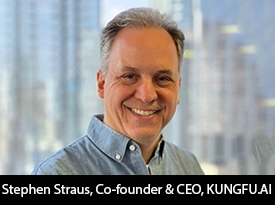
Stephen Straus, Co-founder, Chief Executive Officer