30 Best Companies to Watch 2026
An Expert Rewriting the Rules of Employer Healthcare: Prodigy Benefit Management, LLC
The Silicon Review
Rising medical spend has turned the annual benefits renewal into a predictable drill: premiums climb, plan designs tighten, and employees absorb more cost—often without better access or better outcomes. For many executive teams, the options appear limited: shift cost, reduce benefits, or accept the increase and hope the next year is calmer.
Prodigy Benefit Management, LLC was built to change that equation by addressing what most renewal strategies overlook: behavior, access, and accountability. Prodigy’s Paradigm Plan combines predictive risk insights, credentialed clinical coaching, and virtual access pathways inside a compliance-first participatory framework designed to align incentives with measurable healthcare engagement. The executive objective is straightforward: influence utilization upstream, document value delivery, and reduce avoidable claims while helping employees strengthen household financial protection.
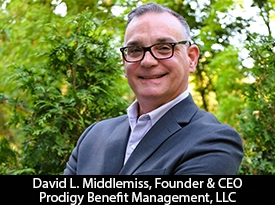
We spoke with founder David L. Middlemiss about why he believes employer healthcare will not be stabilized by plan design alone—and why compliant incentives, smarter triage, and real clinical support must be integrated if employers want durable results.
In Conversation with David L. Middlemiss, Founder and CEO
What motivated you to start Prodigy?
I came into this from financial planning. In the early Affordable Care Act era, two employer clients asked me to review renewals they felt were out of control—18 to 22 percent increases. In New York those plans were community rated and premiums were largely set, but the exercise exposed something bigger: employers were stuck in a cycle with few tools that actually changed utilization.
Employees may face the same copay whether they choose urgent care or primary care, while the cost to the plan can be materially different. People make rational choices based on convenience and what they can see. The downstream claims impact is usually invisible. Add gaps in chronic-condition education and support, and you get higher claims and poorer outcomes. The question became: how do you address cost, access, education, and behavior together—in a way that is measurable and compliant?
Executives hear “preventive” and think “wellness.” What is Prodigy in practical terms?
I avoid “wellness” because many traditional programs reward the already-healthy and fatigue quickly. This is healthcare. We start with health risk assessments supported by predictive analytics, then translate insight into action with private, one-on-one coaching delivered by qualified medical professionals—registered nurses, dietitians, and nutritionists.
We also close access gaps that drive costly utilization: virtual urgent care for common issues, virtual primary care support, and virtual mental health access. Better triage and faster access reduce unnecessary visits and help prevent small issues from becoming expensive events. A program can have great intentions, but if it isn’t usable—if it doesn’t fit real schedules and real motivation—it won’t move the needle.
The Paradigm Plan creates an employee reward opportunity of up to $1,800 annually. How does that work without reducing take-home pay?
The reward is earned; it isn’t a blanket giveaway. Participants complete healthcare activities with demonstrable value—risk reduction, education, care navigation—and they earn rewards under the Plan’s rules. Participants also decide how to use the reward. They can apply it to offset voluntary benefit premiums—such as supplemental coverage, life insurance, or disability coverage—or they can elect to take it as cash. That participant control is a key element. Choice drives ownership, and ownership supports sustained engagement.
From the employer perspective, the model is designed to align incentives with outcomes leadership actually wants: earlier intervention, better decision making, and fewer avoidable claims. When participation changes behavior, behavior changes cost.
Compliance seems central to the model. Why is that non-negotiable?
Because if a plan isn’t defensible, it creates risk for employers and advisors. Paradigm is designed as a participatory plan governed by multiple regulations, including Internal Revenue Code Sections 125, 105,106, and 213(d), along with other related guidance. The practical implication is that plan operations must be structured so that participation, substantiation, and documentation align with the
governing framework.
That’s why we built Paradigm around measurable engagement. We use a points methodology to track participation and support consistent plan administration. Rather than getting into mechanics that can vary by employer and plan configuration, the principle is this: the Plan is designed so the tax treatment and delivery of benefits align with documented participation and the Plan’s governing rules. Employers should always implement and administer any participatory plan in coordination with their legal and tax advisors.
How do predictive analytics and coaching actually shift behavior?
Prediction alone doesn’t change outcomes; people do. Our process is intended to identify likely disease onset within a three- to five-year window and then translate risk insights into action through education and coaching. The predictive accuracy—86 to 90 percent—has been validated by the Validation Institute.
But the leverage comes from coaching that is personal, private, and relevant. The objective isn’t perfection. It’s earlier intervention, better management, fewer complications, and more healthy years. We focus on achievable steps and momentum, not shame. When people feel supported—and when the next right step is clear and realistic—participation becomes more than a checkbox. It becomes a pattern.
How does this change the broker’s role with an executive team?
It elevates the conversation from “rates” to “risk strategy.” A broker who brings a measurable solution like Paradigm can advise on utilization, access, and benefit design that employees actually use. When employees experience real support and tangible value, retention improves and relationships deepen.
For executive teams, this matters because renewals stop being a single annual event and become part of a year-round approach: reduce avoidable spend, strengthen engagement, and improve the employee experience in ways that show up in both claims and culture.
What outcomes should leadership teams look for?
Focus on measurable changes in utilization and avoidable spend: appropriate triage, higher engagement in preventive and disease-management activities, and improved access.
We’ve seen meaningful field results. One self-insured employer reported roughly a 20 percent reduction in healthcare spend after implementing Paradigm; their administrator emphasized they didn’t hire healthier people—the meaningful change was engagement and support. Results vary by workforce and baseline claims experience, but the mechanism is consistent: better decisions earlier tend to cost less later.
Telemedicine is also measurable. While we don’t see identities or individual clinical details, we can categorize call types, map them to CPT codes, and apply CMS-based values to estimate avoided plan spend. During the 2025 plan year, telemedicine utilization translated into more than $150,000 in estimated avoided costs across our participant base.
What’s next for Prodigy?
We evaluate new technology cautiously. There’s hype around AI and emerging diagnostic tools, but clinical validity, data quality, and bias remain real concerns. We adopt tools when they’re accurate,
accountable, and proven.
Operationally, our focus is improving plan design, usability, and engagement—making it easier for participants to take the next right step. We’re also releasing a new plan design in the next month. This design prompts participation through “trigger activities” that guide participants into the next compliant action at the right time—reducing friction and helping people remain aligned with the Plan’s requirements without needing to think about compliance mechanics day to day. The goal is simple: make the compliant behavior the easy behavior.
Meet the leader behind Prodigy Benefit Management, LLC
David L. Middlemiss is the Founder and CEO of Prodigy Benefit Management, LLC. His career began in a small family business, where he learned early that volatility is not an abstraction. Unexpected costs
affect payroll decisions, hiring plans, capital investment, and—most importantly—families. That experience shaped his interest in planning and risk management and ultimately led him into the financial advisory field, where he worked with firms including New York Life, Lincoln Financial Advisors, and MassMutual.
In advisory work, Middlemiss repeatedly encountered the same employer reality: healthcare costs were one of the few line items that could spike with little warning, yet most organizations were offered reactive choices—shift cost, reduce benefits, or accept the increase. He became less focused on premium negotiations and more focused on structural drivers: limited transparency, poor care navigation, inconsistent chronic-condition support, and incentives that rarely reward prevention.
Rather than treat benefits as a purchasing decision, he approached them as a risk-management system. If behavior drives utilization, and utilization drives claims, then any sustainable solution has to align incentives with clinically meaningful actions and deliver support that employees will actually use. Equally important, it has to be governed correctly: measurable, documentable, and defensible under the applicable tax and benefits framework.
Over more than seven years of research and development with attorneys and CPAs, Middlemiss helped build the compliance-first architecture that evolved into Prodigy’s Paradigm Plan. His operating philosophy is consistent across the design: do the right thing, fix what’s broken, and put participants in a position to win—by making better decisions easier, support more accessible, and value delivery measurable.
“The idea is to meet people where they are, give them tools they’ll actually use, and guide them toward better decisions before problems become expensive crises.”
David L. Middlemiss, CEO & Founder
“Costs are going to keep rising. That’s not debatable. The only way forward is better
access, smarter triage, and informed decision-making.”
Search Magazine
Latest Listings