Most Reputable Companies of the Year 2026
“The single biggest reasonTPM and RGM programs fail to deliver ROI isn’t the software — it’s the gap between go-live and adoption. A perfectly configured platform that the sales team won’t use is worth nothing. So we’ve built our services model around closing that gap.”
The Silicon Review
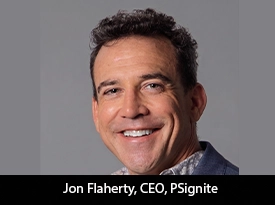
In an industry where more than $500 billion is spent annually on trade promotions, much of the process still relies on fragmented systems and outdated spreadsheets. That gap between investment and efficiency is exactly where PSignite has positioned itself as a transformative force. Founded by Adam Bartkowski and led by Chief Executive Officer Jon Flaherty, the company is redefining how consumer packaged goods brands manage trade promotion, revenue growth, deduction management and financial processes around trade, in an increasingly data-driven marketplace. At the center of PSignite’s innovation is CPGvision, the industry’s only AI-native platform built on Salesforce that unifies Trade Promotion Management, Trade Promotion Optimization, and Revenue Growth Management into a single ecosystem. Designed specifically for the needs of modern consumer goods companies, the platform helps organizations move beyond reactive decision-making and toward intelligent, real-time commercial execution. From emerging brands to global enterprises such as Abbott, The Hershey Company, and Fruit of the Loom, companies managing billions in trade spend rely on PSignite to drive greater visibility, profitability, and operational control.
What truly differentiates PSignite is its combination of technology and hands-on industry expertise. The company delivers not only software, but also blueprinting, implementation, data management, and change management services through a team with deep CPG trade experience. Further strengthening its market position is TPXperts, the industry’s first agentic AI suite purpose-built for trade management. By enabling systems that actively work alongside teams in real time rather than simply recording past activity, PSignite is helping reshape the future of trade promotion management for the global CPG industry.
In conversation with Jon Flaherty, CEO of PSignite
PSignite’s CPGvision platform integrates TPM, TPO, and RGM into a single solution. How does this unified approach help consumer goods companies build trust with their trading partners through more accurate planning and execution?
The platform’s defining advantage is that it eliminates the disjointed spreadsheets, siloed systems, and disparate emails that
plague most CPG trade and deductions teams. When sales is planning in one tool, finance is accruing in a second, and
RGM is modeling pricing in a third, the numbers don’t match — and everyone notices.
CPGvision eliminates the seams. Because TPM, TPO, and RGM all run on a single dataset, the volume forecast a sales lead commits to in a customer plan is the same number the CFO sees in the accrual, the same number RGM uses to optimize the next mechanic, and the same number that flows back to the retailer in joint business planning. We are not “modules” like some of our competitors, where data is sent back and forth, sometimes in disparate UIs. There’s no synchronization lag, no version-control debate, no “let me get back to you on that.” That consistency is what makes our users credible both internally and when they are at the buyer’s table — and it’s what allows our customers to commit to plans they can actually execute.
Your Agentic AI inside CPGvision acts as autonomous helpers that respect security and workflows. How does this technology reduce human error and build confidence in trade spend decisions?
There are three things that genuinely differentiate our TPXperts agents from what else is on the market. First, our agents are trained by trade experts who have actually done these jobs — people who built promotion plans for CPG companies, sat in deduction meetings, and defended forecasts to finance. The agents inherit that judgment. Second, they don’t just summarize or chat — they execute the manual, time-consuming work: building plans, reconciling deductions, generating account-level forecasts, surfacing variance before it becomes a problem.
Third, and increasingly important to our enterprise customers, CPGvision is built to be MCP-ready — designed to plug into the broader agentic ecosystem our customers are building. Most CPGs today aren’t choosing a single AI vendor; they’re assembling a network of agents across finance, supply, commercial, and customer service. Through the Model Context Protocol, our TPXperts can both expose trade context to a customer’s enterprise agents and consume context from theirs — so a CFO’s finance agent can query live trade accruals, or a demand planning agent can pull the latest committed promotion volumes, without brittle point-to-point integrations. We’re contributing to an open agentic fabric, not building another walled garden.
Crucially, every TPXpert — whether operating inside CPGvision or being called by an external orchestrator — operates inside the user’s existing security model and approval workflow. An agent can’t commit a plan a user couldn’t commit themselves, can’t see data a user couldn’t see, and can’t bypass an approval chain.
Outside of being CEO of PSignite, I’m an AI enthusiast with my own agentic solutions, model training and tech stack for personal use. So I know that when it comes to enterprise solutions, the benchmark for security needs to be higher. Agents that work within guardrails are what we call confident automation. Our TPXperts catch errors before they become deductions, make decisions on data that’s current, redirect human time from spreadsheet wrangling to strategic conversations — and their architecture fits into whatever AI models come next.
A client testimonial mentions reducing outstanding deductions from over 1.2 M to less than 200K. What does this tell you about the importance of transparency and accountability in building a reputable trade management process?
When trade spend is the second-largest line item on a CPG company’s P&L, every dollar needs to be traceable. Transparent processes ensure that budgets, accruals, and actual spend are visible and reconcilable. This reduces the risk of invalid deductions, financial surprises, audit failures, or misreported earnings.
An 80%-plus reduction in outstanding deductions comes from the organization being able to see what’s actually happening — every dollar promised, every dollar spent, every dollar disputed — and being able to assign accountability against it with full audit trails preserved to the right record. Many CPGs lose trade dollars because they can’t connect the deduction on the back end to the plan on the front end fast enough to dispute it before the window closes.
CPG companies also struggle with resources to comb through and validate all of the deductions. Our experience with customers has shown that there is a massive amount of money being left on the table because companies need to set thresholds for what to review based on resource availability. Our auto-deduction matching solution is designed to address that specific pain point and unlock significant savings in invalid deductions.
You offer blueprinting, implementation, data management, and change management services alongside your platform. How does this comprehensive approach reduce implementation risk and ensure clients achieve their promised ROI?
The single biggest reason TPM and RGM programs fail to deliver ROI isn’t the software — it’s the gap between go-live and adoption. A perfectly configured platform that the sales team won’t use is worth nothing. So we’ve built our services model around closing that gap.
Blueprinting forces alignment on what success looks like before a line of configuration is touched. Our implementation methodology is precise and transparent — customers see exactly where they are at every stage. Data management addresses the unglamorous reality that most CPGs are integrating ERP, syndicated data, retail POS, and finance systems with inconsistent hierarchies, and that has to be solved properly or every downstream insight is suspect. And change management gets the people ready: sales reps, key account managers, finance partners, and leadership all need to land in the new world together. A key component of our change management program is co-developed SOPs - the Standard Operating Procedures are unique to each organization, ensuring everyone knows exactly what to do, when to do it and how it should be done in CPGvision.
We do often work with client system integration partners, but we are one of the few suppliers out there who do implement their own product. That makes us accountable for the outcome.
What does the future hold for your company and its customers? Are exciting things on the way?
Yes — and the headline is agentic. Trade management is one of the highest-leverage applications of agentic AI in the entire CPG technology stack, because so much of the work is rules-based, data-intensive, and time-sensitive. We’re expanding our TPXperts suite well beyond the launch capabilities into agents that handle real-time promotion adjustments based on live sell-through, autonomous deduction resolution, scenario simulation against live market conditions, and predictive guidance for emerging categories and channels.
Underneath that, we’re continuing to invest in open, interoperable architecture — agents that can collaborate with the rest of a customer’s ecosystem rather than locking them into a closed model. Our customers don’t want a black box; they want a partner that fits into how they already work and makes them measurably faster. That’s the direction we’re building. The companies that get agentic AI right in the next eighteen months are going to set the pace for trade investment efficiency for the rest of the decade, and we intend our customers to be the ones setting it.
“We do often work with client system integration partners, but we are one of the few suppliers out there who do implement their own product. That makes us accountable for the outcome.”
Search Magazine
Latest Listings