>>
Industry>>
Compliance and governance>>
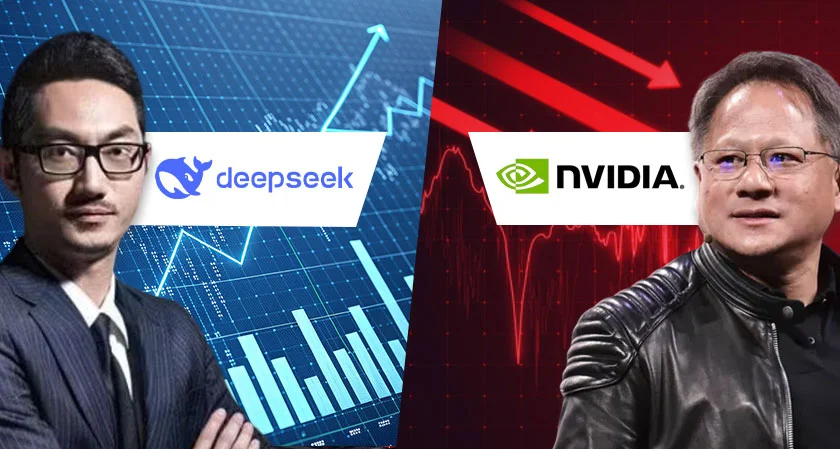
Strategic Disruption: How Deep...Strategic Disruption: How DeepSeek’s AI Breakthrough Toppled Nvidia’s $500B Market Dominance
The Silicon Review
29 January, 2025
Author:
The Silicon Review Team
Nvidia’s historic $500B market collapse, triggered by DeepSeek’s innovation, signals a power shift in tech—urging industries to rethink compliance, governance, and strategic alliances in the AI arms race.
In a stunning reversal of fortune, Nvidia’s stock plummeted by 26% over the past month, erasing nearly $500 billion in market value—the largest single-market loss in U.S. history—as Chinese AI firm DeepSeek unveiled a groundbreaking neural architecture that outperforms Nvidia’s flagship H100 GPUs in benchmark tests. The collapse, rooted in leaked internal reports confirming DeepSeek’s 40% efficiency edge in training large language models (LLMs), has sent shockwaves through global tech markets, forcing executives to confront existential questions about supply chain resilience and regulatory compliance in an increasingly fragmented AI ecosystem.
DeepSeek’s rise, fueled by China’s $50B state-backed semiconductor initiative, exposes vulnerabilities in U.S. export controls designed to limit China’s access to advanced chip making tools. Industry analysts note that DeepSeek’s hybrid quantum-classical computing framework—developed using domestically produced 5nm chips—sidesteps sanctions while achieving 2.1 petaflops per watt, a 22% improvement over Nvidia’s latest architecture. This technological leap has already prompted the U.S. Department of Commerce to fast-track revisions to the October 2023 semiconductor trade restrictions, with compliance experts warning of “unprecedented due diligence requirements” for firms relying on AI hardware.
The fallout extends beyond Wall Street: 43% of Fortune 500 companies with AI roadmaps tied to Nvidia’s ecosystem are now reevaluating vendor contracts, while defense contractors face mounting pressure to audit AI supply chains under new Pentagon procurement guidelines. For compliance officers, the crisis underscores the urgent need for dynamic risk-assessment frameworks—particularly as DeepSeek’s licensing model reportedly bypasses U.S. patent laws through decentralized IP ownership structures. Executives must prioritize third-party AI audits and diversify hardware partnerships to mitigate single-vendor dependency risks. Embedding real-time regulatory monitoring into governance strategies will be critical as global AI standards fracture.