>>
Technology>>
Artificial intelligence>>
Why a Decision Intelligence Pl...Why a Decision Intelligence Platform Is Essential for Autonomous Enterprises

The Silicon Review
22 December, 2025
Autonomous enterprises don’t appear overnight. They evolve. And that evolution usually starts when organizations realize that faster growth, more data, and global operations don’t automatically lead to better decisions.
In many large enterprises, decision-making is still slowed by fragmented systems, delayed insights, and manual handoffs. Teams work hard, but they’re often reacting instead of anticipating. This is where a Decision Intelligence Platform becomes essential not as another tool, but as a different way of connecting insight to action.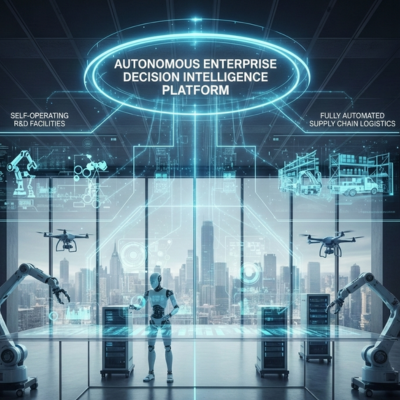
What a Decision Intelligence Platform really means
At a basic level, a Decision Intelligence Platform helps organizations make better decisions faster. But that description alone doesn’t capture why enterprises are adopting it.
In plain terms, it’s a platform that:
- Brings together enterprise data from multiple systems
- Applies analytics and AI to understand what’s happening and what might happen next
- Automates or guides actions based on those insights
Instead of stopping at dashboards or reports, decisions actually move forward. That difference matters more than most teams realize.
Why traditional decision-making struggles at enterprise scale
Most enterprises aren’t short on data. They’re short on time and alignment.
Common challenges show up quickly as organizations grow:
- Data lives across disconnected systems
- Insights arrive after decisions are already made
- Teams rely on manual analysis and spreadsheets
- Approvals take days or weeks instead of hours
Even with strong analytics teams, decision-making often depends on people stitching together information under pressure. That approach doesn’t scale well.
As complexity increases, so does the cost of delay. By the time a report is reviewed, the underlying conditions may have already changed.
Why dashboards and BI tools are no longer enough
Business intelligence tools play an important role, but they were designed for visibility, not action.
Dashboards typically:
- Show what already happened
- Require human interpretation
- Depend on manual follow-ups
- Stop short of execution
A Decision Intelligence Platform goes further. It doesn’t replace BI it builds on it by answering a different question: What should we do next?
That shift from insight to decision to action is what enables more autonomous operations.
How a Decision Intelligence Platform connects insight to action
What makes a Decision Intelligence Platform different is how it brings multiple capabilities together into a single workflow.
Instead of isolated steps, it creates a continuous loop:
- Data is unified across enterprise systems
- Analytics and AI interpret patterns and signals
- Decisions are recommended or triggered automatically
- Actions are executed or routed to the right teams
This approach reduces friction and removes delays that come from manual coordination.
Faster, more confident decisions in real scenarios
Consider a supply planning team facing sudden demand changes. In a traditional setup, analysts review reports, escalate concerns, and wait for approvals. By the time action is taken, conditions may have shifted again.
With a Decision Intelligence Platform:
- Signals are detected earlier
- Scenarios are evaluated in real time
- Decisions are aligned with predefined rules
- Actions move forward with less back-and-forth
The result isn’t just speed. It’s confidence because decisions are based on consistent logic, not last-minute judgment calls.
Supporting autonomous and intelligent operations
Autonomous enterprises don’t eliminate people from decision-making. They remove unnecessary manual steps.
A Decision Intelligence Platform supports autonomy by:
- Handling repeatable, operational decisions automatically
- Escalating exceptions instead of routine cases
- Applying consistent decision logic at scale
- Allowing teams to focus on strategy, not fire drills
Over time, this changes how organizations operate. Decisions happen closer to the moment they’re needed, without constant intervention.
Continuous adaptation, not static planning
One of the biggest limitations of traditional planning is rigidity. Assumptions are set, plans are approved, and teams hope conditions hold.
A Decision Intelligence Platform allows enterprises to adapt continuously:
- Decisions update as data changes
- Scenarios can be simulated before action
- Trade-offs are evaluated in real time
- Responses evolve without restarting the process
This flexibility is critical in environments where change is constant, not occasional.
Business impact beyond speed
While faster decisions get attention, the long-term benefits run deeper.
Enterprises using a Decision Intelligence Platform often see:
- Improved agility across functions
- More consistent decision-making at scale
- Better alignment between strategy and execution
- Reduced operational noise and rework
These improvements compound over time, creating an organization that doesn’t just react but learns and adapts.
Why autonomous enterprises depend on decision intelligence
Autonomy requires trust. Leaders need to trust that decisions are grounded in reliable data, consistent logic, and clear outcomes.
A Decision Intelligence Platform builds that trust by making decisions transparent, repeatable, and explainable. Teams understand why actions are taken, not just that they happened.
This foundation is what allows enterprises to move toward intelligent, autonomous operations without losing control.
Final thoughts
Autonomous enterprises aren’t defined by how much AI they use. They’re defined by how effectively they turn insight into action, at scale and under pressure.
Decision Intelligence Platform provides the structure needed to make that shift, helping organizations move faster, adapt continuously, and operate with greater confidence as complexity grows. For enterprises thinking seriously about the future of decision-making, this approach is becoming less optional and more foundational, a direction reflected in how platforms like aeratechnology position decision intelligence as a core capability for modern organizations.
MOST VIEWED ARTICLES
RECOMMENDED NEWS







TOP NEWS
YOU MAY ALSO LIKE




_2025-12-15_12-44-58.webp)


_2025-11-17_06-38-14.webp)

 (1)_2025-10-21_13-35-14.webp)