>>
Industry>>
Nanotechnology>>
Scientists Confirm 1D Electron...Scientists Confirm 1D Electron Behavior in Phosphorus Chains
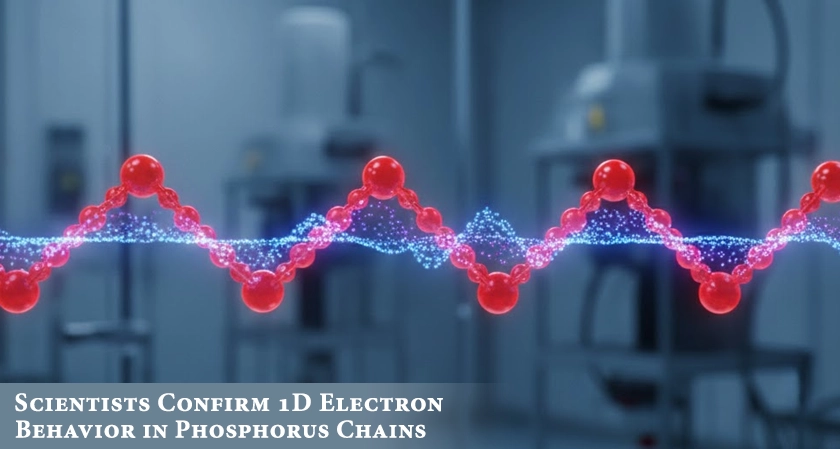
Researchers at BESSY II have experimentally confirmed that phosphorus chains exhibit true one-dimensional electronic behavior. Squeezing them tighter could trigger a transition to metallic state.
For the first time, scientists have experimentally demonstrated that atom-thin phosphorus chains can host truly one-dimensional electrons, a breakthrough that opens new frontiers in quantum materials research. A team at the BESSY II synchrotron in Berlin succeeded in proving that short chains of phosphorus atoms, which self-organize on a silver substrate, exhibit electronic properties confined to a single dimension.
The research team, led by Professor Oliver Rader and Dr. Andrei Varykhalov, used low-temperature scanning tunneling microscopy to create and examine the phosphorus chains. The images revealed short phosphorus chains forming in three distinct directions on the silver surface, each spaced at 120-degree angles. Using angle-resolved photoelectron spectroscopy (ARPES), the team mapped the electronic structure and successfully disentangled signals from differently aligned chains, proving that each individual chain possesses a genuinely one-dimensional electronic character.
The study also revealed a remarkable phase transition tied to chain spacing. When phosphorus chains are spaced farther apart, the material behaves as a semiconductor. However, density functional theory calculations predict that squeezing the chains into a denser, tightly packed array would trigger a transition to metallic behavior. "We are entering a new research field here, a terra incognita where many exciting discoveries may await," said Dr. Varykhalov.
This experimental confirmation moves beyond theoretical speculation, providing a solid foundation for exploring how true one-dimensional materials could revolutionize electronics, offering unprecedented control over electron flow at the atomic scale. The findings were published in the journal Small Structures.