>>
Industry>>
Space>>
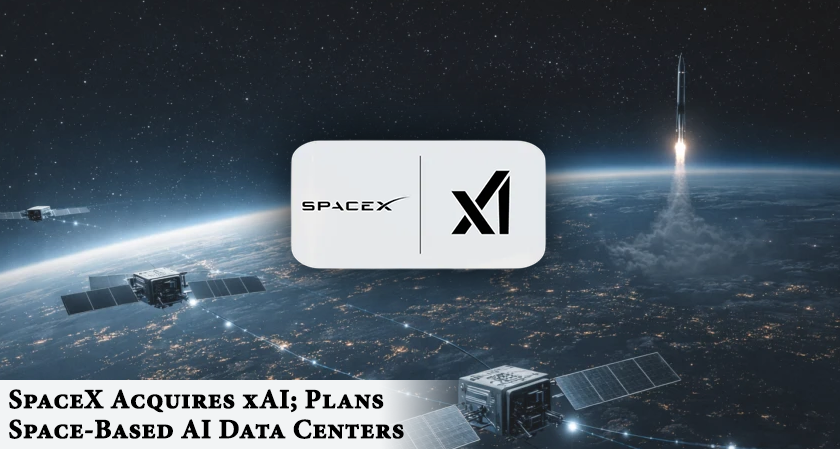
SpaceX Acquires xAI; Plans Spa...SpaceX Acquires xAI; Plans Space-Based AI Data Centers
The Silicon Review
03 February, 2026
Author:
The Silicon Review Team
In a landmark deal, SpaceX acquires Elon Musk's xAI. The goal: leverage Starlink and Starship to build space-based data centers for next-gen AI compute.
In a move consolidating his technology empire, Elon Musk's SpaceX has officially acquired the artificial intelligence company xAI, also founded and owned by Musk. The financial terms of the transaction, structured as an inter-company asset transfer, were not disclosed. The primary stated objective of the acquisition is to pioneer the development of AI data centers in space, leveraging SpaceX's launch infrastructure and satellite network.
The strategic plan, as outlined by Musk, involves using SpaceX's Starship heavy-lift platform to deploy modular computing payloads into low Earth orbit. These space-based data centers would be powered by large-scale solar arrays and linked together via the Starlink satellite constellation, creating an orbital supercomputing network. Musk posited that this could address two critical Earth-bound constraints: the enormous energy consumption of AI clusters and the latency limitations for global data distribution.
"Placing advanced AI compute in space, where solar power is continuous and the thermal environment can be used for cooling, is a logical step for a post-scarcity compute future," Musk stated in a joint announcement. "xAI's Grok and our future models will be trained and served from a constellation beyond Earth."
Industry and space law experts immediately raised profound questions about jurisdiction, data sovereignty, and security. A senior fellow at the Secure World Foundation noted, "This creates an entirely new domain for cybersecurity and regulatory oversight. Whose laws govern an AI model running on a data center in orbit?"
The plan is expected to face significant technical hurdles, including the hardening of computing hardware for radiation, the development of in-orbit maintenance architectures, and the creation of ultra-secure, high-bandwidth data links. However, analysts suggest the synergy is not merely technical. "This vertically integrates Musk's core assets: SpaceX provides the 'space trucking' and comms, xAI provides the computational demand and product, turning Starlink into more than just an internet service," said a leading tech industry analyst.
The announcement has sparked a debate about the commercialization of space and the concentration of advanced technological capability. While proponents hail it as a visionary leap to overcome planetary limits, critics warn of an unchecked acceleration in the private control of critical space-based infrastructure.
SpaceX and xAI have established a new joint task force, "Project Forge," to begin initial architecture studies. The first prototype hardware launches are tentatively slated for no earlier than 2028, pending Starship's operational certification and regulatory approvals.









-Recovered-Recovered-Recovered_2026-07-25_10-24-34.webp")

-Recovered-Recovered-Recovered_2026-07-25_10-03-12.webp")