>>
Industry>>
Environmental sustainability>>
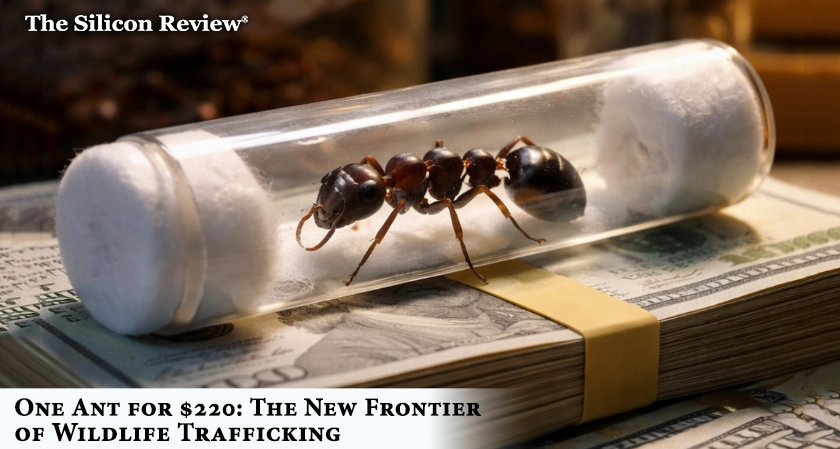
One Ant for $220: The New Fron...One Ant for $220: The New Frontier of Wildlife Trafficking
The Silicon Review
31 March, 2026
Wildlife traffickers are now targeting ants, with rare species selling for up to $220 each. Conservationists warn that the booming online trade is driving some species to the brink of extinction as demand grows among exotic pet collectors in Europe, Asia and North America.
Wildlife traffickers have found a new and unlikely commodity: ants. Rare species are now selling for as much as $220 each on online marketplaces, fueling a booming illicit trade that conservationists warn is pushing some ant species to the brink of extinction.
The trade, centered in Southeast Asia and sub-Saharan Africa, has exploded in recent years as exotic pet collectors in Europe, North America and Japan develop a taste for rare and unusual ant colonies. Some species, prized for their size, color or aggressive behavior, command prices that rival those of more traditional trafficked animals like parrots and reptiles.
"It's completely unregulated, and it's happening right under our noses," said Dr. Eunice Ng, a conservation biologist who has tracked the trade for years. "People don't think of ants as wildlife. They think of them as pests. That perception has allowed this trade to grow unchecked."
The most sought-after species include the African driver ant, known for its aggressive swarming behavior; the bullet ant from Central and South America, whose sting is said to feel like a gunshot; and the Australian bulldog ant, prized for its large size and powerful jaws. A single queen from a rare species can fetch upwards of $200.
Traffickers ship the ants in small plastic containers hidden in packages labeled as toys, electronics or household goods. The small size of the ants makes them difficult to detect at borders, and many shipments pass through customs unnoticed.
The trade has drawn increasing scrutiny from conservation groups and law enforcement. The Convention on International Trade in Endangered Species, known as CITES, does not currently regulate ants, leaving a legal vacuum that traffickers exploit.
"I can buy a live queen of a rare ant species online right now, have it shipped to my door, and no one will stop it," said Tom Banda, a wildlife crime investigator based in Nairobi. "That's a problem."
In response, several countries have begun strengthening their own wildlife laws. Australia, home too many prized ant species, recently banned the export of native ants except for scientific research. Kenya and South Africa are considering similar measures.
But enforcement remains a challenge. Traffickers use encrypted messaging apps and private social media groups to connect with buyers, making it difficult for authorities to track transactions.
As traffickers pivot to ants selling rare species for hundreds of dollars each The Silicon Review examines the new frontier of wildlife crime, where the smallest creatures command the highest prices and a regulatory gap threatens to drive species to extinction before anyone even notices.
MOST VIEWED ARTICLES
RECOMMENDED NEWS








LATEST NEWS


TOP NEWS
YOU MAY ALSO LIKE


_2025-11-17_06-38-14.webp)