>>
Other>>
Blogs>>
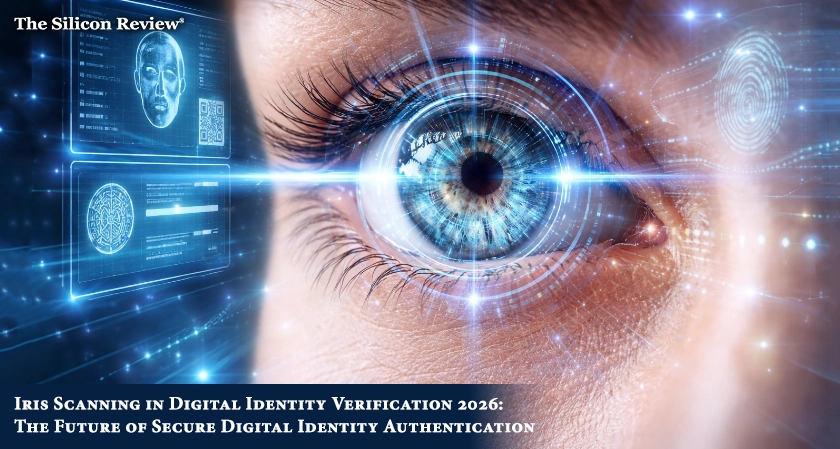
Iris Scanning in Digital Ident...Iris Scanning in Digital Identity Verification 2026: The Future of Secure Digital Identity Authentication
-Sashindra Suresh
Passwords are a joke. You know it. I know it. Hackers definitely know it.
Every few weeks, another company gets breached. Millions of usernames and passwords spill onto the dark web. And what do we do? Reset our passwords. Add another number at the end. Maybe a special character if we are feeling ambitious. Then it happens again.
The truth is simple: passwords were never designed for a world where every person has dozens of online accounts and cybercriminals run automated guessing tools. That world is here. And passwords are losing.
That is why in 2026 digital identity verification is shifting toward something far more secure: the human iris scanning.
What Is Iris Scanning & Why Does It Matter?
Iris scanning is exactly what it sounds like. A camera captures the unique pattern of your iris the colored ring around your pupil. That pattern is then converted into a mathematical template and stored for future authentication.
Here is what makes iris scanning different from fingerprints or facial recognition.
Your iris has over 200 to 256 unique identifying features. Fingerprints have about 40. And unlike your face, which changes with age, makeup, lighting, or expression, your iris remains stable for decades.
Banks are testing iris scanning for high-value transactions. Axis Bank in India is the first to explore iris scanning; Airports are using it for expedited security lanes. Major hubs, including Singapore Changi Airport & airports in the UAE, use biometric identification smart gates for security, immigration, & boarding, a growing number of online identity verification service providers are integrating iris recognition into their platforms.
How Iris Scanning Fits into Digital Identity Verification
The broader category of digital identity verification includes everything from document scans to knowledge-based authentication. But most of these methods share a common weakness: they can be faked, stolen, or forgotten.
Iris scanning solves all three problems.
- Cannot be faked:Modern iris scanners detect pupil dilation, blink patterns, and even the natural oscillation of the eye. A photograph or video replay will not work.
- Cannot be stolen easily:Unlike a password stored in a database, your iris template is encrypted and stored locally on your device in most implementations. Even if a hacker intercepts the data, they cannot reverse-engineer your actual iris from the template.
- Cannot be forgotten:You never lose your eyes. You never need to reset them.
This is why biometric identification is rapidly becoming the standard for high-assurance authentication. And among all biometrics fingerprints, voice, face, gait iris scanning offers the highest accuracy.
How Iris Data Is Stored and Who Can Actually Access It
Iris scanning sounds simple. A camera captures your iris pattern. A mathematical template gets created. That template is used later to verify you. But here is where most details on the internet get vague & where people get worried. Let’s explore that in detail.
Where is the Mathematical template "IrisCode” stored?
There are three models. Each has different privacy implications.
Model 1: Local storage (your device only).
Your iris template never leaves your phone or laptop. When you authenticate, the scan happens locally. The template stays on your device. Apple's Face ID works this way the mathematical representation of your face never goes to Apple's servers. Some iris scanners offer the same. This is the most private option.
Model 2: Enterprise storage (encrypted servers).
Your employer or your bank stores your iris template on their own encrypted servers. In theory, only authorized systems can access it. In practice, anyone with database admin rights or a court order could potentially retrieve it. Most enterprise iris deployments use this model. It is secure, but not zero-trust.
Model 3: Centralized global database (Sam Altman’s World model).
This is where things get controversial.
World (formerly Worldcoin) is the most famous example. They scan your iris using a device called the Orb. They create a unique identifier called a "World ID." That identifier is stored on a blockchain which is public by design, which means No single company controls the database. No one can alter or delete the records arbitrarily. Anyone can verify. Any third-party app can check if a World ID is valid without asking World for permission. No double-registration. Because the hash is public, the system can instantly detect if the same iris tries to register twice.
Here is what World actually stores: a hash of your iris code, not the iris image itself. A hash is a one-way mathematical function. You cannot reverse it to recreate your iris. But the hash still acts as a unique identifier.
Can anyone access it?
For World: yes and no. The hash is on a public blockchain. Anyone can see that some hash exists. But they cannot connect that hash to your real-world identity unless World or another party collects additional data that links your wallet to your name.
For enterprise systems: only the organization and its authorized vendors can access the templates. But governments with subpoenas can demand access. Hackers can target the database.
For local storage: no one can access it except you & the local app you authorized.
The Altman connection.
Sam Altman, CEO of OpenAI, co-founded World. The project's stated goal is to create a global proof-of-personhood a way to distinguish humans from AI bots online. The criticism is that World is creating a global biometric database that could be exploited by future governments or bad actors.
World's response: the hashed iris code cannot be reversed. And users control their own data through self-custodial wallets.
The skeptic's response: if the hash is on a public blockchain, it exists forever. Even if it cannot be reversed today, quantum computing might change that tomorrow.
What this means for you.
Before you enroll in any iris scanning system whether for banking, border control, or a World Orb ask three questions:
- Where is my template stored?Local, enterprise, or public blockchain?
- Can I delete it?Some systems allow deletion. World does not the hash is permanent on the blockchain.
- Who else can access it?Your bank? Your employer? The government? A future hacker?
Iris scanning is powerful. But power without transparency is dangerous. The technology is not the problem. The storage model is.
Real-World Applications Already in Motion
You might think iris scanning is still years away. It is not.
- Financial services:Several major banks in the Middle East and Asia banks like Qatar National Bank (QNB), Doha Bank, UAE central Bank, Axis Bank & many more have already deployed iris scanning for ATM access and mobile banking. Customers look into a camera. The system authenticates them. No card. No PIN. No phone.
- Border control:Airports in the UAE, UK, and Netherlands (Amsterdam Airport Schiphol) use iris scanning for automated passport control. Frequent travelers register their irises once. Then they walk through a gate that opens in seconds.
- Healthcare:Hospitals like Novant Health & Martin Health have implemented systems like RightPatient®, which uses iris and facial recognition to immediately link patients to their electronic health records (EHR) upon arrival. This reduces errors caused by mismatched names or lost ID cards.
- Enterprise security:Companies handling sensitive data are rolling out iris scanning for workstation login and data center access. Employees no longer need to remember complex passwords that change every 90 days. Key players in this space include Thales (France), IDEMIA (France), Iris ID (US), and others that provide technology aimed at replacing traditional access methods
For any online identity verification service that needs to prevent fraud while minimizing friction for legitimate users, iris scanning is the logical next step.
The Technology behind the Scan
Let us get technical for a moment but not too technical.
Modern iris scanners utilize near-infrared (NIR) light, typically in the 700-900 nm range to illuminate the eye, which is invisible to humans & does not cause pupil constriction, allowing for a fully dilated & detailed image. The camera captures multiple images in less than a second. Then algorithms map the unique patterns crypts, furrows, rings, and freckles into a digital template.
That template is typically between 512 bytes & 10 kilobytes. Tiny. Which means it can be stored on a smartphone, a smart card, or a local server without the need of much storage.
When you authenticate, the system captures a fresh image, generates a new template, and compares it to the stored one. If they match within a defined threshold, you are in.
The interesting fact is that this entire process happens in milliseconds (one-thousandth of a second), where Image Capture (15–200 Milliseconds), Template Creation (200–500 Milliseconds), Database Matching (Millisecond Range) totally a human experience around the iris scanner would be around 2 seconds per individual.
Why This Matters for Businesses
If you run a business that handles sensitive customer data, you have a problem. Passwords are leaking. Two-factor authentication helps but adds friction. And fraudsters are getting smarter.
Iris scanning offers a way out.
- Lower fraud rates:A stolen password works anywhere. A stolen iris template is useless without the live eye attached to it.
- Better user experience:Customers do not want to remember another password. They do not want to wait for an SMS code. They want to look at their phone and be done.
- Regulatory alignment:Regulations like PSD2 and GDPR are pushing toward stronger authentication. Iris scanning meets the bar for "strong customer authentication" in most jurisdictions.
Integrating iris scanning into your online identity verification service is not just about security. It is about staying ahead of both criminals & competitors.
Frequently Asked Questions (FAQs)
What is digital identity verification?
Digital identity verification is the process of confirming that someone is who they claim to be online. It includes methods like passwords, two-factor authentication, document scans, and biometrics like iris scanning.
How accurate is iris scanning compared to fingerprints?
Iris scanning is significantly more accurate. Fingerprints have about 40 unique features. Irises have over 200. False acceptance rates for iris scanning can be as low as 1 in 1.2 million.
Is iris scanning safe for my eyes?
Yes. Iris scanners use near-infrared light, which is harmless and invisible. The light level is far lower than sunlight or even standard indoor lighting.
Can twins fool an iris scanner?
No. Even identical twins have different iris patterns. The iris forms randomly in the womb and is unique to each individual.
What is an online identity verification service?
An online identity verification service is a platform that helps businesses confirms user identities remotely. These services often combine document verification, facial recognition, and increasingly, iris scanning.
How much does iris scanning technology cost?
Costs have dropped significantly. Consumer-grade iris scanners now cost under $100. Enterprise-grade devices range from $500 to $2,000. Cloud-based verification services charge per transaction.
What happens if I get eye surgery?
Most eye surgeries, including LASIK and cataract removal, do not change your iris pattern. The iris is behind the cornea, so surface-level procedures leave it unaffected.
Can I use iris scanning on my smartphone?
Some smartphones already include iris scanners. Several Android models launched the feature years ago. Adoption slowed due to COVID and mask wearing, but interest is returning.
About the Author
Sashindra Suresh is an experienced writer specializing in artificial intelligence, software development, and emerging technologies. With a strong ability to translate complex technical concepts into clear, engaging insights, she has contributed to a wide range of publications and platforms. Her work focuses on making cutting-edge innovations accessible to both industry professionals and curious readers alike.