>>
Technology>>
Artificial intelligence>>
From Vibe Coding to Vibe Resea...From Vibe Coding to Vibe Research: Crossing the "Carbon Wall" in AI for Science
The Silicon Review
31 March, 2026
Since Andrej Karpathy, a founding member of OpenAI, catalyzed the "Vibe Coding" movement, the paradigm has rapidly transcended the boundaries of software engineering. What began as a shift in how we write code has triggered a universal "Karpathy Moment" across the natural sciences, solidifying a formidable new category in the AI for Science (AI4S) sector: "Vibe Research."
This new paradigm is defined by a constellation of pioneering platforms that bridge the gap between human intent and the physical reality of atoms and cells, turning abstract hypotheses into tangible breakthroughs.
Mapping the Brains and Bodies of AI4S
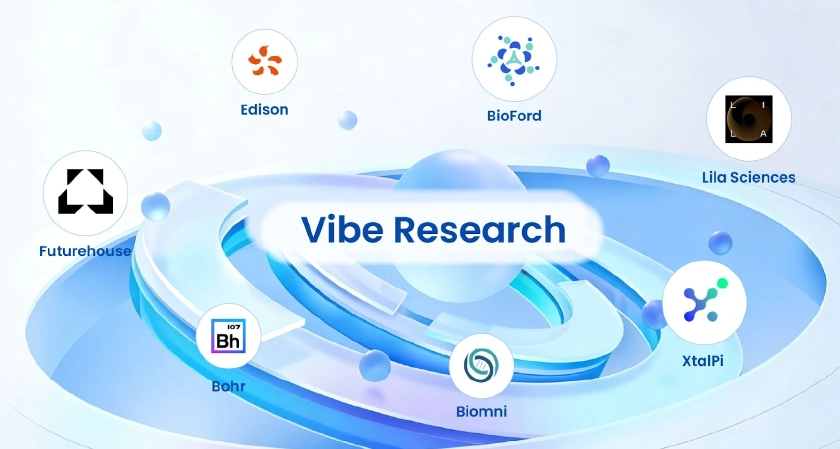
The current market is no longer a collection of isolated tools, but a sophisticated, interlinked hierarchy of autonomous agents. At the cognitive apex sits Futurehouse, the "Scientific OpenAI." This non-profit powerhouse has a breathtaking mission: to compress a century of scientific progress into a single decade.
Futurehouse achieves this through its signature "animal-named" agents: Crow acts as the generalist brain, Falcon synthesizes existing knowledge, Owl conducts exhaustive research, and Phoenix autonomously designs the next experiment. Its commercial arm, Edison, now delivers this "Edison-moment" of discovery to the enterprise via the Kosmos platform.
This cognitive layer is further bolstered by Elicit, which has turned agonizing months of literature review into minutes of structured data extraction, and Stanford’s Biomni, a multi-modal "all-in-one" partner that interprets complex scientific data with human-like fluidity. Even the friction of paper preparation is being smoothed away. OpenAI’s Prism has created a LaTeX-native cloud workspace to unify collaboration, while FigureLabs uses AI to eliminate the aesthetic hurdle of creating professional scientific illustrations.
However, "Vibe Research" demands action as much as thought. The revolution is moving from the cloud to the concrete. Giants like Lila Sciences, backed by Flagship Pioneering, are building AI Science Factories™ to achieve "Scientific Superintelligence." Simultaneously, XtalPi utilizes massive robotic clusters and quantum physics to run thousands of parallel trials. Where physical tests are cost-prohibitive, Bohr Space Station accelerates discovery within the digital twin of a molecule or alloy. Another standout from the Vibe Research stable is BioFord, a 'Full-Stack Scientific OS' that deploys a quartet of AI agents—BioScholar, BioDesigner, BioModeler, and BioAnalyst—to automate the end-to-end research lifecycle.
When the Silicon Brain Hits the Carbon Wall
Despite the soaring intelligence of these "Cloud Brains," a silicon mind eventually hits the "Carbon Wall" of the physical world. The transition from a digital hypothesis to a physical result is not a simple click of a button; it is an engineering abyss fraught with the inherent tensions of "Vibe Research."
The most haunting specter in AI4S is Hallucination. In a domain where precision is non-negotiable, the tendency of large models to "confidently invent" chemical properties creates a fundamental friction with scientific rigor. For a researcher, a 95% accuracy rate is a failure if the remaining 5% leads to a laboratory explosion or a decade of wasted R&D.
The true measure of Vibe Research lies not in its capacity for inspiration, but in its rigor of elimination. Its success hinges on leveraging physical laws as non-negotiable constraint functions, filtering out hallucinations that—while theoretically elegant—remain physically impossible.
Furthermore, even if the "Vibe" is logically sound, reliable automation requires harmonizing robotic arms, reactors, and sensors from a dozen different vendors—most of which lack unified standards. The "Vibe" is often lost in the friction of incompatible hardware or the drift of physical sensors. This is the new frontier of Embodied Intelligence: the ability of an agent to command physical instruments without human intervention.
Pioneers like Lila Sciences and XtalPi have opted for the "Heavy Asset" route, building self-contained automated labs. While XtalPi focuses on massive parallel screening, Lila emphasizes "proactive learning" to fill its own knowledge gaps.
The Rise of the Scientific Architect
This era demands "Scientific Architects"—hybrids who possess the biological intuition of a Darwin and the algorithmic precision of a von Neumann. Yet, traditional academia remains trapped in rigid disciplinary silos. We are starving for talent capable of bridging Python scripts and pipettes. Until we produce experts who can debug a neural network while simultaneously understanding a metabolic pathway, the true potential of "Vibe Research" will remain locked behind the gates of human fragmentation.
The ultimate form of "Vibe Research" will not be a single tool, but Ecological Integration. The goal is a comprehensive AI upgrade spanning from the microscopic discovery of a new molecule to its macroscopic industrial production. As these disparate technologies converge, the scientist of the future will evolve from a lab technician into a conductor, guiding a grand scientific symphony driven by the power of "Vibe."
MOST VIEWED ARTICLES
RECOMMENDED NEWS








LATEST NEWS


TOP NEWS
YOU MAY ALSO LIKE


_2025-11-17_06-38-14.webp)