>>
Industry>>
Lifestyle and fashion>>
Why Dressing Like You Hunt Dem...Why Dressing Like You Hunt Demons by Night and Headline Stages by Day Is a Perfectly Valid Life Choice
The Silicon Review
25 March, 2026
Author:
The Silicon Review Team
There is a particular kind of person who looks at a high-production K-Pop stage outfit and thinks: this is extraordinary, but what if it also suggested the wearer could survive an encounter with something genuinely supernatural? This person is not confused. They are not making a category error. They are identifying something real about the relationship between performance aesthetics and fantasy aesthetics that has been quietly building into one of the more interesting and distinct costume design traditions of the current era.
The choice to inhabit both worlds simultaneously, to dress as someone who is equally at home on a brilliantly lit concert stage and in the middle of a serious demon-hunting operation, is not just a valid aesthetic decision. It is a genuinely interesting and revealing one that says something meaningful about how contemporary creative culture actually works and where its most vital and generative energy is currently flowing.
Performance and Fantasy Have Always Been Closer Than They Appear
The separation between performance aesthetics and fantasy aesthetics is largely a matter of context rather than fundamental content. Both traditions are theatrical at their core. Both use clothing to communicate identity, status, and narrative to an audience. Both are designed to create emotional impact and a sense of powerful presence in whoever is watching. The costumes worn by K-Pop performers on stage are, in a very real sense, fantasy costumes already. They present an idealized, heightened version of the performer and the world they inhabit, filtered through a production sensibility that is itself a form of world-building.
Dark fantasy aesthetics, including the visual language of demon hunters, do the same thing from a different direction and with different tools. They communicate a story about the wearer: that they are powerful, that they have faced difficult things, that they carry both beauty and danger within the same frame. When these two traditions meet, they are not combining opposites. They are recognizing a shared purpose and amplifying what each already does.
Why the Demon Hunter Aesthetic Works So Well With K-Pop
The demon hunter visual vocabulary, with its dark materials, protective armor elements, and weaponry that doubles as ornamentation, provides something that K-Pop performance aesthetics can genuinely use: narrative gravity. K-Pop styling is extraordinarily accomplished at creating visual impact in the present moment, but the stories it tells tend to exist in a kind of eternal present. The demon hunter aesthetic introduces history, consequence, and a suggestion that the person wearing the costume has been tested in ways that leave a visible mark.
This combination produces a very specific and compelling visual effect. The person wearing it does not simply look spectacular. They look like someone who has earned the right to look spectacular through things they have survived and overcome. That distinction is subtle but it changes everything about how the costume reads and how the person wearing it carries themselves within it, which in turn changes how the audience receives and responds to them.
The Craft Behind the Best Versions
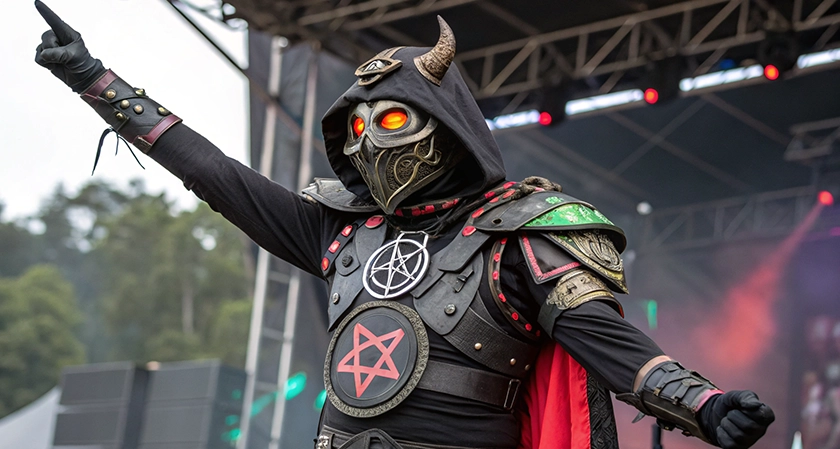
The best K-Pop Demon Hunters Costumes are not simple exercises in combining two reference libraries of visual elements. They require genuine design intelligence and considerable technical skill to work at the level the best examples consistently achieve. The challenge is to integrate the precision and visual coherence that K-Pop aesthetics demand with the textural richness and narrative weight of dark fantasy without losing what makes either tradition effective on its own terms or reducing either to a superficial gesture.
The designers and cosplayers who have mastered this balance tend to approach it through the specific details that define each tradition. They use dark, high-quality fabrics that have the movement and drape of performance wear but the weight and texture of fantasy costuming. They incorporate armor and structural elements that read as genuinely protective rather than merely decorative, but that are shaped and proportioned in ways that follow K-Pop visual logic. They use color palettes that sit thoughtfully at the intersection of both traditions: deep jewel tones, dark metallics, and the occasional burst of brightness that serves as dramatic contrast rather than baseline register.
The Community That Has Built Around This Aesthetic
One of the most remarkable things about the K-Pop demon hunter costume tradition is the extraordinary community that has formed around it over time. It draws from K-Pop fandom, from dark fantasy cosplay, from fashion design communities, and from gaming and visual arts aesthetics, and the creative overlap between these groups has produced a conversation that none of them could have generated alone from within their own existing boundaries.
People are sharing construction techniques, sourcing premium materials together, developing methods specifically suited to this hybrid aesthetic, and producing work that is genuinely advancing the craft of costume design more broadly. The community aspect is not incidental to the aesthetic. It is part of what makes this particular tradition interesting, and it is one of the reasons the work continues to evolve rather than settling into a fixed formula.
What This Choice Says About Creative Culture Now
The willingness to occupy two aesthetic worlds simultaneously without feeling any need to choose between them is characteristic of how contemporary creative culture approaches identity and self-expression at its most vital. The old categorical imperatives, the idea that certain aesthetics belong together and others are fundamentally incompatible, have lost most of their authority in communities where creative intelligence and enthusiasm matter more than adherence to established boundaries.
What matters now is whether the combination is genuinely interesting, whether it is executed with real skill and care, and whether it says something worth saying. Dressing like you hunt demons by night and headline stages by day says something worth saying. It says that the things you love do not have to be kept in separate containers, that creative ambition is fully allowed to move across traditional borders, and that the most interesting aesthetic territory is usually found in places where different traditions have not yet learned to expect each other.